
Keel

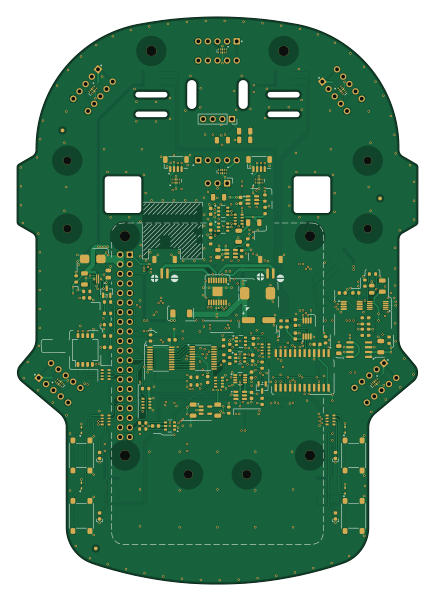
About the Keel PCB
Keel is an open source STM32 PCB design by BisocMOrg, published on GitHub under the MIT license. It is a 6-layer board measuring 106 × 150 mm, with 147 components from 65 distinct parts.
Its main chip is the STM32C011F4P6, from the STM32 family. Other key parts include the DRV8411PWPR, TPS259474LRPWR, IS31FL3218-GRLS2, LT1763IS8-3.3#PBF and TCA9517ADGKR. By type, the board carries 48 resistors, 33 capacitors, 29 ICs, 12 diodes, 6 LEDs and 5 connectors.
It belongs with the robotics & motion designs in this gallery.
From the project
Keel: Raspberry Pi 4 robot baseboard with a hardware safety controller - KiCad hardware, safety-MCU firmware, a C library with Python and Java bindings, and a 3D-printable chassis
Keel is a robot baseboard for a Raspberry Pi 4. The Pi plugs in upside down on top of it. Keel drives two DC motors and powers an ultrasonic sensor. It has six RGB underlights, four buttons with LEDs, I2C expansion and a servo header (J5, not fitted).
A small safety microcontroller and hardware logic gates decide when the motors and the servo get power. The Pi asks for power; it cannot force it on. A fault, a missed heartbeat or a stuck safety MCU removes it.
Main components on the Keel
Keel bill of materials (BOM)
147 components, 65 distinct parts — part numbers from the project's BOM.
| Qty | Part | Footprint | Refs |
|---|---|---|---|
| 1 | DRV8411PWPR Texas Instruments | DRV8411A_PWP0016_C01_ExternalVias | U1 |
| 1 | TPS259474LRPWR Texas Instruments | TPS25947_RPW0010A | U2 |
| 1 | IS31FL3218-GRLS2 Lumissil | IS31FL3218_SOP24 | U3 |
| 1 | LT1763IS8-3.3#PBF LT1763IS8-3.3 Analog Devices | SOIC-8_3.9x4.9mm_P1.27mm | U4 |
| 2 | TCA9517ADGKR Texas Instruments | VSSOP-8_3x3mm_P0.65mm | U6, U7 |
| 1 | 74LVC2G07GV,125 74LVC2G07GV Nexperia | Nexperia_SOT457_SC74_1.5x2.9mm_P0.95mm | U8 |
| 2 | 74LVC2G17GV,125 74LVC2G17GV Nexperia | Nexperia_SOT457_SC74_1.5x2.9mm_P0.95mm | U9, U28 |
| 1 | TPD2S703QDGSRQ1 Texas Instruments | MSOP-10_3x3mm_P0.5mm | U10 |
| 1 | TPS3808G50DBVT Texas Instruments | SOT-23-6 | U11 |
| 1 | STM32C011F4P6 STMicroelectronics | TSSOP-20_4.4x6.5mm_P0.65mm | U12 |
| 1 | TPS3436CABFDDDFRQ1 Texas Instruments | TI_DDF0008A_1.6x2.9mm_P0.65mm_CommonMask | U13 |
| 2 | 74LVC1G11GV,125 74LVC1G11GV Nexperia | Nexperia_SOT457_SC74_1.5x2.9mm_P0.95mm | U14, U27 |
| 2 | TPS2553DBVR-1 Texas Instruments | SOT-23-6 | U15, U30 |
| 1 | TPS70933DBVT Texas Instruments | SOT-23-5 | U16 |
| 10 | TPD4E05U06DQAR Texas Instruments | TI_DQA0010A_TPD4E05U06_AB_Compatible_CommonMask | U17, U18, U19, U20, U21, U22, U23, U24 +2 |
| 1 | SN74LVC541APWR Texas Instruments | TSSOP-20_4.4x6.5mm_P0.65mm | U29 |
| 1 | BSS84AK,215 BSS84AK Nexperia | SOT-23 | Q1 |
| 2 | BM04B-SRSS-TB I2C 1x04 JST | JST_SH_BM04B-SRSS-TB_1x04-1MP_P1.00mm_Vertical | X1, X3 |
| 1 | SSW-104-01-G-S Ultrasonic 1x04 Samtec | PinSocket_1x04_P2.54mm_Vertical | J1 |
| 1 | S2B-ZR-SM4A-TF Left motor 1x02 JST | JST_ZH_S2B-ZR-SM4A-TF_1x02-1MP_P1.50mm_Horizontal | J2 |
Show 45 more
| Qty | Part | Footprint | Refs |
|---|---|---|---|
| 1 | S2B-ZR-SM4A-TF Right motor 1x02 JST | JST_ZH_S2B-ZR-SM4A-TF_1x02-1MP_P1.50mm_Horizontal | J3 |
| 1 | I2C 1x05 | PinHeader_1x05_P2.54mm_Vertical | J4 |
| 1 | Servo 1x03 | PinHeader_1x03_P2.54mm_Vertical | J5 |
| 5 | I2C 2x05 | PinHeader_2x05_Row5.08_DNP | JP1, JP2, JP3, JP4, JP5 |
| 1 | SSW-120-01-G-D Raspberry Pi 2x20 Samtec | PinSocket_2x20_P2.54mm_Vertical | PI1 |
| 4 | PTS645SM43SMTR92 Push switch C&K | SW_SPST_PTS645Sx43SMTR92 | SW1, SW2, SW3, SW4 |
| 1 | TDA04H0SB1R DIP switch 4-pos C&K | SW_DIP_SPSTx04_Slide_KingTek_DSHP04TS_W7.62mm_P1.27mm | SW5 |
| 6 | IN-P55TATRGB Inolux | LED_Inolux_IN-P55TATRGB_PLCC6_5.0x5.5mm_P1.8mm | RGB1, RGB2, RGB3, RGB4, RGB5, RGB6 |
| 4 | 150060WS75000 Wurth Elektronik | LED_0603_1608Metric | D1, D2, D3, D4 |
| 1 | PMEG6030ELP,115 PMEG6030ELP Nexperia | D_SOD-128 | D5 |
| 1 | SM15T6V8A-TR SM15T6V8A STMicroelectronics | D_SMC | D6 |
| 1 | SMBJ6.0CA Littelfuse | D_SMB | D7 |
| 4 | TPD1E05U06DYAR Texas Instruments | TI_DYA0002A_TPD1E05U06_SOD523 | D8, D9, D10, D11 |
| 1 | BAT54C,215 BAT54C Nexperia | SOT-23 | D12 |
| 16 | GRM188R72A104KA35D 100n 100V X7R Murata | C_0603_1608Metric | C1, C12, C13, C14, C15, C16, C17, C21 +8 |
| 1 | EEE-FP1C470AP 47u 16V Panasonic | CP_Elec_6.3x5.8 | C4 |
| 1 | GRM033R61E104KE14D 100n 25V X5R Murata | C_0201_0603Metric | C5 |
| 1 | GRM1885C1H472JA01D 4.7n 50V C0G Murata | C_0603_1608Metric | C6 |
| 4 | GRM219R71E105KA88D 1u 25V X7R Murata | C_0805_2012Metric | C7, C9, C19, C34 |
| 3 | GRM31CR71E106KA12L 10u 25V X7R Murata | C_1206_3216Metric | C8, C10, C32 |
| 5 | GRM31CR71H475KA12L 4.7u 50V X7R Murata | C_1206_3216Metric | C18, C30, C31, C35, C37 |
| 1 | GRM1885C1H102JA01D 1n 50V C0G Murata | C_0603_1608Metric | C29 |
| 1 | GRM1885C1H103JA01D 10n 50V C0G Murata | C_0603_1608Metric | C36 |
| 2 | RC1206FR-07330RL 330R 1% 0.25W YAGEO | R_1206_3216Metric | R5, R6 |
| 1 | RC0603FR-0712KL 12k 1% 0.1W YAGEO | R_0603_1608Metric | R7 |
| 1 | RC0603FR-072K21L 2.21k 1% 0.1W YAGEO | R_0603_1608Metric | R8 |
| 1 | ERA-3ARB3162V 31.6k 0.1% 0.1W Panasonic | R_0603_1608Metric | R9 |
| 1 | ERA-3ARB3091V 3.09k 0.1% 0.1W Panasonic | R_0603_1608Metric | R10 |
| 1 | RT0603BRB0710KL 10k 0.1% 0.1W YAGEO | R_0603_1608Metric | R11 |
| 7 | RC0603FR-071KL 1k 1% 0.1W YAGEO | R_0603_1608Metric | R12, R20, R23, R26, R28, R29, R31 |
| 5 | RC0603FR-0710KL 10k 1% 0.1W YAGEO | R_0603_1608Metric | R17, R46, R47, R48, R49 |
| 5 | RC0603FR-0722KL 22k 1% 0.1W YAGEO | R_0603_1608Metric | R19, R42, R43, R44, R45 |
| 1 | RC0603FR-07118KL 118k 1% 0.1W YAGEO | R_0603_1608Metric | R21 |
| 1 | RC0603FR-0720KL 20k 1% 0.1W YAGEO | R_0603_1608Metric | R22 |
| 1 | RC0603FR-07100KL 100k 1% 0.1W Yageo | R_0603_1608Metric | R24 |
| 1 | RC0603FR-07470RL 470R 1% 0.1W YAGEO | R_0603_1608Metric | R25 |
| 1 | RC0603FR-0752K3L 52.3k 1% 0.1W YAGEO | R_0603_1608Metric | R27 |
| 1 | RC0603FR-0747KL 47k 1% 0.1W YAGEO | R_0603_1608Metric | R30 |
| 1 | RC0603FR-07210KL 210k 1% 0.1W Yageo | R_0603_1608Metric | R32 |
| 2 | CRCW12062R20FKEAHP 2.2R 1% 0.75W Vishay | R_1206_3216Metric | R33, R34 |
| 2 | RL0805FR-070R82L 0.82R 1% 0.125W YAGEO | R_0805_2012Metric | R35, R36 |
| 1 | RC0603FR-072K2L 2.2k 1% 0.1W YAGEO | R_0603_1608Metric | R37 |
| 4 | RC0603FR-071K8L 1.8k 1% 0.1W YAGEO | R_0603_1608Metric | R38, R39, R40, R41 |
| 4 | YC164-FR-071KL 4x1k 1% 0.0625W YAGEO | YC164_4x0603 | RN1, RN2, RN3, RN11 |
| 4 | YC164-FR-0710KL 4x10k 1% 0.0625W YAGEO | YC164_4x0603 | RN6, RN8, RN9, RN10 |
Keel design files
The KiCad project lives in the BisocMOrg/Keel repository on GitHub; these links point at the commit this page was built from.
Keel: common questions
What microcontroller does the Keel use?
The Keel is built around the STM32C011F4P6, from the STM32 family.
How big is the Keel PCB?
The Keel measures 106 × 150 mm, has 6 copper layers and is 1.6 mm thick.
How many components are on the Keel?
147 components, from 65 distinct parts, with part numbers taken from the project's own BOM. The full bill of materials is listed on this page.
Where can I download the Keel design files?
From the BisocMOrg/Keel repository on GitHub, which has the KiCad layout, the schematic and the BOM; the links under Design files point to each one.
Can I use the Keel design in my own project?
Yes, under the terms of its MIT license, which BisocMOrg chose for the repository.
Can I test firmware for the Keel without the hardware?
Yes. HardLabs builds a simulation of the board from its netlist and BOM, so you can run and debug STM32 firmware against it before you order a PCB.
Similar boards
 STM32
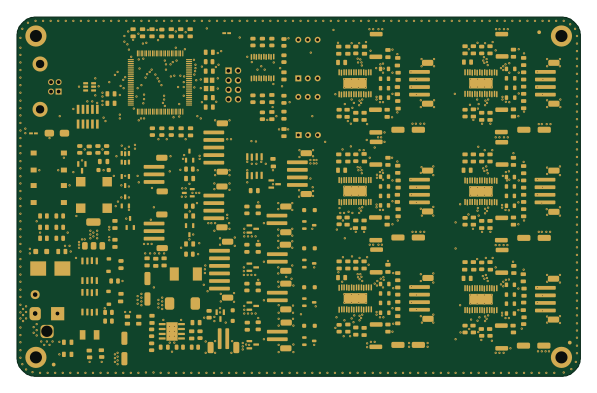
LumenPnP Motherboard
opulo-inc
149 × 95 mm296 parts4LCC-BY-SA-4.03.7k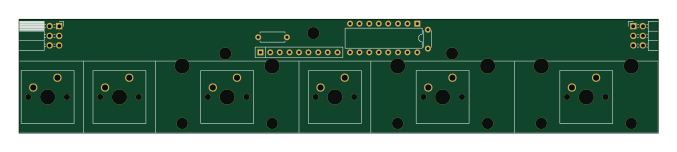 STM32
Type g
google
169 × 30 mm24 parts2LApache-2.02.9k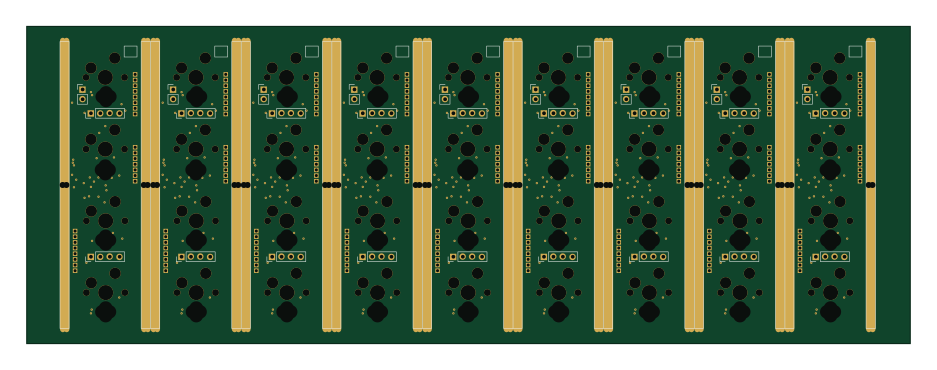 STM32
Main panel
234 × 84 mm26 parts4LApache-2.02.9k STM32
Base
52.3 × 52.3 mm36 parts2LApache-2.02.9k STM32
Type a
150 × 30 mm14 parts2LApache-2.02.9k STM32
Type c
188 × 30 mm17 parts2LApache-2.02.9k