
Ghost fader

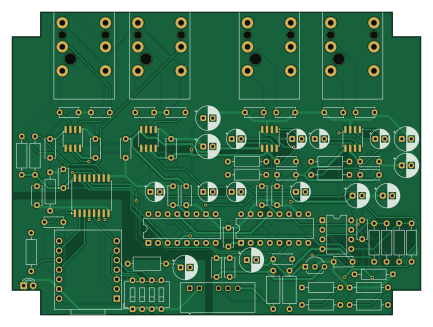
About the Ghost fader PCB
Ghost fader is an open source RP2040/RP2350 PCB design by chris-albert, published on GitHub. It is a 2-layer board measuring 108 × 80 mm, with 82 components from 28 distinct parts.
Its main chip is the XIAO RP2040, from the RP2040/RP2350 family. Other key parts include the THAT1246S08, PGA2310PA, OPA2134PA, THAT1646S08 and ISO7762FDW. By type, the board carries 45 capacitors, 17 resistors, 10 ICs, 4 connectors, 3 inductors and 1 switch.
It belongs with the audio designs in this gallery.
From the project
MIDI-controlled volume and pan for balanced stereo synths (Teensy 4.0 + PGA2310)
USB-MIDI-controlled volume and pan for two balanced 1/4" line channels. Balanced in, always-balanced out, one input becomes stereo automatically. Bus-powered Seeed XIAO RP2040 plus a 2x2 gain matrix of PGA2310 attenuators. Revision D: USB only, no DIN jack, no DC jack; the audio side is galvanically isolated from the computer. A TI ISO7762F carries the four control lines and two sense lines across a split in the ground pours, the DC-DC module is the only power path across it, and a 78L05 makes the PGA logic supply on the audio side. About $6 of parts on top of rev C (XIAO RP2040, Traco TBA…
Main components on the Ghost fader
Ghost fader bill of materials (BOM)
82 components, 28 distinct parts — part numbers from the project's BOM.
| Qty | Part | Footprint | Refs |
|---|---|---|---|
| 2 | THAT1246S08 | SOIC-8_3.9x4.9mm_P1.27mm | U1, U2 |
| 2 | PGA2310PA | DIP-16_W7.62mm | U3, U4 |
| 1 | OPA2134PA | DIP-8_W7.62mm | U5 |
| 2 | THAT1646S08 | SOIC-8_3.9x4.9mm_P1.27mm | U6, U7 |
| 1 | ISO7762FDW | SOIC-16W_7.5x10.3mm_P1.27mm | U8 |
| 1 | XIAO RP2040 | XIAO_RP2040_THT | U9 |
| 1 | L78L05 | TO-92_Inline_Wide | U10 |
| 4 | NRJ6HF | Jack_6.35mm_Neutrik_NRJ6HF_Horizontal | J1, J2, J3, J4 |
| 1 | TBA 2-0522 | Converter_DCDC_TRACO_TBA2-xxxx_Dual_THT | PS1 |
| 1 | MIDI channel | SW_DIP_SPSTx04_Slide_6.7x11.72mm_W7.62mm_P2.54mm_LowProfile | SW1 |
| 1 | MIDI act | LED_D3.0mm | LED1 |
| 1 | 600R@100MHz 1A | L_Axial_L7.0mm_D3.3mm_P10.16mm_Horizontal_Fastron_MICC | FB1 |
| 2 | 10uH 300mA | L_Axial_L7.0mm_D3.3mm_P10.16mm_Horizontal_Fastron_MICC | L1, L2 |
| 8 | 100p C0G | C_Disc_D5.0mm_W2.5mm_P5.00mm | C1, C2, C7, C8, C9, C10, C15, C16 |
| 8 | 10u NP | CP_Radial_D5.0mm_P2.50mm | C3, C4, C5, C6, C17, C18, C19, C20 |
| 1 | 47u low-ESR | CP_Radial_D6.3mm_P2.50mm | C11 |
| 2 | 100u 25V | CP_Radial_D6.3mm_P2.50mm | C12, C13 |
| 1 | 10U 10u | CP_Radial_D6.3mm_P2.50mm | C14 |
| 19 | 100n | C_Disc_D5.0mm_W2.5mm_P5.00mm | C21, C22, C23, C24, C25, C26, C27, C28 +11 |
| 4 | 10u | CP_Radial_D6.3mm_P2.50mm | C40, C41, C42, C43 |
Show 8 more
| Qty | Part | Footprint | Refs |
|---|---|---|---|
| 1 | 100N 100n | C_Disc_D5.0mm_W2.5mm_P5.00mm | C44 |
| 1 | 1n 1kV | C_Disc_D5.0mm_W2.5mm_P5.00mm | C45 |
| 2 | 100K 100k | R_Axial_DIN0207_L6.3mm_D2.5mm_P10.16mm_Horizontal | R1, R14 |
| 8 | 10k | R_Axial_DIN0207_L6.3mm_D2.5mm_P10.16mm_Horizontal | R2, R3, R4, R5, R6, R7, R8, R9 |
| 4 | 10R | R_Axial_DIN0207_L6.3mm_D2.5mm_P10.16mm_Horizontal | R10, R11, R12, R13 |
| 1 | 10K 10k | R_Axial_DIN0207_L6.3mm_D2.5mm_P10.16mm_Horizontal | R15 |
| 1 | 1k | R_Axial_DIN0207_L6.3mm_D2.5mm_P10.16mm_Horizontal | R16 |
| 1 | 1M | R_Axial_DIN0207_L6.3mm_D2.5mm_P10.16mm_Horizontal | R17 |
Ghost fader design files
The KiCad project lives in the chris-albert/ghost-fader repository on GitHub; these links point at the commit this page was built from.
Ghost fader: common questions
What microcontroller does the Ghost fader use?
The Ghost fader is built around the XIAO RP2040, from the RP2040/RP2350 family.
How big is the Ghost fader PCB?
The Ghost fader measures 108 × 80 mm, has 2 copper layers and is 1.6 mm thick.
How many components are on the Ghost fader?
82 components, from 28 distinct parts, with part numbers taken from the project's own BOM. The full bill of materials is listed on this page.
Where can I download the Ghost fader design files?
From the chris-albert/ghost-fader repository on GitHub, which has the KiCad layout, the schematic and the BOM; the links under Design files point to each one.
Can I use the Ghost fader design in my own project?
The repository has no license, so all rights stay with chris-albert. Use it as a reference, and ask the author before reusing the design.
Can I test firmware for the Ghost fader without the hardware?
Yes. HardLabs builds a simulation of the board from its netlist and BOM, so you can run and debug RP2040/RP2350 firmware against it before you order a PCB.
More boards in ghost-fader
Similar boards
 RP2040/RP2350
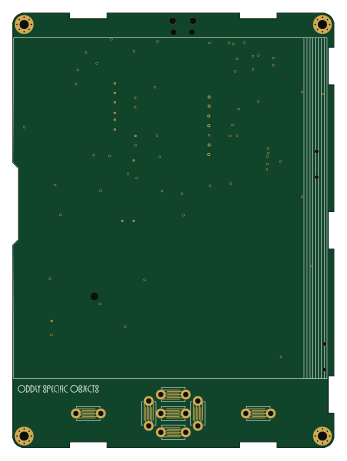
Open Book Abridged Edition
joeycastillo
85 × 115 mm29 parts2LCC-BY-SA-4.08.1k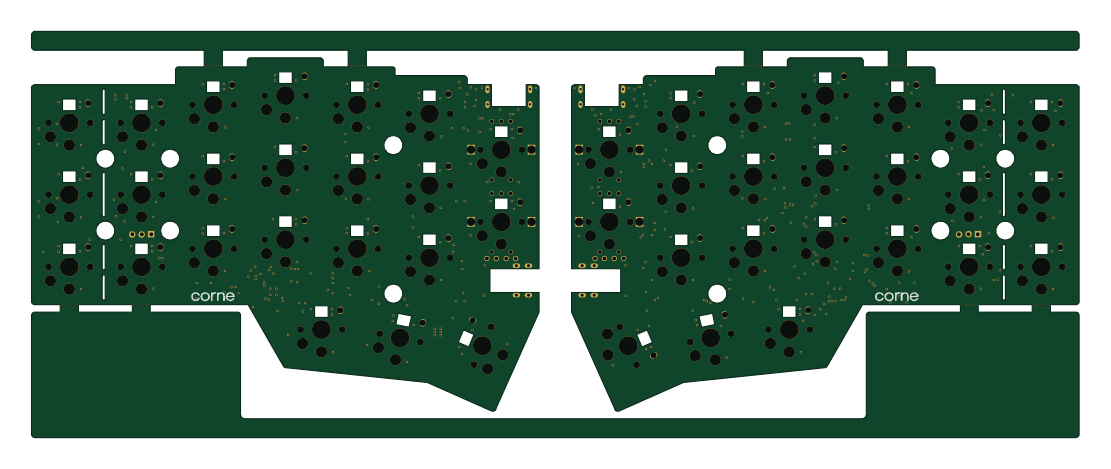 RP2040/RP2350
Corne
foostan
277.2 × 107.5 mm164 parts2LCC-BY-4.07.7k RP2040/RP2350
Corne
277.2 × 107.5 mm164 parts2LCC-BY-4.07.7k RP2040/RP2350
Msa
Mentra-Community
47.8 × 9.4 mm53 parts2LMIT1.2k RP2040/RP2350
Open Source Smart Glasses
93 × 10.5 mm80 parts4LMIT1.2k RP2040/RP2350
MSA
30.5 × 138 mm61 parts2LMIT1.2k