
Bionic-Butterfly

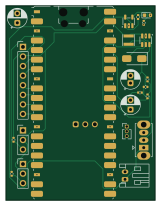
About the Bionic-Butterfly PCB
Bionic-Butterfly is an open source Raspberry Pi PCB design by CookieCodesAI, published on GitHub under the MIT license. It is a 2-layer board measuring 39.5 × 51.5 mm, with 23 components from 19 distinct parts.
Its main chip is the RaspberryPi_Pico_W, from the Raspberry Pi family. By type, the board carries 1 module, 1 switch, 1 LED, 1 diode and 1 inductor.
It belongs with the robotics & motion and power & battery designs in this gallery.
From the project
A butterfly-like drone that can be manually controlled.
The wings will be made with flower paper and carbon fiber to make sure that they don't weigh too much. Additionally, the wings will be connected to the servo horns with a connector that I will make and mold to make sure that it fits perfectly.
The PCB will be able to fit in the gap in the middle of the body. The servos will be placed on the angled sides of the main body and the wires will be connected as shown in the wiring diagram. The 2S LiPo battery is the yellow rectangle that was measured with the dimensions of the LiPo battery in my BOM.
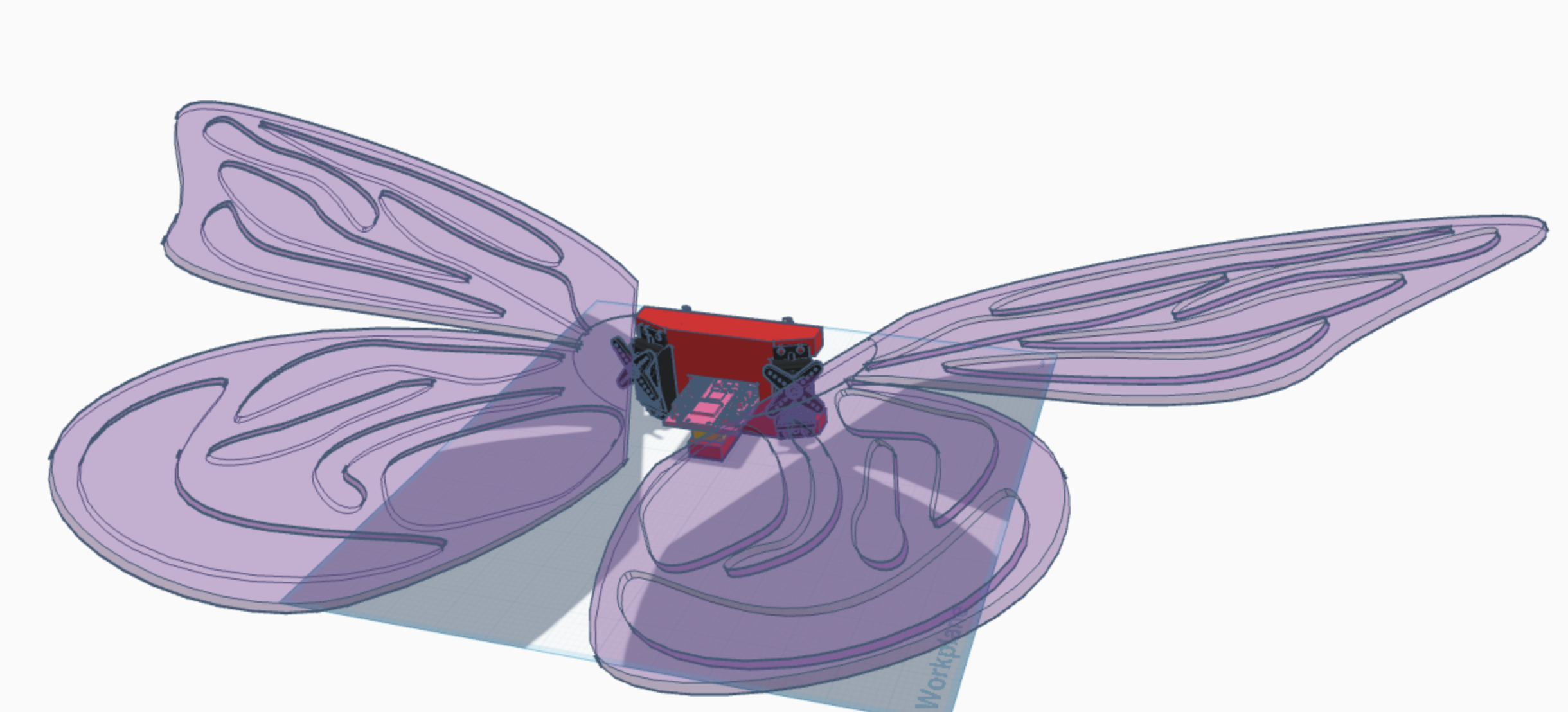
Main components on the Bionic-Butterfly
Bionic-Butterfly bill of materials (BOM)
23 components, 19 distinct parts — part numbers from the project's BOM.
| Qty | Part | Footprint | Refs |
|---|---|---|---|
| 1 | RaspberryPi_Pico_W | RaspberryPi_Pico_W_SMD_HandSolder | A1 |
| 2 | 100uF | CP_Radial_D5.0mm_P2.50mm | C_3V3, C_BAT1 |
| 2 | 100nF | C_0402_1005Metric | C_3V3_bypass1, C_5V_bypass1 |
| 1 | 100uF | CP_Radial_D5.0mm_P2.00mm | C_5V1 |
| 1 | Conn_01x02_Socket | JST_PH_S2B-PH-K_1x02_P2.00mm_Horizontal | J_BAT1 |
| 1 | Conn_01x03_Pin | PinHeader_1x03_P1.27mm_Vertical | J_DBG1 |
| 1 | Conn_01x08_Pin | PinHeader_1x08_P2.54mm_Vertical | J_EXT1 |
| 2 | Conn_01x03_Pin | PinHeader_1x03_P2.54mm_Vertical | J_SRV1, J_SRV2 |
| 1 | ~ | SOT-23-5 | MCP73831 |
| 1 | ~ | SOT-23-6 | MT3608 |
| 1 | 100k | R_0402_1005Metric | R_FB1 |
| 1 | 36k | R_0402_1005Metric | R_FB2 |
| 1 | 1k | R_0402_1005Metric | R_LED1 |
| 1 | 2k | R_0402_1005Metric | R_PROG1 |
| 2 | 47 | R_0402_1005Metric | R_SRV1, R_SRV2 |
| 1 | SW_SPDT | SW_Slide_SPDT_Straight_CK_OS102011MS2Q | SW1 |
| 1 | LED | LED_0603_1608Metric | LED_CHG1 |
| 1 | SS14 | D_SMA | D1 |
| 1 | 4.7uH | L_Taiyo-Yuden_NR-30xx | L1 |
Bionic-Butterfly design files
The KiCad project lives in the CookieCodesAI/Bionic-Butterfly repository on GitHub; these links point at the commit this page was built from.
Bionic-Butterfly: common questions
What microcontroller does the Bionic-Butterfly use?
The Bionic-Butterfly is built around the RaspberryPi_Pico_W, from the Raspberry Pi family.
How big is the Bionic-Butterfly PCB?
The Bionic-Butterfly measures 39.5 × 51.5 mm, has 2 copper layers and is 1.6 mm thick.
How many components are on the Bionic-Butterfly?
23 components, from 19 distinct parts, with part numbers taken from the project's own BOM. The full bill of materials is listed on this page.
Where can I download the Bionic-Butterfly design files?
From the CookieCodesAI/Bionic-Butterfly repository on GitHub, which has the KiCad layout, the schematic and the BOM; the links under Design files point to each one.
Can I use the Bionic-Butterfly design in my own project?
Yes, under the terms of its MIT license, which CookieCodesAI chose for the repository.
Can I test firmware for the Bionic-Butterfly without the hardware?
Yes. HardLabs builds a simulation of the board from its netlist and BOM, so you can run and debug Raspberry Pi firmware against it before you order a PCB.
Similar boards
 Raspberry Pi
Haxo hw
cardonabits
102.4 × 211.3 mm38 parts2LCustom license672 Raspberry Pi
Desktop 50 Pin TopConn
BlueSCSI
89.2 × 82.6 mm103 parts2LGPL-3.0449 Raspberry Pi
PowerBook
74.5 × 56.3 mm78 parts2LGPL-3.0449 Raspberry Pi
BitDogLab Main SMD version
BitDogLab
87.9 × 98.7 mm124 parts2LCERN-OHL-S-2.0201 Raspberry Pi
BitDogLab 5.4
87.9 × 123.9 mm56 parts2LCERN-OHL-S-2.0201 Raspberry Pi
Zynthian mini v2 20 buttons short
zynthian
163 × 120 mm87 parts2LNo license154