
Nobo

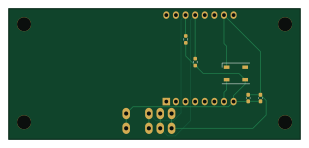
About the Nobo PCB
Nobo is an open source ESP8266 PCB design by csabigee, published on GitHub under the GPL-3.0 license. It is a 2-layer board measuring 77 × 34.5 mm, with 7 components from 5 distinct parts.
Its main chip is the WeMos_D1_mini, from the ESP8266 family. By type, the board carries 2 capacitors, 2 resistors, 1 IC, 1 connector and 1 diode.
It belongs with the iot & wireless designs in this gallery.
From the project
PCB design files for the nobo thermostat
https://github.com/csabigee/nobo-pcb/assets/96885207/b5cf36cf-c3b2-4169-932b-3addc52b22ec
:mag: Reverse engineering the protocol :mag_right:
:hammerandwrench: Building the custom thermostat :hammerandwrench:
Main components on the Nobo
Nobo bill of materials (BOM)
7 components, 5 distinct parts.
| Qty | Part | Footprint | Refs |
|---|---|---|---|
| 1 | WeMos_D1_mini | WEMOS_D1_mini_light2 | U1 |
| 1 | Conn_01x04 | nobo | CON1 |
| 1 | WS2812B | LED_WS2812B_PLCC4_5.0x5.0mm_P3.2mm | D1 |
| 2 | 10u | C_0603_1608Metric_Pad1.08x0.95mm_HandSolder | C2, C3 |
| 2 | 10k | R_0603_1608Metric_Pad0.98x0.95mm_HandSolder | R1, R2 |
Nobo design files
The KiCad project lives in the csabigee/nobo-pcb repository on GitHub; these links point at the commit this page was built from.
- Layoutnobo.kicad_pcb
- Schematicnobo.kicad_sch
Nobo: common questions
What microcontroller does the Nobo use?
The Nobo is built around the WeMos_D1_mini, from the ESP8266 family.
How big is the Nobo PCB?
The Nobo measures 77 × 34.5 mm, has 2 copper layers and is 1.6 mm thick.
How many components are on the Nobo?
7 components, from 5 distinct parts. The full bill of materials is listed on this page.
Where can I download the Nobo design files?
From the csabigee/nobo-pcb repository on GitHub, which has the KiCad layout and the schematic; the links under Design files point to each one.
Can I use the Nobo design in my own project?
Yes, under the terms of its GPL-3.0 license, which csabigee chose for the repository.
Can I test firmware for the Nobo without the hardware?
Yes. HardLabs builds a simulation of the board from its netlist and BOM, so you can run and debug ESP8266 firmware against it before you order a PCB.
Similar boards
 ESP8266
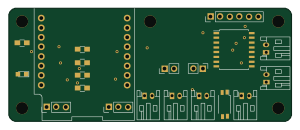
ESP8266ControllerCircuit
stuartpittaway
75 × 30 mm20 parts2LCC-BY-NC-4.01.1k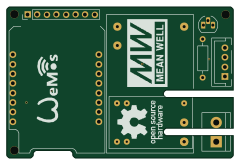 ESP8266
HASwitchPlate
aderusha
60 × 40 mm8 parts2LMIT738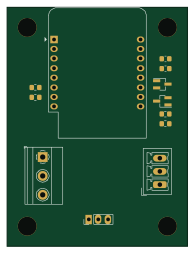 ESP8266
RatGDO-OpenSource-D1Mini-ESP8266
Kaldek
47.8 × 63.3 mm12 parts2LMIT506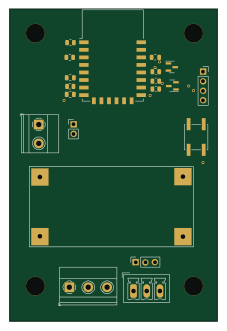 ESP8266
RatGDO-OpenSource-Bare-ESP8266
55 × 82.7 mm20 parts2LMIT506 ESP8266
Goatgdo
32.9 × 53.3 mm23 parts2LMIT506 ESP8266
Iaq board
nkitanov
70.1 × 43.2 mm17 parts2LNo license398