
Ignition


About the Ignition PCB
Ignition is an open source STM32 PCB design by cuspaceflight, published on GitHub. It is a 2-layer board measuring 8 × 3 mm, with 105 components from 55 distinct parts.
Its main chip is the STM32F071CBT6, from the STM32 family. Other key parts include the SWD, RFM95W and TSR 0.5-2433. By type, the board carries 33 resistors, 19 diodes, 12 connectors, 12 capacitors, 11 test points and 6 transistors.
It belongs with the rf & radio designs in this gallery.
From the project
Rocket motor ignition and valve control from far, far away
OkGo is Cambridge University Space Flight's rocket firing controller.
OkGo was designed for testing the Quasar hybrid rocket motor. It allowed remote (over 100m of wire) control of the nitrous oxide valve and firing of the ignition e-match. It was constructed using an ad-hoc point-to-point layout. An entirely passive design, it simply uses mechanical switches to trigger relays. It was later upgraded to control two valves, one of which passed a low flow of nitrous oxide to help start the motor.
Main components on the Ignition
Ignition bill of materials (BOM)
105 components, 55 distinct parts.
| Qty | Part | Footprint | Refs |
|---|---|---|---|
| 1 | SWD | FTSH-105-01-F-D-K | U103 |
| 1 | RFM95W | RFM95W | U105 |
| 1 | STM32F071CBT6 | LQFP48_ST | U106 |
| 1 | TSR 0.5-2433 | TSR-0_5 | U107 |
| 1 | VAL** | M3_MOUNT_FANCY | M3_MOUNT |
| 6 | BSS138BK | SOT-23 | Q101, Q201, Q202, Q203, Q204, Q205 |
| 1 | 8MHz | XTAL50x32 | Y101 |
| 1 | BATT | PCB_SPADE | P105 |
| 1 | ARM_LED | JST-PA-2-VERT | P107 |
| 1 | BUZZ | JST-PA-2-VERT | P109 |
| 1 | SMA | SMA_upright | P111 |
| 1 | CH3_LED | JST-PA-2-VERT | P201 |
| 1 | CH3 | PCB_SPADE | P203 |
| 1 | CH1_LED | JST-PA-2-VERT | P204 |
| 1 | CH1 | PCB_SPADE | P206 |
| 1 | CH4_LED | JST-PA-2-VERT | P207 |
| 1 | CH4 | PCB_SPADE | P209 |
| 1 | CH2_LED | JST-PA-2-VERT | P210 |
| 1 | CH2 | PCB_SPADE | P212 |
| 1 | 6.3x32 | 6x32_fuseclip | F101 |
Show 35 more
| Qty | Part | Footprint | Refs |
|---|---|---|---|
| 5 | 16A SPST | Relay_RT314 | K201, K202, K203, K204, K205 |
| 1 | BATT | TESTPOINT | TP101 |
| 1 | GND | TESTPOINT | TP102 |
| 1 | nRST | TESTPOINT | TP103 |
| 1 | 3v3 | TESTPOINT | TP104 |
| 1 | FiringDist | TESTPOINT | TP201 |
| 1 | USRelay | TESTPOINT | TP202 |
| 1 | RelaySense | TESTPOINT | TP203 |
| 1 | ContCH3 | TESTPOINT | TP204 |
| 1 | ContCH1 | TESTPOINT | TP205 |
| 1 | ContCH4 | TESTPOINT | TP206 |
| 1 | ContCH2 | TESTPOINT | TP207 |
| 6 | TVS_small | R_0603 | D101, D103, D206, D210, D214, D218 |
| 1 | RED | LED-0805 | D104 |
| 1 | GREEN | LED-0805 | D105 |
| 1 | YELLOW | LED-0805 | D106 |
| 5 | MBR2H200SFT1G | SOD-123FL | D201, D205, D209, D213, D217 |
| 5 | D | SOD-123F | D202, D204, D208, D212, D216 |
| 5 | 100n | C_0805 | C101, C102, C104, C105, C109 |
| 2 | 4u7 | C_0805 | C103, C106 |
| 1 | 10n | C_0805 | C107 |
| 1 | 100u | C_1206 | C108 |
| 1 | 1u | C_0805 | C110 |
| 2 | 15p | C_0805 | C111, C112 |
| 5 | 10k | R_0805 | R101, R207, R212, R217, R222 |
| 1 | 3k3 | R_0805 | R102 |
| 1 | 75R | R_0805 | R103 |
| 1 | 100R | R_0805 | R104 |
| 6 | 180R | R_0805 | R105, R201, R208, R213, R218, R223 |
| 7 | 100k | R_0805 | R106, R202, R204, R210, R214, R220, R224 |
| 3 | R | R_0805 | R107, R108, R109 |
| 5 | 1k | R_0805 | R203, R206, R211, R216, R221 |
| 2 | 430 | R_0805 | R205, R215 |
| 1 | 510R | R_0805 | R209 |
| 1 | 510 | R_0805 | R219 |
Ignition design files
The KiCad project lives in the cuspaceflight/OkGo repository on GitHub; these links point at the commit this page was built from.
Ignition: common questions
What microcontroller does the Ignition use?
The Ignition is built around the STM32F071CBT6, from the STM32 family.
How big is the Ignition PCB?
The Ignition measures 8 × 3 mm, has 2 copper layers and is 1.6 mm thick.
How many components are on the Ignition?
105 components, from 55 distinct parts. The full bill of materials is listed on this page.
Where can I download the Ignition design files?
From the cuspaceflight/OkGo repository on GitHub, which has the KiCad layout; the links under Design files point to each one.
Can I use the Ignition design in my own project?
The repository has no license, so all rights stay with cuspaceflight. Use it as a reference, and ask the author before reusing the design.
Can I test firmware for the Ignition without the hardware?
Yes. HardLabs builds a simulation of the board from its netlist and BOM, so you can run and debug STM32 firmware against it before you order a PCB.
More boards in OkGo
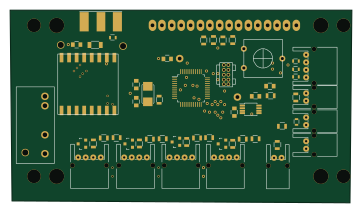
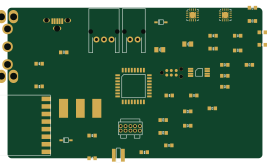
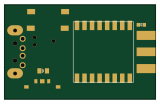
Similar boards
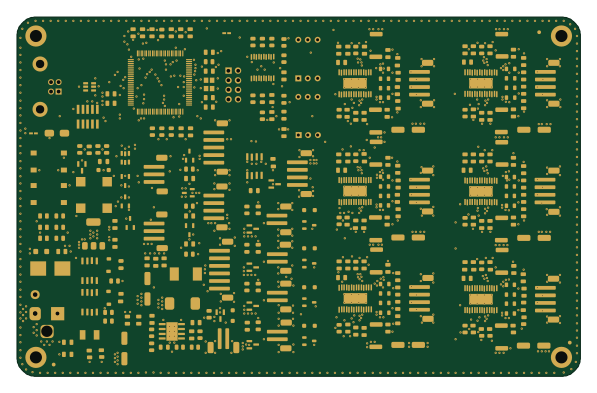 STM32
STM32LumenPnP Motherboard
opulo-inc
149 × 95 mm296 parts4LCC-BY-SA-4.03.7k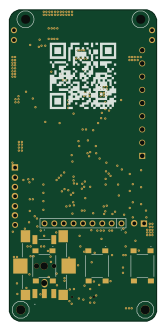 STM32
STM32AxxSolder
AxxAxx
39 × 82.5 mm122 parts2LGPL-3.01.7k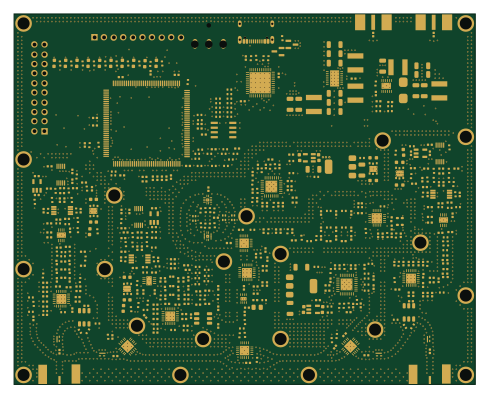 STM32
STM32LibreVNA
jankae
122 × 98 mm592 parts6LGPL-3.01.6k STM32
STM32AIOC
skuep
21 × 31.5 mm47 parts2LMIT1.4k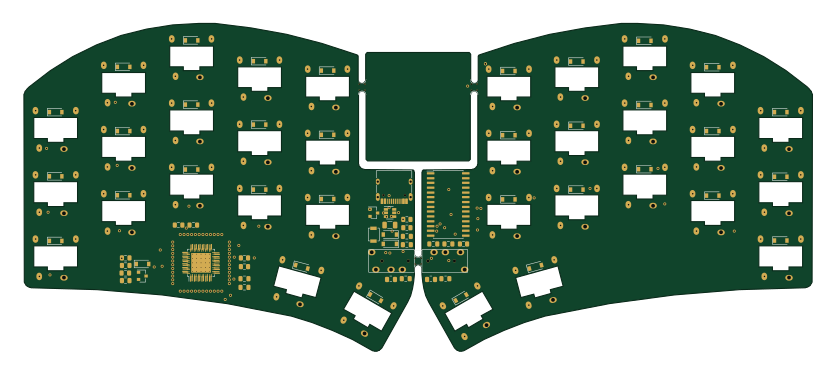 STM32
STM32Ferris
pierrechevalier83
208.8 × 86.8 mm102 parts2LSHL-2.11.3k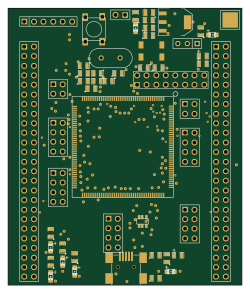 STM32
STM32176 pin board
rusefi
61.8 × 73.2 mm76 parts2LGPL-3.01.2k