
Pecanpico9

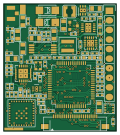
About the Pecanpico9 PCB
Pecanpico9 is an open source STM32 PCB design by DL7AD, published on GitHub under the GPL-3.0 license. It is a 2-layer board measuring 29.8 × 33.7 mm, with 112 components from 52 distinct parts.
Its main chip is the STM32F413xG, from the STM32 family. Other key parts include the SPV1040T, TPS62260DRVR, ADP322ACPZ-115-R7, Si4063-B1B-FM and EVA-7M. By type, the board carries 42 capacitors, 31 resistors, 9 ICs, 6 connectors, 6 inductors and 5 diodes.
It belongs with the rf & radio and power & battery designs in this gallery.
From the project
A lightweight APRS tracker for balloons
Note: The most recent Pecan design is Pecan Pico 10
Other than usual position tracker, this tracker has also the ability to take pictures with a camera and send them to the ground. The tracker can use RTTY/SSDV to transmit those to the ground. While RTTY can only be received directly, this tracker can also use APRS/SSDV. Therefore SSDV has been integraded into the APRS protocol. This new protocol allows the user to receive pcitures by using their APRS receiver and a computer. There is no tuning required, so everything could work autonomously. APRS has been integrated for the image…
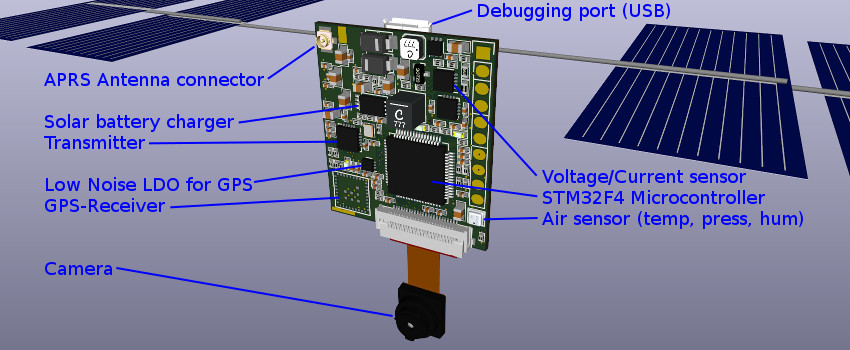
Main components on the Pecanpico9
Pecanpico9 bill of materials (BOM)
112 components, 52 distinct parts.
| Qty | Part | Footprint | Refs |
|---|---|---|---|
| 1 | SPV1040T | TSSOP-8_4.4x3mm_Pitch0.65mm | IC1 |
| 1 | TPS62260DRVR | DFN-6-1EP_2x2mm_Pitch0.65mm | IC2 |
| 1 | ADP322ACPZ-115-R7 | QFN-16-1EP_3x3mm_Pitch0.5mm | IC3 |
| 1 | Si4063-B1B-FM | QFN-20-1EP_4x4mm_Pitch0.5mm | IC4 |
| 1 | STM32F413xG | LQFP-64_10x10mm_Pitch0.5mm | IC5 |
| 1 | EVA-7M | EVA7M | IC6 |
| 1 | PAC1720-1-AIA-TR | DFN-10-1EP_3x3mm_Pitch0.5mm | IC7 |
| 1 | LDLN015PU33R | DFN-6-1EP_2x2mm_Pitch0.5mm | IC8 |
| 1 | BME280 | BME280 | IC9 |
| 1 | FDN306P | SOT-23 | Q1 |
| 1 | KT2016K26000BCW18ZAS | tcxo | X1 |
| 1 | CONN_01X25 | FFC1x24_0.5mm | P1 |
| 1 | CONN_01X10 | Pin_Header_Straight_1x10 | P2 |
| 1 | ZX62-B-5PA(33) | USB_Micro-B_SMD | P3 |
| 2 | IPX 2mm | IPX_2mm | P4, P6 |
| 1 | CONN_01X02 | Pin_Header_Straight_1x02_SMD | P5 |
| 4 | Testpad | PAD_3x1.5 | W1, W2, W3, W9 |
| 2 | Testpad | Testpad | W4, W5 |
| 3 | Pad | PAD_6x3 | W6, W8, W10 |
| 2 | Pad | PAD_3x3 | W7, W11 |
Show 32 more
| Qty | Part | Footprint | Refs |
|---|---|---|---|
| 1 | blue | LED_0603 | D2 |
| 1 | green | LED_0603 | D3 |
| 1 | red | LED_0603 | D7 |
| 2 | RFN1L7STE25 | RFN1L7S | D8, D9 |
| 1 | XAL4040-103 | XAL4040 | L1 |
| 1 | LPS3015-222 | LPS3015 | L2 |
| 1 | 470n | C_0805 | L3 |
| 2 | 56n | C_0805 | L4, L6 |
| 1 | 82n | C_0805 | L5 |
| 2 | 22u | C_0805 | C1, C31 |
| 1 | 1n | C_0402 | C2 |
| 3 | 10u | C_0805 | C3, C4, C6 |
| 3 | 22p | C_0402 | C5, C24, C26 |
| 11 | 2u2 | C_0402 | C8, C9, C10, C11, C12, C13, C22, C37 +3 |
| 12 | 100n | C_0402 | C14, C20, C23, C29, C30, C33, C35, C43 +4 |
| 3 | 100p | C_0402 | C15, C16, C34 |
| 2 | 470p | C_0402 | C18, C19 |
| 2 | 3.3p | C_0402 | C25, C27 |
| 1 | 1u | C_0402 | C28 |
| 2 | 10n | C_0402 | C32, C38 |
| 1 | 220k | R_0402 | R1 |
| 8 | 100k | R_0402 | R2, R9, R14, R17, R23, R24, R28, R31 |
| 3 | 22k | R_0402 | R3, R5, R33 |
| 3 | 10k | R_0402 | R4, R6, R32 |
| 1 | 510k | R_0402 | R7 |
| 2 | 249k | R_0402 | R8, R36 |
| 4 | 1k5 | R_0402 | R10, R11, R21, R35 |
| 2 | 0R1 | R_0603 | R18, R22 |
| 2 | N/A | R_0402 | R19, R20 |
| 2 | 4k7 | R_0402 | R25, R26 |
| 1 | 0R | R_0402 | R27 |
| 2 | 1k | R_0402 | R29, R30 |
Pecanpico9 design files
The KiCad project lives in the DL7AD/pecanpico9 repository on GitHub; these links point at the commit this page was built from.
Pecanpico9: common questions
What microcontroller does the Pecanpico9 use?
The Pecanpico9 is built around the STM32F413xG, from the STM32 family.
How big is the Pecanpico9 PCB?
The Pecanpico9 measures 29.8 × 33.7 mm, has 2 copper layers and is 1 mm thick.
How many components are on the Pecanpico9?
112 components, from 52 distinct parts. The full bill of materials is listed on this page.
Where can I download the Pecanpico9 design files?
From the DL7AD/pecanpico9 repository on GitHub, which has the KiCad layout; the links under Design files point to each one.
Can I use the Pecanpico9 design in my own project?
Yes, under the terms of its GPL-3.0 license, which DL7AD chose for the repository.
Can I test firmware for the Pecanpico9 without the hardware?
Yes. HardLabs builds a simulation of the board from its netlist and BOM, so you can run and debug STM32 firmware against it before you order a PCB.
Similar boards
 STM32
STM32LumenPnP Motherboard
opulo-inc
149 × 95 mm296 parts4LCC-BY-SA-4.03.7k STM32
STM32AxxSolder
AxxAxx
39 × 82.5 mm122 parts2LGPL-3.01.7k STM32
STM32AIOC
skuep
21 × 31.5 mm47 parts2LMIT1.4k STM32
STM32Ferris
pierrechevalier83
208.8 × 86.8 mm102 parts2LSHL-2.11.3k STM32
STM32176 pin board
rusefi
61.8 × 73.2 mm76 parts2LGPL-3.01.2k STM32
STM32Brain board STM32F407
61.8 × 73.2 mm69 parts2LGPL-3.01.2k