
FTDItoRS232

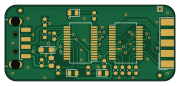
About the FTDItoRS232 PCB
FTDItoRS232 is an open source PCB design by DMAelec, published on GitHub. It is a 2-layer board measuring 45 × 20 mm, with 21 components from 13 distinct parts.
Other key parts include the FT232RL and MAX213. By type, the board carries 10 capacitors, 3 diodes, 3 resistors, 2 ICs, 2 connectors and 1 inductor.
It belongs with the usb & debug tools designs in this gallery.
From the project
FTDI based USB to RS232 adapter
This adapter is designed with KiCad ver 5.1 and has the gerbers located in the GERBER.zip folder. The bill of materials which contains the part values and Digikey/Mouser part numbers are located in the BOM.txt file.
NOTE: It is recommended to use a PCB vendor that can produce 1.2mm boards in order to properly fit the DB-9 connector. ALSO NOTE: This project utilizes mostly SMD parts and is for people with proper skills and tools for working with SMD.
Main components on the FTDItoRS232
FTDItoRS232 bill of materials (BOM)
21 components, 13 distinct parts.
| Qty | Part | Footprint | Refs |
|---|---|---|---|
| 1 | FT232RL | SSOP-28_5.3x10.2mm_P0.65mm | U1 |
| 1 | MAX213 | SSOP-28_5.3x10.2mm_P0.65mm | U2 |
| 1 | USB_A | USB_A_Plug_Horizontal | J1 |
| 1 | DE9_Male | DSUB-9_Male_EdgeMount_P2.77mm | J2 |
| 1 | PWR | LED_0805_2012Metric | D1 |
| 1 | RX | LED_0805_2012Metric | D2 |
| 1 | TX | LED_0805_2012Metric | D3 |
| 1 | FERRITE BEAD | L_0805_2012Metric_Pad1.15x1.40mm_HandSolder | FB1 |
| 1 | 10nF | C_0603_1608Metric | C1 |
| 2 | 47pF | C_0603_1608Metric | C2, C3 |
| 6 | 100nF | C_0603_1608Metric | C4, C6, C7, C8, C9, C10 |
| 1 | 4.7uF | CP_EIA-3216-18_Kemet-A | C5 |
| 3 | 470 | R_0603_1608Metric | R1, R2, R3 |
FTDItoRS232 design files
The KiCad project lives in the DMAelec/FTDItoRS232 repository on GitHub; these links point at the commit this page was built from.
- LayoutFTDItoRS232.kicad_pcb
FTDItoRS232: common questions
How big is the FTDItoRS232 PCB?
The FTDItoRS232 measures 45 × 20 mm, has 2 copper layers and is 1.6 mm thick.
How many components are on the FTDItoRS232?
21 components, from 13 distinct parts. The full bill of materials is listed on this page.
Where can I download the FTDItoRS232 design files?
From the DMAelec/FTDItoRS232 repository on GitHub, which has the KiCad layout; the links under Design files point to each one.
Can I use the FTDItoRS232 design in my own project?
The repository has no license, so all rights stay with DMAelec. Use it as a reference, and ask the author before reusing the design.
Similar boards
XG Station Power
osy
54.3 × 91 mm9 parts2LCC-BY-4.0703
USB Hub Test
50 × 50 mm85 parts4LCC-BY-4.0703
FW-EC-DongleHiderPlus
LeoDJ
28.2 × 26.1 mm14 parts4LCERN-OHL-W-2.0490
Adapter tsop48
bbogush
48 × 33 mm3 parts2LGPL-3.0389
Adapter tsop48 solder
48 × 33 mm3 parts2LGPL-3.0389
Adapter soic8 solder
48 × 20 mm3 parts2LGPL-3.0389