
AmigaStereoMixer

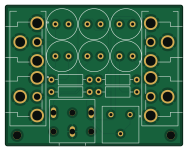
About the AmigaStereoMixer PCB
AmigaStereoMixer is an open source PCB design by dschneller, published on GitHub. It is a 2-layer board measuring 47 × 37.3 mm, with 16 components from 8 distinct parts.
By type, the board carries 6 capacitors, 5 connectors and 4 resistors.
It belongs with the retro computing and audio designs in this gallery.
From the project
A simple circuit to allow merging stereo input channels
A simple circut to allow merging stereo input channels.
When listening with headphones, though, there is no way for sound from the left channel to reach the right ear and vice versa. This often feels very unnatural, because, for example all percussion instruments might be on the right, while the melody is only getting to the left ear.
This little board allows cross-fading the left and right channels to keep the separation, but have a little of each channel bleed over to the other side.
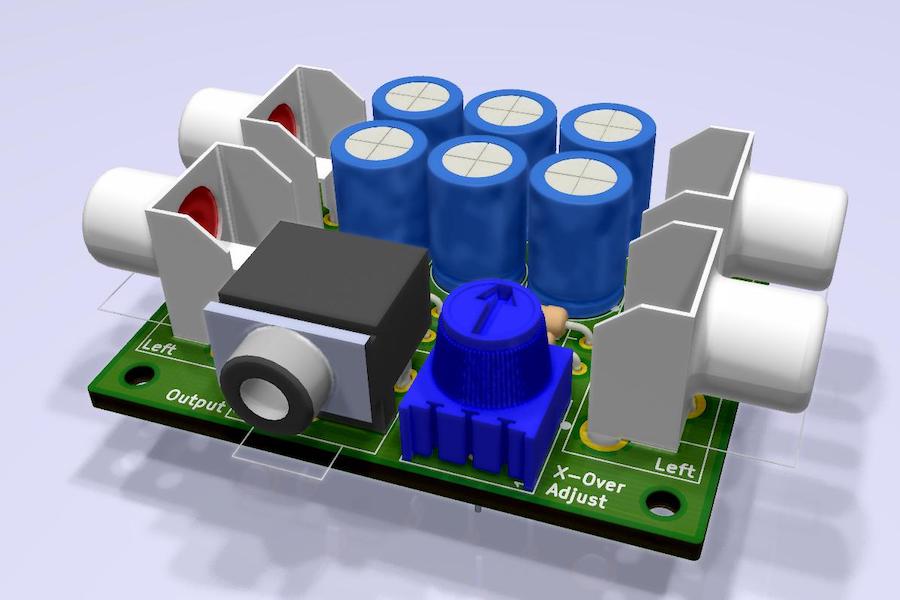
AmigaStereoMixer bill of materials (BOM)
16 components, 8 distinct parts.
| Qty | Part | Footprint | Refs |
|---|---|---|---|
| 1 | IN1_R | CUI_RCJ-012 | J1 |
| 1 | IN1_L | CUI_RCJ-012 | J2 |
| 1 | IN2_L | CUI_RCJ-012 | J3 |
| 1 | IN2_R | CUI_RCJ-012 | J4 |
| 1 | OUT_TRS | CUI_SJ1-3553NG | J5 |
| 1 | 1k | Potentiometer_Bourns_3386F_Vertical | RV1 |
| 6 | 47uF | C_Radial_D8.0mm_H11.5mm_P3.50mm | C1, C2, C3, C4, C5, C6 |
| 4 | 10 | R_Axial_DIN0207_L6.3mm_D2.5mm_P10.16mm_Horizontal | R1, R2, R3, R4 |
AmigaStereoMixer design files
The KiCad project lives in the dschneller/AmigaStereoMixer repository on GitHub; these links point at the commit this page was built from.
AmigaStereoMixer: common questions
How big is the AmigaStereoMixer PCB?
The AmigaStereoMixer measures 47 × 37.3 mm, has 2 copper layers and is 1.6 mm thick.
How many components are on the AmigaStereoMixer?
16 components, from 8 distinct parts. The full bill of materials is listed on this page.
Where can I download the AmigaStereoMixer design files?
From the dschneller/AmigaStereoMixer repository on GitHub, which has the KiCad layout; the links under Design files point to each one.
Can I use the AmigaStereoMixer design in my own project?
The repository has no license, so all rights stay with dschneller. Use it as a reference, and ask the author before reusing the design.
Similar boards
KLOR
GEIGEIGEIST
160.2 × 118.3 mm79 parts2LGPL-3.01.2k
ButtonsLEDs
shanteacontrols
390 × 37 mm82 parts2LApache-2.0956
USB
52 × 12.6 mm6 parts2LApache-2.0956
Pots
390 × 93 mm75 parts2LApache-2.0956
OpenTendo
Redherring32
196.3 × 118.7 mm93 parts2LTAPR-OHL-1.0850
PicoGUS Hand386
polpo
29.2 × 75.2 mm43 parts4LGPL-2.0800