
Alexi2C

About the Alexi2C PCB
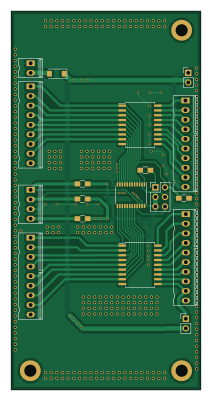
Alexi2C is an open source PCB design by F6ITU, published on GitHub. It is a 2-layer board measuring 50 × 100 mm, with 22 components from 13 distinct parts.
Other key parts include the TCA9555PWR and ULN2803A. By type, the board carries 9 connectors, 7 resistors, 3 ICs, 2 capacitors and 1 diode.
It belongs with the rf & radio and retro computing designs in this gallery.
From the project
A Red Pitaya and Hermes Lite 2.0 I2C ctrl board (Alex retrofit)
I2C control board interfacing Alexiares/Penelope input/output filter set with Hermes Lite 2.x & Red Pitaya
It could also be used with a decimal/7 bits binary input for Hermes lite 1.0
This board is a fork of the DC2PD interface for the Red Pitaya http://rz1zr.ru/files/HermesandAlex_outputs.pdf
- Control a set of Alexiares LPF and HPF filters using the Hermes lite or Red Pitaya's I2C output (Steve KF7O or Pavel Denim's firmware). http://pavel-demin.github.io/red-pitaya-notes/sdr-transceiver-hpsdr/
Main components on the Alexi2C
Alexi2C bill of materials (BOM)
22 components, 13 distinct parts.
| Qty | Part | Footprint | Refs |
|---|---|---|---|
| 1 | TCA9555PWR | TSSOP-24_4.4x7.8mm_Pitch0.65mm | U2 |
| 2 | ULN2803A | SOIC-18W_7.5x11.6mm_Pitch1.27mm | U3, U4 |
| 1 | Conn_01x04 | kk100_22-23-2041 | J1 |
| 1 | Conn_02x03_Odd_Even | Pin_Header_Straight_2x03_Pitch2.54mm | J2 |
| 1 | Conn_01x02 | kk100_22-23-2021 | J3 |
| 2 | Conn_01x10 | kk100_22-23-2101 | J4, J5 |
| 2 | Conn_01x09 | kk100_22-23-2091 | J6, J11 |
| 2 | Conn_01x02 | Pin_Header_Straight_1x02_Pitch2.54mm | J12, J13 |
| 1 | D | D_2010 | D1 |
| 1 | 100n | C_0805_HandSoldering | C5 |
| 1 | 10n | C_0805_HandSoldering | C6 |
| 6 | 4k7 | R_0805_HandSoldering | R1, R2, R3, R5, R6, R7 |
| 1 | 0R | R_0805_HandSoldering | R4 |
Alexi2C design files
The KiCad project lives in the F6ITU/Alexi2C repository on GitHub; these links point at the commit this page was built from.
- LayoutAlexi2c.kicad_pcb
Alexi2C: common questions
How big is the Alexi2C PCB?
The Alexi2C measures 50 × 100 mm, has 2 copper layers and is 1.6 mm thick.
How many components are on the Alexi2C?
22 components, from 13 distinct parts. The full bill of materials is listed on this page.
Where can I download the Alexi2C design files?
From the F6ITU/Alexi2C repository on GitHub, which has the KiCad layout; the links under Design files point to each one.
Can I use the Alexi2C design in my own project?
The repository has no license, so all rights stay with F6ITU. Use it as a reference, and ask the author before reusing the design.
Similar boards
Amiga External
hoglet67
21.9 × 76.7 mm6 parts2LGPL-3.01.0k
Atari pickup
26.4 × 53.9 mm7 parts2LGPL-3.01.0k
Deniseadapter
26.7 × 62.2 mm16 parts2LGPL-3.01.0k
Analog
53.9 × 23.2 mm33 parts2LGPL-3.01.0k
Rgb to hdmi
77 × 97 mm67 parts2LGPL-3.01.0k
Buffer
53.9 × 23.2 mm13 parts2LGPL-3.01.0k