
ShoutDUINO

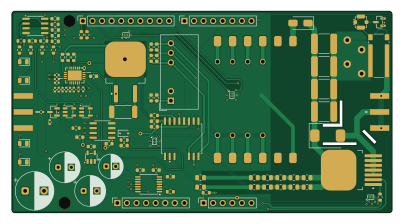
About the ShoutDUINO PCB
ShoutDUINO is an open source PCB design by HWS-XMS, published on GitHub under the MIT license. It is a 4-layer board measuring 100.8 × 53.3 mm, with 106 components from 62 distinct parts.
Other key parts include the TMP117NAIYBGR, 74AHCT1G08, 74AHCT1G86, LM393 and LT3751EUFD#PBF. By type, the board carries 45 resistors, 29 capacitors, 13 ICs, 9 diodes, 7 connectors and 2 transistors.
From the project
Arduino-based, safe-ish, EMFI tool, at lower cost.
Attention: I still want to place and route the unity gain buffer on the feedback path. That's not yet in the prod. files.
Arduino-based, safe-ish, EMFI tool, at lower cost.
The board charges a capacitor to a programmable high voltage, then discharges it through an injection coil on a trigger event. Trigger timing can come from the host over UART (soft trigger) or from an external trigger input, with host-side tooling for parameter sweeps.
Main components on the ShoutDUINO
ShoutDUINO bill of materials (BOM)
106 components, 62 distinct parts — part numbers from the project's BOM.
| Qty | Part | Footprint | Refs |
|---|---|---|---|
| 4 | TMP117NAIYBGR TMP117xxYBG | Texas_DSBGA-6_0.95x1.488mm_Layout2x3_P0.4mm | U1, U2, U3, U14 |
| 1 | 74AHCT1G08 | SOT-23-5 | U4 |
| 1 | 74AHCT1G86 | SOT-23-5 | U5 |
| 1 | LM393 | SOIC-8_3.9x4.9mm_P1.27mm | U6 |
| 1 | LT3751EUFD#PBF LT3751EUFD_TRPBF | QFN50P400X500X80-21N | U7 |
| 1 | MCP3201 | SOIC-8_3.9x4.9mm_P1.27mm | U8 |
| 1 | AD5293 | TSSOP-14_4.4x5mm_P0.65mm | U9 |
| 1 | UCC21530DWKR | SOIC14_7P6X10P5_TEX | U10 |
| 1 | MGJ2D121505SC | Converter_DCDC_Murata_MGJ2DxxxxxxSC_THT | U11 |
| 1 | MCP601-xOT | SOT-23-5 | U12 |
| 1 | NTBG015N065SC1 | TO-263-7_TabPin8 | Q1 |
| 1 | IRFS4227 | TO-263-2 | Q5 |
| 1 | DNP Power | PinSocket_1x08_P2.54mm_Vertical | J1 |
| 1 | DNP Digital/PWM | PinSocket_1x10_P2.54mm_Vertical | J2 |
| 1 | DNP Analog | PinSocket_1x06_P2.54mm_Vertical | J3 |
| 1 | DNP Digital/PWM | PinSocket_1x08_P2.54mm_Vertical | J4 |
| 1 | C3172723 Conn_Coaxial | SMA_Amphenol_132289_EdgeMount | J5 |
| 1 | C3172723 Conn_Coaxial_Small | SMA_Amphenol_132289_EdgeMount | J6 |
| 1 | C434806 Conn_Coaxial | U.FL_Molex_MCRF_73412-0110_Vertical | J7 |
| 1 | 1:10 | GA3460-BL | TRAN1 |
Show 42 more
| Qty | Part | Footprint | Refs |
|---|---|---|---|
| 1 | BZT52C3V3S | D_SOD-323 | D1 |
| 2 | BAT54S | SOT-23 | D2, D9 |
| 1 | C2899997 High-Voltage (RED) | LED_0805_2012Metric | D3 |
| 1 | C98222 Armed (Blue) | LED_0805_2012Metric | D4 |
| 1 | C25170727 Temperature (Orange) | LED_0805_2012Metric | D5 |
| 1 | US1M | D_SMA | D6 |
| 1 | C25170728 Power OK (Green) | LED_0805_2012Metric | D7 |
| 1 | GP3D010A120S | D_SMC | D10 |
| 4 | 2.2uF | C_2220_5750Metric | C1, C2, C3, C33 |
| 7 | 1UF 1uF | C_0603_1608Metric | C4, C34, C35, C36, C37, C38, C41 |
| 6 | 100NF 100nF | C_0603_1608Metric | C5, C10, C27, C28, C40, C42 |
| 1 | 100nF | C_0603_1608Metric | C11 |
| 4 | 1nF | C_0402_1005Metric | C12, C13, C14, C15 |
| 1 | 100UF 100uF | CP_Radial_D6.3mm_P2.50mm | C25 |
| 2 | 470UF 470uF | CP_Radial_D8.0mm_P3.50mm | C26, C30 |
| 1 | 680UF 680uF | CP_Radial_D10.0mm_P5.00mm | C29 |
| 1 | 10NF 10nF | C_0603_1608Metric | C31 |
| 1 | 100PF 100pF | C_0603_1608Metric | C32 |
| 1 | 10UF 10uF | C_0603_1608Metric | C39 |
| 1 | 5 | R_0603_1608Metric | R1 |
| 1 | 10MOHM 10mOhm | FC4L110_OHM | R2 |
| 2 | 4.7K 4.7k | R_0603_1608Metric | R3, R4 |
| 6 | 10K 10k | R_0603_1608Metric | R5, R9, R35, R37, R39, R41 |
| 3 | 10K 10k | R_0402_1005Metric | R6, R15, R16 |
| 1 | 100 | R_0402_1005Metric | R7 |
| 4 | 330 | R_0603_1608Metric | R8, R42, R43, R44 |
| 1 | 30K 30k | R_0603_1608Metric | R10 |
| 2 | 178K 178k | R_0402_1005Metric | R11, R14 |
| 2 | 274K 274k | R_0402_1005Metric | R12, R13 |
| 1 | 40.2K 40.2k | R_0402_1005Metric | R17 |
| 1 | 665 | R_0603_1608Metric | R18 |
| 1 | 1k | R_0603_1608Metric | R19 |
| 1 | 18.2K 18.2k | R_0603_1608Metric | R20 |
| 1 | 40.2K 40.2k | R_0603_1608Metric | R21 |
| 10 | 200k | R_0805_2012Metric | R22, R23, R24, R25, R26, R29, R30, R31 +2 |
| 1 | 25K 5.1k | R_0805_2012Metric | R27 |
| 1 | 25MOHM 25mOhm | R_2512_6332Metric_Pad1.40x3.35mm_HandSolder | R28 |
| 1 | 12.1K 2.53k | R_0805_2012Metric | R34 |
| 1 | 20K 20k | R_0603_1608Metric | R36 |
| 1 | 8.2K 8.2k | R_0603_1608Metric | R38 |
| 1 | 5.1K 5.1k | R_0603_1608Metric | R40 |
| 1 | 2.2k | R_0603_1608Metric | R45 |
ShoutDUINO design files
The KiCad project lives in the HWS-XMS/ShoutDUINO repository on GitHub; these links point at the commit this page was built from.
ShoutDUINO: common questions
How big is the ShoutDUINO PCB?
The ShoutDUINO measures 100.8 × 53.3 mm, has 4 copper layers and is 1.6 mm thick.
How many components are on the ShoutDUINO?
106 components, from 62 distinct parts, with part numbers taken from the project's own BOM. The full bill of materials is listed on this page.
Where can I download the ShoutDUINO design files?
From the HWS-XMS/ShoutDUINO repository on GitHub, which has the KiCad layout, the schematic and the BOM; the links under Design files point to each one.
Can I use the ShoutDUINO design in my own project?
Yes, under the terms of its MIT license, which HWS-XMS chose for the repository.