
Ai orchestrator

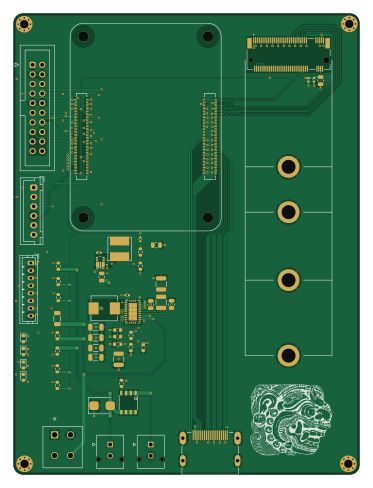
About the Ai orchestrator PCB
Ai orchestrator is an open source Raspberry Pi PCB design by ianisms, published on GitHub under the MIT license. It is a 6-layer board measuring 91.4 × 121.9 mm, with 54 components from 40 distinct parts.
Its main chip is the ComputeModule5-CM5-A, from the Raspberry Pi family. Other key parts include the 5V Buck and 3.3V Buck. By type, the board carries 20 capacitors, 12 resistors, 10 connectors, 5 diodes, 2 ICs and 1 transistor.
It belongs with the audio and dev boards & breakouts designs in this gallery.
From the project
Fully local voice assistant: gRPC orchestrator, MCP tool plane with authorization boundaries, custom TTS, Pi CM5 smart speaker with custom carrier board
Voice client and hardware for a fully local voice assistant. A Raspberry Pi Compute Module 5 on a custom carrier board captures audio from an XMOS XVF3800 mic array over I2S, streams it to the AI server over gRPC, and plays the reply through a Wondom JAB5 DSP amplifier on the same I2S bus. There is no cloud dependency anywhere in the audio path.
1. The client listens continuously for a wakeword with openWakeWord. The deployed unit uses a custom phrase trained with the openWakeWord training notebook; that model is not included, and wakemodelpath defaults to the bundled heyjarvis model, which…
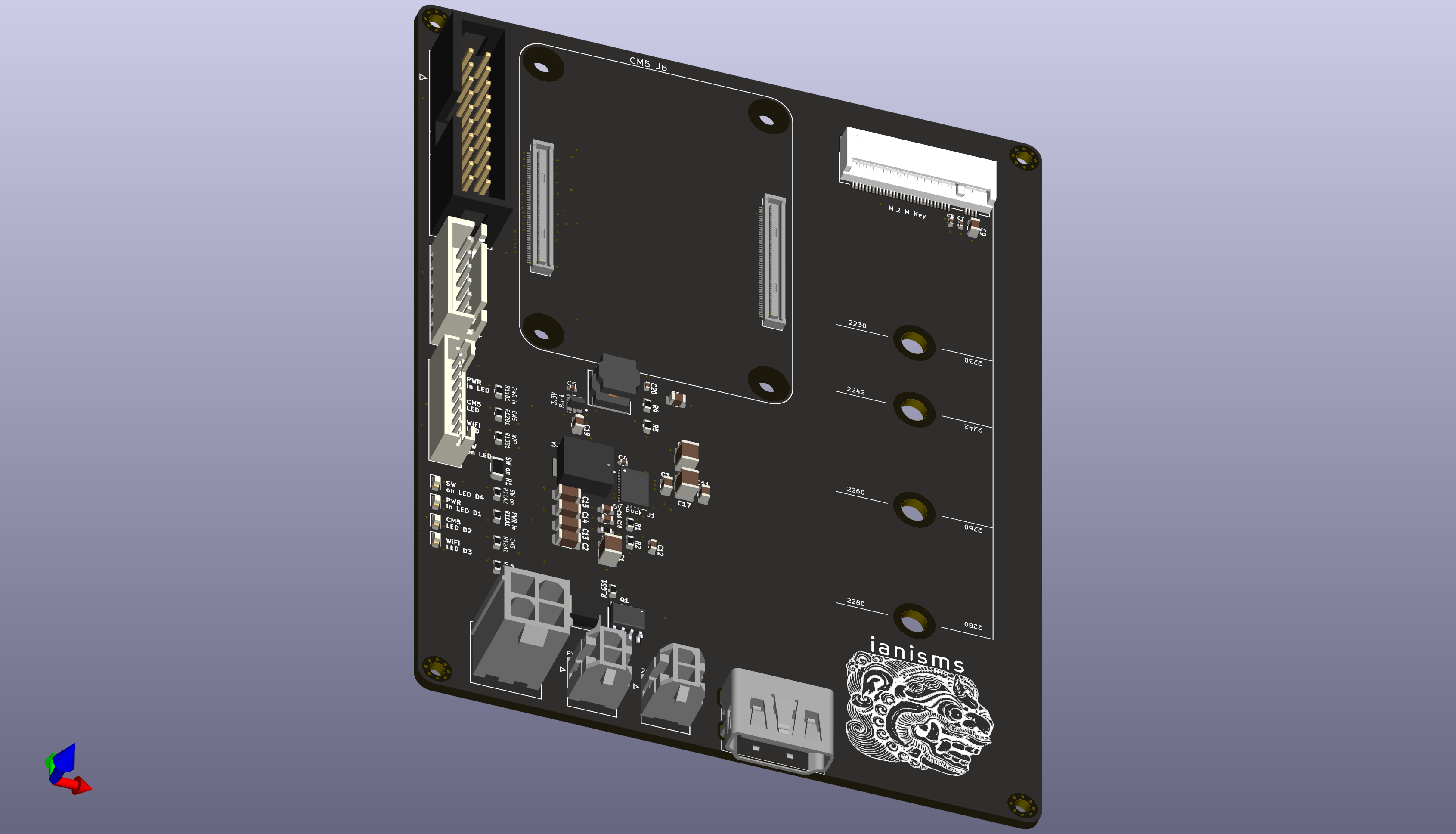
Main components on the Ai orchestrator
Ai orchestrator bill of materials (BOM)
54 components, 40 distinct parts.
| Qty | Part | Footprint | Refs |
|---|---|---|---|
| 1 | 5V Buck | LM73606RNPT | U1 |
| 1 | 3.3V Buck | CONV_AP63357DV-7 | U2 |
| 1 | Q_PMOS_GDS | SI4435DDY | Q1 |
| 1 | 28V in | MOLEX_430450212 | J1 |
| 1 | SW in | MOLEX_430450212 | J2 |
| 1 | JAB5 Power out | MOLEX_39281043 | J3 |
| 1 | ComputeModule5-CM5-A | Raspberry-Pi-5-Compute-Module_B | J5 |
| 1 | ComputeModule5-CM5-B | Raspberry-Pi-5-Compute-Module_A | J6 |
| 1 | M.2 nvme | M.2 M Key socket | J7 |
| 1 | JAB5 I2S out | JST_XH_B6B-XH-A_1x06_P2.50mm_Vertical | J8 |
| 1 | XVF3800 out J9 | IDC-Header_2x10_P2.54mm_Vertical | J9 |
| 1 | HDMI_A_1.4 | TE_1747981-1 | J10 |
| 1 | EXT_LED_BLOCK | JST_PH_B8B-PH-K_1x08_P2.00mm_Vertical | J11 |
| 1 | 3.3uH | INDM7066X300N | 3.3V Inductor L2 |
| 1 | 100k | R_0603_1608Metric | R_GS1 |
| 1 | 2.2k | R_1206_3216Metric | SW on R1 |
| 1 | PWR_IN_LED | LED_0603_1608Metric | D1 |
| 1 | CM5_PWR_LED | LED_0603_1608Metric | D2 |
| 1 | WIFI_LED | LED_0603_1608Metric | D3 |
| 1 | SW_ON_LED | LED_0603_1608Metric | D4 |
Show 20 more
| Qty | Part | Footprint | Refs |
|---|---|---|---|
| 1 | D_TVS | D_SMB | D5 |
| 1 | 4.7uH | L_Bourns_SRN6045TA | L1 |
| 1 | 47uF | C_1210_3225Metric | C1 |
| 4 | 22uF | C_1206_3216Metric | C2, C13, C14, C15 |
| 1 | 0.47uF | C_0805_2012Metric | C3 |
| 1 | 0.47uF | C_0402_1005Metric | C4 |
| 4 | 0.1uF | C_0402_1005Metric | C5, C7, C8, C20 |
| 2 | 22uF | C_0805_2012Metric | C6, C9 |
| 2 | 10uF | C_1210_3225Metric | C10, C17 |
| 2 | 10uF | C_0805_2012Metric | C11, C19 |
| 1 | 0.1uF | C_0603_1608Metric | C12 |
| 2 | 2.2uF | C_0603_1608Metric | C16, C18 |
| 1 | 100k | R_0603_1608Metric | R1 |
| 1 | 24.9k | R_0603_1608Metric | R2 |
| 1 | 39.2k | R_0603_1608Metric | R3 |
| 1 | 31.6k | R_0603_1608Metric | R4 |
| 1 | 10k | R_0603_1608Metric | R5 |
| 3 | 18k | R_0603_1608Metric | R11A1, R11A2, R11B1 |
| 2 | 1k | R_0603_1608Metric | R12A1, R12B1 |
| 2 | 470R | R_0603_1608Metric | R13A1, R13B1 |
Ai orchestrator design files
The KiCad project lives in the ianisms/ai-orchestrator repository on GitHub; these links point at the commit this page was built from.
Ai orchestrator: common questions
What microcontroller does the Ai orchestrator use?
The Ai orchestrator is built around the ComputeModule5-CM5-A, from the Raspberry Pi family.
How big is the Ai orchestrator PCB?
The Ai orchestrator measures 91.4 × 121.9 mm, has 6 copper layers and is 1.6 mm thick.
How many components are on the Ai orchestrator?
54 components, from 40 distinct parts. The full bill of materials is listed on this page.
Where can I download the Ai orchestrator design files?
From the ianisms/ai-orchestrator repository on GitHub, which has the KiCad layout and the schematic; the links under Design files point to each one.
Can I use the Ai orchestrator design in my own project?
Yes, under the terms of its MIT license, which ianisms chose for the repository.
Can I test firmware for the Ai orchestrator without the hardware?
Yes. HardLabs builds a simulation of the board from its netlist and BOM, so you can run and debug Raspberry Pi firmware against it before you order a PCB.
Similar boards
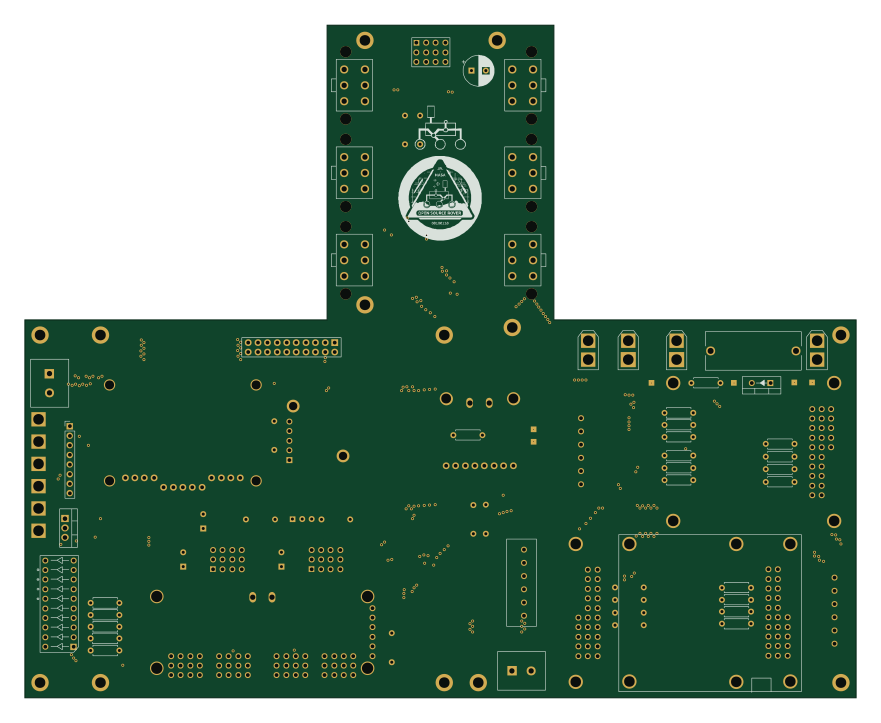 Raspberry Pi
Open source rover
nasa-jpl
220 × 178 mm144 parts2LApache-2.09.7k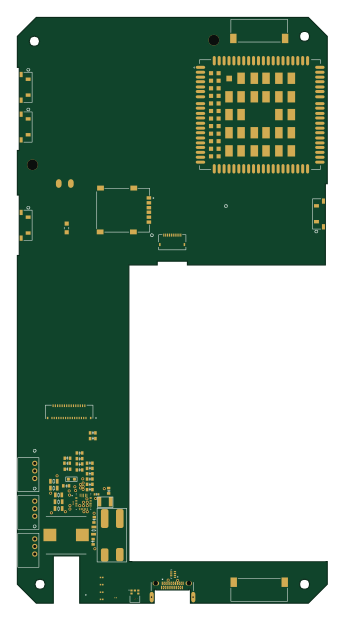 Raspberry Pi
SPIRIT
SPIRIT-org
82 × 155 mm130 parts6LCERN-OHL-S-2.01.3k Raspberry Pi
CM5RevEng
schlae
55 × 40 mm417 parts10LNo license1.0k Raspberry Pi
Haxo hw
cardonabits
102.4 × 211.3 mm38 parts2LCustom license672 Raspberry Pi
Desktop 50 Pin TopConn
BlueSCSI
89.2 × 82.6 mm103 parts2LGPL-3.0449 Raspberry Pi
PowerBook
74.5 × 56.3 mm78 parts2LGPL-3.0449