
OctoPi-Buck-Converter

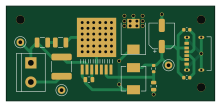
About the OctoPi-Buck-Converter PCB
OctoPi-Buck-Converter is an open source PCB design by jgoeszoom, published on GitHub. It is a 2-layer board measuring 55.1 × 25 mm, with 17 components from 13 distinct parts.
Other key parts include the LM22678TJ-ADJ. By type, the board carries 3 test points, 2 connectors, 2 resistors, 1 IC, 1 diode and 1 inductor.
It belongs with the power & battery designs in this gallery.
From the project
A popular upgrade for 3D printers is to use Octopi on a Raspberry Pi for remote control slicing and printing. However, to power the Pi off the same PSU requires a buck converter. But most implementations cannot provide the necessary current requirements at peak load, so I decided to make my own.
However, the popular method of powering the Raspberry Pi is using a buck converter to stop the power from the PSU(24V) to 5V using the LM2596 buck converter. This popular regulator is readily available online but they have a big problem. They can always provide enough amperage to Raspberry Pi's, namely Raspberry Pi 4s.
So I decided to make this implementation using the LM22678J-ADJ that can be set to provide enough current at 5V. Using TI's Webench power designer I created the necessary supporting circuitry and simulated the circuit in LTSpice and made the PCB in KiCAD.
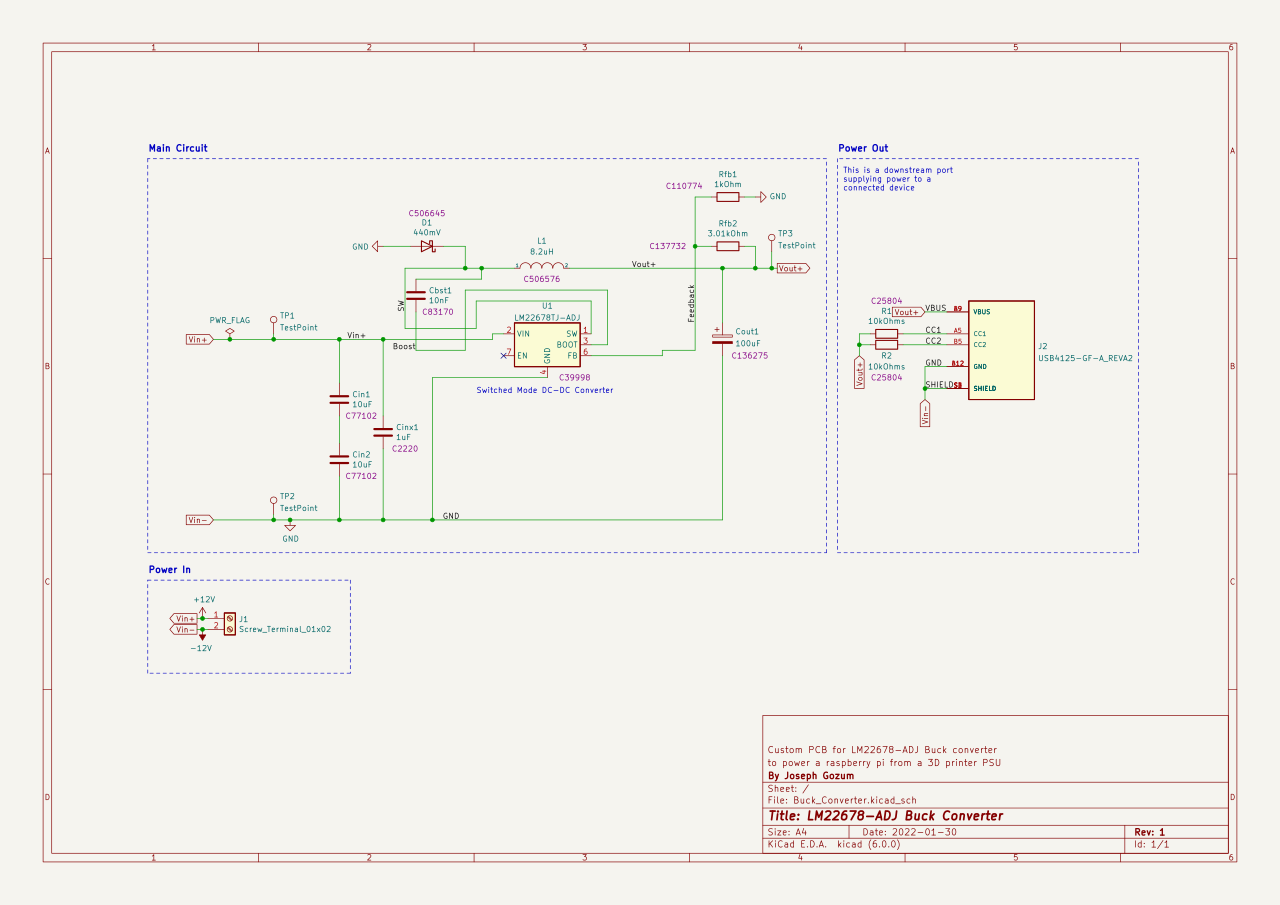
Main components on the OctoPi-Buck-Converter
OctoPi-Buck-Converter bill of materials (BOM)
17 components, 13 distinct parts.
| Qty | Part | Footprint | Refs |
|---|---|---|---|
| 1 | LM22678TJ-ADJ | LM22678TJE-ADJ&slash_NOPB | U1 |
| 1 | Screw_Terminal_01x02 | TerminalBlock_bornier-2_P5.08mm | J1 |
| 1 | USB4125-GF-A_REVA2 | GCT_USB4125-GF-A_REVA2 | J2 |
| 1 | 10nF | C_0805_2012Metric | Cbst1 |
| 2 | 10uF | C_1210_3225Metric | Cin1, Cin2 |
| 1 | 1uF | C_2220_5650Metric | Cinx1 |
| 1 | 100uF | CP_Elec_6.3x5.9 | Cout1 |
| 1 | 1kOhm | R_0805_2012Metric | Rfb1 |
| 1 | 3.01kOhm | R_0603_1608Metric | Rfb2 |
| 3 | TestPoint | TestPoint_Loop_D2.50mm_Drill1.0mm | TP1, TP2, TP3 |
| 1 | 440mV | D_SMC | D1 |
| 1 | 8.2uH | L_Vishay_IHLP-2525 | L1 |
| 2 | 10kOhms | R_0603_1608Metric | R1, R2 |
OctoPi-Buck-Converter design files
The KiCad project lives in the jgoeszoom/OctoPi-Buck-Converter repository on GitHub; these links point at the commit this page was built from.
- LayoutBuck_Converter.kicad_pcb
- SchematicBuck_Converter.kicad_sch
OctoPi-Buck-Converter: common questions
How big is the OctoPi-Buck-Converter PCB?
The OctoPi-Buck-Converter measures 55.1 × 25 mm, has 2 copper layers and is 1.6 mm thick.
How many components are on the OctoPi-Buck-Converter?
17 components, from 13 distinct parts. The full bill of materials is listed on this page.
Where can I download the OctoPi-Buck-Converter design files?
From the jgoeszoom/OctoPi-Buck-Converter repository on GitHub, which has the KiCad layout and the schematic; the links under Design files point to each one.
Can I use the OctoPi-Buck-Converter design in my own project?
The repository has no license, so all rights stay with jgoeszoom. Use it as a reference, and ask the author before reusing the design.
Similar boards
EinkPDA screen
TalismanDesign
95 × 54 mm27 parts2LApache-2.02.0k
Stack chan
stack-chan
50 × 50 mm33 parts2LApache-2.01.7k
Display Carrier
AxxAxx
35.6 × 58.2 mm5 parts2LGPL-3.01.7k
ProgrammingAdapter
stuartpittaway
10.5 × 83 mm3 parts2LCC-BY-NC-4.01.1k
TemperaturePCB PANEL
116 × 75.5 mm178 parts2LCC-BY-NC-4.01.1k
Module 16S PassiveBalanceAddOn
61 × 74 mm86 parts2LCC-BY-NC-4.01.1k