
PulseNet

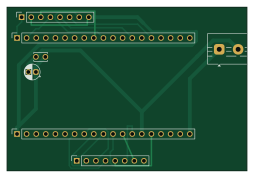
About the PulseNet PCB
PulseNet is an open source ESP32 PCB design by KateLu16, published on GitHub under the MIT license. It is a 2-layer board measuring 63.4 × 43.2 mm, with 7 components from 7 distinct parts.
Its main chip is the ESP32_LEFT, from the ESP32 family. By type, the board carries 5 connectors and 2 capacitors.
It belongs with the iot & wireless designs in this gallery.
From the project
Smart wireless quiz & assessment system — ESP32 BLE clickers, Raspberry Pi gateway, FastAPI dashboard with live analytics and AI quiz generation
ESP32 clickers · BLE · Raspberry Pi gateway · FastAPI dashboard with live analytics
An end-to-end IoT course project — Ho Chi Minh City University of Technology and Education (HCMUTE)
PulseNet turns any classroom into an interactive one. Every student gets a battery-powered wireless response device: they type their student ID on a 4×4 keypad, receive each question on a 1.8″ TFT display over BLE, and answer with a single key press. A Raspberry Pi acts as the BLE gateway and local server, running the database, REST API and the teacher dashboard — a web app for importing questions, running…

PulseNet bill of materials (BOM)
7 components, 7 distinct parts.
| Qty | Part | Footprint | Refs |
|---|---|---|---|
| 1 | ESP32_LEFT | PinSocket_1x19_P2.54mm_Vertical | J1 |
| 1 | ESP32_RIGHT | PinSocket_1x19_P2.54mm_Vertical | J2 |
| 1 | SCREEN | PinSocket_1x08_P2.54mm_Vertical | J3 |
| 1 | KEYPAD | PinSocket_1x08_P2.54mm_Vertical | J4 |
| 1 | BATTERY_and_SWITCH | TerminalBlock_MaiXu_MX126-5.0-02P_1x02_P5.00mm | J5 |
| 1 | 10uF | CP_Radial_D4.0mm_P2.00mm | C1 |
| 1 | 100nF | C_Disc_D3.4mm_W2.1mm_P2.50mm | C2 |
PulseNet design files
The KiCad project lives in the KateLu16/PulseNet repository on GitHub; these links point at the commit this page was built from.
- LayoutDevice/Device.kicad_pcb
- SchematicDevice/Device.kicad_sch
PulseNet: common questions
What microcontroller does the PulseNet use?
The PulseNet is built around the ESP32_LEFT, from the ESP32 family.
How big is the PulseNet PCB?
The PulseNet measures 63.4 × 43.2 mm, has 2 copper layers and is 1.6 mm thick.
How many components are on the PulseNet?
7 components, from 7 distinct parts. The full bill of materials is listed on this page.
Where can I download the PulseNet design files?
From the KateLu16/PulseNet repository on GitHub, which has the KiCad layout and the schematic; the links under Design files point to each one.
Can I use the PulseNet design in my own project?
Yes, under the terms of its MIT license, which KateLu16 chose for the repository.
Can I test firmware for the PulseNet without the hardware?
Yes. HardLabs builds a simulation of the board from its netlist and BOM, so you can run and debug ESP32 firmware against it before you order a PCB.
Similar boards
 ESP32
OSO-BOOK-B1
joeycastillo
85 × 115 mm65 parts2LCC-BY-SA-4.08.1k ESP32
Powertrain
byrantech
64 × 45.4 mm171 parts4LMIT4.3k ESP32
Esp32 minimal
atopile
36.2 × 26.8 mm20 parts2LMIT4.0k ESP32
Badge
56.3 × 39 mm239 parts4LMIT4.0k ESP32
Racer
StuckAtPrototype
36 × 50.2 mm70 parts4LApache-2.03.8k ESP32
Controller
29 × 74 mm58 parts4LApache-2.03.8k