
PCB Sentinel

About the PCB Sentinel
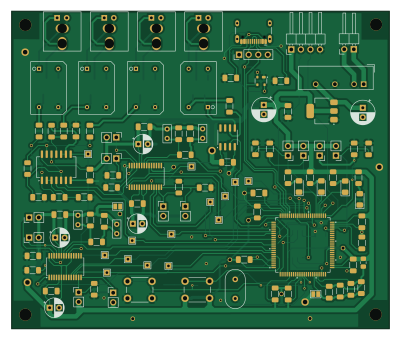
PCB Sentinel is an open source STM32 PCB design by lishangqiu, published on GitHub under the MIT license. It is a 2-layer board measuring 100 × 84 mm, with 136 components from 68 distinct parts.
Its main chip is the STM32H743VIT6, from the STM32 family. Other key parts include the 74HC04, MAX3490, W25Q64, DIR9001 and AMS1117-3.3. By type, the board carries 44 capacitors, 38 resistors, 14 test points, 12 jumpers, 7 ICs and 7 connectors.
It belongs with the audio designs in this gallery.
From the project
"Asynchronous SPDIF Mixer" is a hardware and software project designed to synchronize and mix up to three asynchronous S/PDIF streams into a single 48 kHz output stream. The system compensates for drift between sources and uses interpolation to ensure smooth and artifact-free aud
"Asynchronous SPDIF Mixer" is a hardware and software project designed to synchronize and mix up to three asynchronous S/PDIF streams into a single 48 kHz output stream. The system compensates for drift between sources and uses interpolation to ensure smooth and artifact-free audio transitions. The project includes USB-MIDI control, allowing real-time mixing of the three audio channels via an external MIDI controller or any MIDI-compatible software.
Main components on the PCB Sentinel
PCB Sentinel bill of materials (BOM)
136 components, 68 distinct parts.
| Qty | Part | Footprint | Refs |
|---|---|---|---|
| 1 | STM32H743VIT6 | LQFP100-14x14mm | U1 |
| 1 | 74HC04 | SO-14_5.3x10.2mm_P1.27mm | U2 |
| 1 | MAX3490 | SOIC-8_3.9x4.9mm_P1.27mm | U3 |
| 1 | W25Q64 | SOIC-8_5.23x5.23mm_P1.27mm | U4 |
| 2 | DIR9001 | TSSOP-28-1EP_4.4x9.7mm_P0.65mm_EP2.85x6.7mm | U5, U6 |
| 1 | AMS1117-3.3 | SOT-223-3_TabPin2 | U7 |
| 1 | 25Mhz | Quartz | Y1 |
| 1 | Power In | PinHeader_1x02_P2.54mm_Horizontal | J1 |
| 1 | Debug | PinHeader_1x04_P2.54mm_Horizontal | J2 |
| 1 | USB_C_Receptacle_USB2.0_16P | USB_C_Receptacle_HCTL_HC-TYPE-C-16P-01A | J3 |
| 1 | S/PDIF-Out | CINCH_RCA | J4 |
| 1 | S/PDIF-In1 | CINCH_RCA | J5 |
| 1 | S/PDIF-In2 | CINCH_RCA | J6 |
| 1 | S/PDIF-In3 | CINCH_RCA | J7 |
| 1 | CFG1 | PinHeader_1x02_P2.54mm_Vertical | JP1 |
| 1 | CFG2 | PinHeader_1x02_P2.54mm_Vertical | JP2 |
| 1 | CFG3 | PinHeader_1x02_P2.54mm_Vertical | JP3 |
| 1 | CFG4 | PinHeader_1x02_P2.54mm_Vertical | JP4 |
| 1 | PSCK1_1 | PinHeader_1x02_P2.54mm_Vertical | JP5 |
| 1 | PSCK0_1 | PinHeader_1x02_P2.54mm_Vertical | JP6 |
Show 48 more
| Qty | Part | Footprint | Refs |
|---|---|---|---|
| 1 | FMT1_1 | PinHeader_1x02_P2.54mm_Vertical | JP7 |
| 1 | FMT0_1 | PinHeader_1x02_P2.54mm_Vertical | JP8 |
| 1 | PSCK1_2 | PinHeader_1x02_P2.54mm_Vertical | JP9 |
| 1 | PSCK0_2 | PinHeader_1x02_P2.54mm_Vertical | JP10 |
| 1 | FMT1_2 | PinHeader_1x02_P2.54mm_Vertical | JP11 |
| 1 | FMT0_2 | PinHeader_1x02_P2.54mm_Vertical | JP12 |
| 1 | B1205_2W | Converter_DCDC_TRACO_TBA1-xxxxE_Single_THT | PS1 |
| 1 | BOOT | SW_PUSH_6mm_H5mm | SW1 |
| 1 | RESET | SW_PUSH_6mm_H5mm | SW2 |
| 4 | PE 65612 | PE-65612 | T1, T2, T3, T4 |
| 1 | BCLK1 | TestPoint_THTPad_1.5x1.5mm_Drill0.7mm | TP1 |
| 1 | LRCLK1 | TestPoint_THTPad_1.5x1.5mm_Drill0.7mm | TP2 |
| 1 | DOUT1 | TestPoint_THTPad_1.5x1.5mm_Drill0.7mm | TP3 |
| 1 | ERROR1 | TestPoint_THTPad_1.5x1.5mm_Drill0.7mm | TP4 |
| 1 | NO_AUDIO1 | TestPoint_THTPad_1.5x1.5mm_Drill0.7mm | TP5 |
| 1 | Out | TestPoint_THTPad_1.5x1.5mm_Drill0.7mm | TP6 |
| 1 | In1 | TestPoint_THTPad_1.5x1.5mm_Drill0.7mm | TP7 |
| 1 | BCLK2 | TestPoint_THTPad_1.5x1.5mm_Drill0.7mm | TP8 |
| 1 | LRCLK2 | TestPoint_THTPad_1.5x1.5mm_Drill0.7mm | TP9 |
| 1 | DOUT2 | TestPoint_THTPad_1.5x1.5mm_Drill0.7mm | TP10 |
| 1 | ERROR2 | TestPoint_THTPad_1.5x1.5mm_Drill0.7mm | TP11 |
| 1 | NO_AUDIO2 | TestPoint_THTPad_1.5x1.5mm_Drill0.7mm | TP12 |
| 1 | In2 | TestPoint_THTPad_1.5x1.5mm_Drill0.7mm | TP13 |
| 1 | In3 | TestPoint_THTPad_1.5x1.5mm_Drill0.7mm | TP14 |
| 1 | PRTR5V0U2X | SOT-143 | D1 |
| 1 | 3.3V | LED_1206_3216Metric_Pad1.42x1.75mm_HandSolder | D2 |
| 1 | In3 | LED_1206_3216Metric_Pad1.42x1.75mm_HandSolder | D3 |
| 1 | In2 | LED_1206_3216Metric_Pad1.42x1.75mm_HandSolder | D4 |
| 1 | In1 | LED_1206_3216Metric_Pad1.42x1.75mm_HandSolder | D5 |
| 1 | 1K 100MHz | C_0805_2012Metric_Pad1.18x1.45mm_HandSolder | FB1 |
| 24 | 100n | C_1206_3216Metric_Pad1.33x1.80mm_HandSolder | C1, C2, C3, C4, C5, C6, C8, C10 +16 |
| 2 | 1u | C_1206_3216Metric_Pad1.33x1.80mm_HandSolder | C7, C9 |
| 2 | 2.2u | C_1206_3216Metric_Pad1.33x1.80mm_HandSolder | C13, C14 |
| 4 | 10u | CP_Radial_D5.0mm_P2.50mm | C16, C19, C20, C23 |
| 2 | 100u | CP_Radial_D6.3mm_P2.50mm | C24, C25 |
| 2 | 15p | C_1206_3216Metric_Pad1.33x1.80mm_HandSolder | C29, C30 |
| 2 | 4.7n | C_1206_3216Metric_Pad1.33x1.80mm_HandSolder | C31, C37 |
| 2 | 68n | C_1206_3216Metric_Pad1.33x1.80mm_HandSolder | C32, C38 |
| 2 | 68n | C_Rect_L4.6mm_W2.0mm_P2.50mm_MKS02_FKP02 | C41, C44 |
| 2 | 4.7n | C_Rect_L4.6mm_W2.0mm_P2.50mm_MKS02_FKP02 | C42, C43 |
| 3 | 0 | SolderJumper-2_P1.3mm_Bridged2Bar_Pad1.0x1.5mm | R1, R37, R38 |
| 12 | 10k | R_1206_3216Metric_Pad1.30x1.75mm_HandSolder | R2, R3, R4, R5, R15, R16, R17, R18 +4 |
| 2 | 5.1K | R_1206_3216Metric_Pad1.30x1.75mm_HandSolder | R6, R7 |
| 4 | 47k | R_1206_3216Metric_Pad1.30x1.75mm_HandSolder | R8, R24, R31, R35 |
| 6 | 4.7K | R_1206_3216Metric_Pad1.30x1.75mm_HandSolder | R9, R10, R11, R12, R13, R14 |
| 6 | 75 | R_1206_3216Metric_Pad1.30x1.75mm_HandSolder | R19, R20, R21, R23, R30, R34 |
| 2 | 680 | R_1206_3216Metric_Pad1.30x1.75mm_HandSolder | R22, R33 |
| 3 | 2.2k | R_1206_3216Metric_Pad1.30x1.75mm_HandSolder | R25, R32, R36 |
PCB Sentinel design files
The KiCad project lives in the lishangqiu/PCB_Sentinel repository on GitHub; these links point at the commit this page was built from.
PCB Sentinel: common questions
What microcontroller does the PCB Sentinel use?
The PCB Sentinel is built around the STM32H743VIT6, from the STM32 family.
How big is the PCB Sentinel?
The PCB Sentinel measures 100 × 84 mm, has 2 copper layers and is 1.6 mm thick.
How many components are on the PCB Sentinel?
136 components, from 68 distinct parts. The full bill of materials is listed on this page.
Where can I download the PCB Sentinel design files?
From the lishangqiu/PCB_Sentinel repository on GitHub, which has the KiCad layout and the schematic; the links under Design files point to each one.
Can I use the PCB Sentinel design in my own project?
Yes, under the terms of its MIT license, which lishangqiu chose for the repository.
Can I test firmware for the PCB Sentinel without the hardware?
Yes. HardLabs builds a simulation of the board from its netlist and BOM, so you can run and debug STM32 firmware against it before you order a PCB.
Similar boards
 STM32
STM32LumenPnP Motherboard
opulo-inc
149 × 95 mm296 parts4LCC-BY-SA-4.03.7k STM32
STM32Type c
google
188 × 30 mm17 parts2LApache-2.02.9k STM32
STM32Main panel
234 × 84 mm26 parts4LApache-2.02.9k STM32
STM32Base
52.3 × 52.3 mm36 parts2LApache-2.02.9k STM32
STM32Type a
150 × 30 mm14 parts2LApache-2.02.9k STM32
STM32Type e
140.5 × 30 mm13 parts2LApache-2.02.9k