
Pico-2v

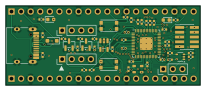
About the Pico-2v PCB
Pico-2v is an open source RP2040/RP2350 PCB design by lucasbaizer, published on GitHub. It is a 4-layer board measuring 51.5 × 21 mm, with 51 components from 25 distinct parts.
Its main chip is the C41378174, from the RP2040/RP2350 family. Other key parts include the C53352, C556901, C205964 and C151353. By type, the board carries 21 capacitors, 12 resistors, 7 connectors, 5 ICs, 3 diodes and 2 switches.
It belongs with the dev boards & breakouts designs in this gallery.
From the project
RP2354A development board with switchable voltage, QSPI breakout, and more
Pico 2V is an RP2350 development board that is (mostly) pin-compatible with the official Raspberry Pi Pico 2 board, but with some additional features and changes:
Switchable 3.3V/1.8V GPIOs: the official Pico 2 only supports running at 3.3V. Pico 2V has a jumper that lets you select between 3.3V and 1.8V. QSPI breakout: the official Pico 2 has an RP2350A as the chip, with on-board flash wired to the RP2350A's QSPI interface. Pico 2V has on RP2354A instead, which has 2MiB on-chip flash. As such, the RP2354A's QSPI interface on Pico 2V is broken out into two headers that can fit an SOIC-8…
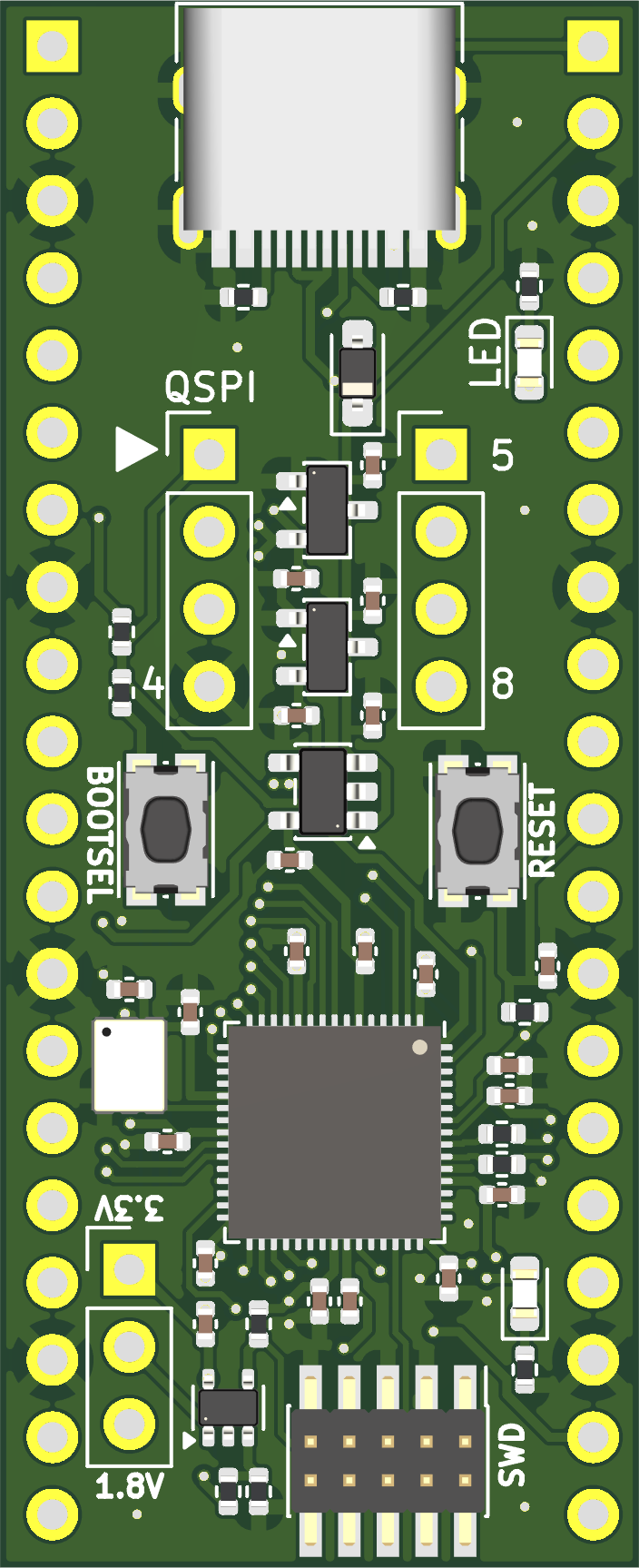
Main components on the Pico-2v
Pico-2v bill of materials (BOM)
51 components, 25 distinct parts — part numbers from the project's BOM.
| Qty | Part | Footprint | Refs |
|---|---|---|---|
| 1 | C41378174 RP2354A | RP2350A-QFN-60-1EP_7x7_P0.4mm_EP3.4x3.4mm_ThermalVias | U1 |
| 1 | C53352 MCP1703T-3302E/CB | SOT-23 | U2 |
| 1 | C556901 MCP1703T-1802E/CB | SOT-23 | U3 |
| 1 | C205964 TLV71311PDBVR | SOT-23-5 | U4 |
| 1 | C151353 LMV331 | SOT-353_SC-70-5 | U5 |
| 1 | C17560642 ECS-3225MV-120-BN-TR3 | ECS-3225MV-120-BN-TR3 | Y1 |
| 1 | C165948 USB_C_Receptacle_USB2.0_16P | USB_C_Receptacle_HRO_TYPE-C-31-M-12 | J1 |
| 1 | C49257 VOLTSEL | PinHeader_1x03_P2.54mm_Vertical | J2 |
| 1 | DNP Header-1 | PinHeader_1x20_P2.54mm_Vertical | J3 |
| 1 | DNP Header-2 | PinHeader_1x20_P2.54mm_Vertical | J4 |
| 2 | Conn_01x04 | PinHeader_1x04_P2.54mm_Vertical | J5, J6 |
| 1 | C41376037 Conn_02x05_Odd_Even | PinHeader_2x05_P1.27mm_Vertical_SMD | J7 |
| 1 | UK-B0273-SP25Y KMR231GLFS USAKRO | SW_Push_1P1T_NO_CK_KMR2 | SW1 |
| 1 | C99271 KMR231GLFS | SW_Push_1P1T_NO_CK_KMR2 | SW2 |
| 1 | B5817WS BS5817WS Micro Commercial Co | D_SOD-323_HandSoldering | D1 |
| 2 | 19-21SURC/S530-A2/TR8 RED Everlight | LED_0603_1608Metric | D2, D3 |
| 1 | C23733 4.7uF | C_0402_1005Metric | C1 |
| 13 | C1525 100nF | C_0402_1005Metric | C2, C3, C4, C5, C6, C7, C8, C9 +5 |
| 6 | C52923 1uF | C_0402_1005Metric | C13, C14, C15, C16, C17, C19 |
| 1 | C15525 10uF | C_0402_1005Metric | C21 |
Show 5 more
| Qty | Part | Footprint | Refs |
|---|---|---|---|
| 4 | C25744 10k | R_0402_1005Metric | R1, R6, R10, R11 |
| 2 | C11702 1k | R_0402_1005Metric | R2, R9 |
| 2 | C25100 27 | R_0402_1005Metric | R3, R4 |
| 2 | WR04X4700FTL 470R Walsin | R_0402_1005Metric | R5, R12 |
| 2 | WR04X5101FTL 5.1K Walsin | R_0402_1005Metric | R7, R8 |
Pico-2v design files
The KiCad project lives in the lucasbaizer/pico-2v repository on GitHub; these links point at the commit this page was built from.
- Layoutpico-2v.kicad_pcb
- Schematicpico-2v.kicad_sch
- BOMfab/rev0/smt/pico-2v-bom.xls
Pico-2v: common questions
What microcontroller does the Pico-2v use?
The Pico-2v is built around the C41378174, from the RP2040/RP2350 family.
How big is the Pico-2v PCB?
The Pico-2v measures 51.5 × 21 mm, has 4 copper layers and is 0.8 mm thick.
How many components are on the Pico-2v?
51 components, from 25 distinct parts, with part numbers taken from the project's own BOM. The full bill of materials is listed on this page.
Where can I download the Pico-2v design files?
From the lucasbaizer/pico-2v repository on GitHub, which has the KiCad layout, the schematic and the BOM; the links under Design files point to each one.
Can I use the Pico-2v design in my own project?
The repository has no license, so all rights stay with lucasbaizer. Use it as a reference, and ask the author before reusing the design.
Can I test firmware for the Pico-2v without the hardware?
Yes. HardLabs builds a simulation of the board from its netlist and BOM, so you can run and debug RP2040/RP2350 firmware against it before you order a PCB.
Similar boards
 RP2040/RP2350
Open Book Abridged Edition
joeycastillo
85 × 115 mm29 parts2LCC-BY-SA-4.08.1k RP2040/RP2350
Corne
foostan
277.2 × 107.5 mm164 parts2LCC-BY-4.07.7k RP2040/RP2350
Corne
277.2 × 107.5 mm164 parts2LCC-BY-4.07.7k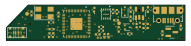 RP2040/RP2350
Msa
Mentra-Community
47.8 × 9.4 mm53 parts2LMIT1.2k RP2040/RP2350
Open Source Smart Glasses
93 × 10.5 mm80 parts4LMIT1.2k RP2040/RP2350
MSA
30.5 × 138 mm61 parts2LMIT1.2k