
Philcoba

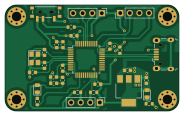
About the Philcoba PCB
Philcoba is an open source STM32 PCB design by mekatronik-achmadi, published on GitHub. It is a 2-layer board measuring 46 × 28 mm, with 30 components from 17 distinct parts.
Its main chip is the STM32F103C8T6, from the STM32 family. Other key parts include the AMS1117-3.3. By type, the board carries 13 capacitors, 6 resistors, 4 connectors, 2 ICs, 2 diodes and 1 crystal.
From the project
Store My Personal Examples on Development Topics
Main components on the Philcoba
Philcoba bill of materials (BOM)
30 components, 17 distinct parts.
| Qty | Part | Footprint | Refs |
|---|---|---|---|
| 1 | STM32F103C8T6 | LQFP-48_7x7mm_P0.5mm | U1 |
| 1 | AMS1117-3.3 | SOT-223-3_TabPin2 | U2 |
| 1 | 16MHz | Crystal_SMD_3225-4Pin_3.2x2.5mm | Y1 |
| 1 | USB_B_Micro | USB_Micro-B_Wuerth_629105150521 | J1 |
| 3 | Conn_01x04_Pin | PinHeader_1x04_P2.54mm_Vertical | J2, J3, J4 |
| 1 | SW_SPDT | SW_SPDT_PCM12 | SW1 |
| 1 | RED | LED_0805_2012Metric | D1 |
| 1 | GREEN | LED_0805_2012Metric | D2 |
| 1 | 120R | L_0603_1608Metric | FB1 |
| 5 | 100n | C_0603_1608Metric | C1, C2, C3, C4, C9 |
| 1 | 10u | C_0603_1608Metric | C5 |
| 1 | 10n | C_0603_1608Metric | C6 |
| 2 | 1u | C_0603_1608Metric | C7, C8 |
| 2 | 10p | C_0603_1608Metric | C10, C11 |
| 2 | 22u | C_0603_1608Metric | C12, C13 |
| 1 | 10K | R_0603_1608Metric | R1 |
| 5 | 1K5 | R_0603_1608Metric | R2, R3, R4, R5, R6 |
Philcoba design files
The KiCad project lives in the mekatronik-achmadi/example_collection repository on GitHub; these links point at the commit this page was built from.
Philcoba: common questions
What microcontroller does the Philcoba use?
The Philcoba is built around the STM32F103C8T6, from the STM32 family.
How big is the Philcoba PCB?
The Philcoba measures 46 × 28 mm, has 2 copper layers and is 1.6 mm thick.
How many components are on the Philcoba?
30 components, from 17 distinct parts. The full bill of materials is listed on this page.
Where can I download the Philcoba design files?
From the mekatronik-achmadi/example_collection repository on GitHub, which has the KiCad layout and the schematic; the links under Design files point to each one.
Can I use the Philcoba design in my own project?
The repository has no license, so all rights stay with mekatronik-achmadi. Use it as a reference, and ask the author before reusing the design.
Can I test firmware for the Philcoba without the hardware?
Yes. HardLabs builds a simulation of the board from its netlist and BOM, so you can run and debug STM32 firmware against it before you order a PCB.
More boards in example_collection
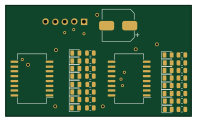
LED16SMD
49.2 × 29.3 mm36 parts2LNo license2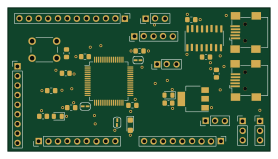 STM32
STM32STM32 LQFP64 Minimum System
69.4 × 37.9 mm34 parts2LNo license2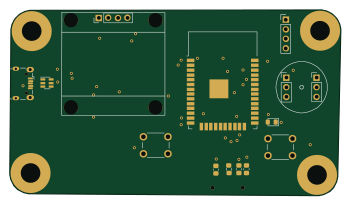 ESP32
ESP32Oledsndio
87.7 × 49.2 mm33 parts2LNo license2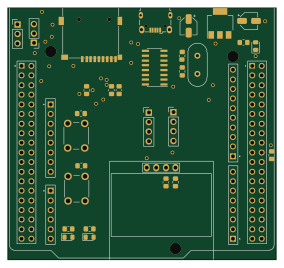
Nucleo shield
70.9 × 66.5 mm31 parts2LNo license2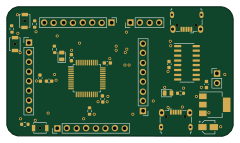 STM32
STM32Stm32pp
59.8 × 34.2 mm30 parts2LNo license2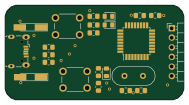 AVR/Arduino
Generic USBAsp
47.3 × 25 mm23 parts2LNo license2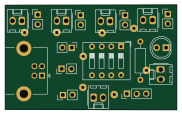
Papank
45.4 × 27.7 mm18 parts2LNo license2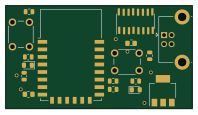 ESP8266
Minimal ESP-12F Module
49.6 × 27.3 mm17 parts2LNo license2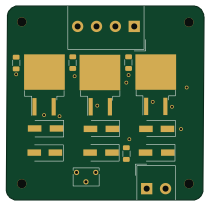
UVW BLDC Controller
52.4 × 51.5 mm16 parts2LNo license2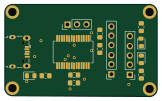
Generic USB FT232 RL
40.4 × 24.4 mm15 parts2LNo license2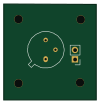
Uvled
24.5 × 25.4 mm10 parts2LNo license2
Similar boards
 STM32
STM32LumenPnP Motherboard
opulo-inc
149 × 95 mm296 parts4LCC-BY-SA-4.03.7k STM32
STM32AxxSolder
AxxAxx
39 × 82.5 mm122 parts2LGPL-3.01.7k STM32
STM32AIOC
skuep
21 × 31.5 mm47 parts2LMIT1.4k STM32
STM32Ferris
pierrechevalier83
208.8 × 86.8 mm102 parts2LSHL-2.11.3k STM32
STM32176 pin board
rusefi
61.8 × 73.2 mm76 parts2LGPL-3.01.2k STM32
STM32Brain board STM32F407
61.8 × 73.2 mm69 parts2LGPL-3.01.2k