
HGS Carrier

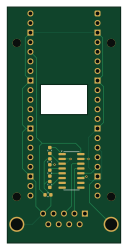
About the HGS Carrier PCB
HGS Carrier is an open source ESP32 PCB design by natehorst240-sketch, published on GitHub. It is a 2-layer board measuring 30 × 62.5 mm, with 7 components from 3 distinct parts.
Its main chip is the ESP32-S3-Touch-LCD-1.9, from the ESP32 family. Other key parts include the MAX3232ESE+. By type, the board carries 5 capacitors, 1 IC and 1 connector.
It belongs with the usb & debug tools designs in this gallery.
From the project
Pico-format carrier that sits under the Waveshare ESP32-S3-Touch-LCD-1.9 (SKU 30939) and gives it a DE9 RS-232 port for the A109 DAU maintenance connector.
Pico-format carrier that sits under the Waveshare ESP32-S3-Touch-LCD-1.9 (SKU 30939) and gives it a DE9 RS-232 port for the A109 DAU maintenance connector.
- U1 MAX3232, VCC on +3V3 only (never 5 V — the S3 is not 5 V tolerant), charge-pump caps C1–C5 100 nF (C1±, C2±, V+, V−). - 9600 baud, 8N1 (Serial1.begin(9600, SERIAL8N1, RX=IO18, TX=IO16) in firmware) — matches the original app's 9600,n,8,1. - The firmware uses Serial1 on IO16/IO18, a second UART. Do not move it to IO43/IO44 (UART0, header pins 1/2): the ROM bootloader prints its 115200 banner there at power-up, straight into the DAU. -…
Main components on the HGS Carrier
HGS Carrier bill of materials (BOM)
7 components, 3 distinct parts — part numbers from the project's BOM.
| Qty | Part | Footprint | Refs |
|---|---|---|---|
| 1 | MAX3232ESE+ MAX3232 Analog Devices | SOIC-16_3.9x9.9mm_P1.27mm | U1 |
| 1 | ESP32-S3-Touch-LCD-1.9 - | RaspberryPi_Pico_Common_THT | J1 |
| 5 | CL10B104KB8NNNC 100nF Samsung | C_0603_1608Metric | C1, C2, C3, C4, C5 |
HGS Carrier design files
The KiCad project lives in the natehorst240-sketch/HGS repository on GitHub; these links point at the commit this page was built from.
HGS Carrier: common questions
What microcontroller does the HGS Carrier use?
The HGS Carrier is built around the ESP32-S3-Touch-LCD-1.9, from the ESP32 family.
How big is the HGS Carrier PCB?
The HGS Carrier measures 30 × 62.5 mm, has 2 copper layers and is 1.6 mm thick.
How many components are on the HGS Carrier?
7 components, from 3 distinct parts, with part numbers taken from the project's own BOM. The full bill of materials is listed on this page.
Where can I download the HGS Carrier design files?
From the natehorst240-sketch/HGS repository on GitHub, which has the KiCad layout, the schematic and the BOM; the links under Design files point to each one.
Can I use the HGS Carrier design in my own project?
The repository has no license, so all rights stay with natehorst240-sketch. Use it as a reference, and ask the author before reusing the design.
Can I test firmware for the HGS Carrier without the hardware?
Yes. HardLabs builds a simulation of the board from its netlist and BOM, so you can run and debug ESP32 firmware against it before you order a PCB.
More boards in HGS
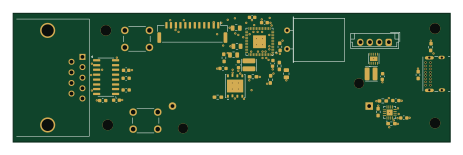
Similar boards
 ESP32
Open Book Abridged Edition
joeycastillo
85 × 115 mm65 parts2LCC-BY-SA-4.08.1k ESP32
Powertrain
byrantech
64 × 45.4 mm171 parts4LMIT4.3k ESP32
Esp32 minimal
atopile
36.2 × 26.8 mm20 parts2LMIT4.0k ESP32
Badge
56.3 × 39 mm239 parts4LMIT4.0k ESP32
Controller
StuckAtPrototype
29 × 74 mm58 parts4LApache-2.03.8k ESP32
Racer
36 × 50.2 mm70 parts4LApache-2.03.8k