
Receiver

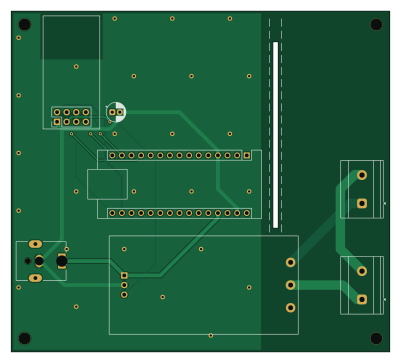
About the Receiver PCB
Receiver is an open source AVR/Arduino PCB design by navneet-krishna, published on GitHub. It is a 2-layer board measuring 100 × 90 mm, with 7 components from 7 distinct parts.
Its main chip is the Arduino_Nano, from the AVR/Arduino family. Other key parts include the nRF24L01. By type, the board carries 3 connectors, 1 IC, 1 module, 1 relay and 1 capacitor.
It belongs with the iot & wireless designs in this gallery.
From the project
Wireless lamp switch: Arduino Nano + nRF24L01 transmitter and relay receiver PCBs (KiCad 10)
Two 2-layer boards: a battery-powered Transmitter (touch-to-toggle) and a mains-switching Receiver.
Open either .kicadpro in KiCad 10. Both projects share the libraries through the local sym-lib-table / fp-lib-table`.
Transmitter: BAT+, BAT-, VINRAW, +5V, GND, TOUCHSIG, RF3V3, RFCE, RFCSN, RFSCK, RFMOSI, RFMISO
Receiver: +5V, GND, RELAYIN, RF, ACHOTIN, ACHOTOUT, AC_NEUTRAL
Main components on the Receiver
Receiver bill of materials (BOM)
7 components, 7 distinct parts.
| Qty | Part | Footprint | Refs |
|---|---|---|---|
| 1 | nRF24L01 | PinHeader_2x04_P2.54mm_Vertical | U1 |
| 1 | Arduino_Nano | Arduino_Nano | A1 |
| 1 | 5V_DC_IN | BarrelJack_CUI_PJ-063AH_Horizontal | J1 |
| 1 | AC_IN | TerminalBlock_MetzConnect_Type175_RT02702HBLC_1x02_P7.50mm_Horizontal | J2 |
| 1 | AC_OUT | TerminalBlock_MetzConnect_Type175_RT02702HBLC_1x02_P7.50mm_Horizontal | J3 |
| 1 | Relay_5V_1CH | Relay_Module_1CH | K1 |
| 1 | 10uF | CP_Radial_D5.0mm_P2.00mm | C1 |
Receiver design files
The KiCad project lives in the navneet-krishna/Wireless_Lamp_Switch repository on GitHub; these links point at the commit this page was built from.
- LayoutReceiver.kicad_pcb
- SchematicReceiver.kicad_sch
Receiver: common questions
What microcontroller does the Receiver use?
The Receiver is built around the Arduino_Nano, from the AVR/Arduino family.
How big is the Receiver PCB?
The Receiver measures 100 × 90 mm, has 2 copper layers and is 1.6 mm thick.
How many components are on the Receiver?
7 components, from 7 distinct parts. The full bill of materials is listed on this page.
Where can I download the Receiver design files?
From the navneet-krishna/Wireless_Lamp_Switch repository on GitHub, which has the KiCad layout and the schematic; the links under Design files point to each one.
Can I use the Receiver design in my own project?
The repository has no license, so all rights stay with navneet-krishna. Use it as a reference, and ask the author before reusing the design.
Can I test firmware for the Receiver without the hardware?
Yes. HardLabs builds a simulation of the board from its netlist and BOM, so you can run and debug AVR/Arduino firmware against it before you order a PCB.
More boards in Wireless_Lamp_Switch
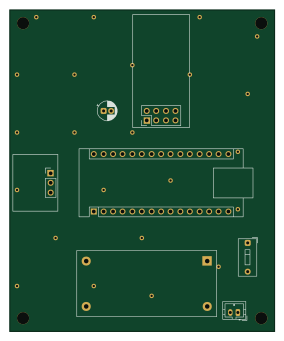
Similar boards
 AVR/Arduino
Magspoof
samyk
35 × 29 mm11 parts2LNo license4.2k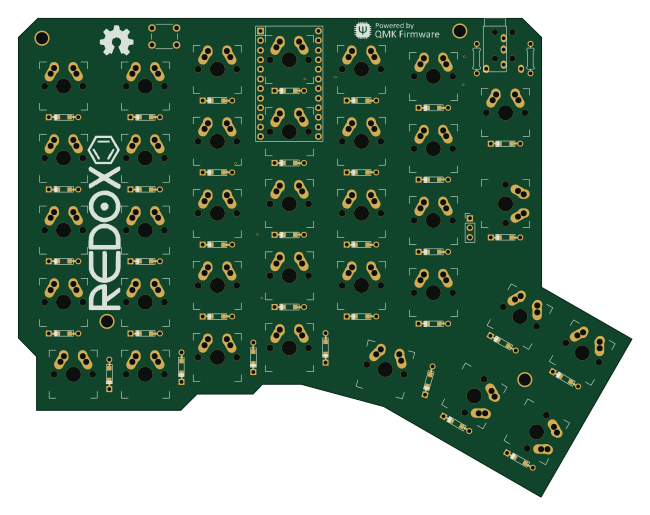 AVR/Arduino
Redox keyboard
mattdibi
162.2 × 126.5 mm77 parts2LMIT2.0k AVR/Arduino
Labrador
espotek-org
36.8 × 34.7 mm75 parts2LNo license1.2k AVR/Arduino
V4
stuartpittaway
30 × 50 mm38 parts2LCC-BY-NC-4.01.1k AVR/Arduino
ModuleV450
30 × 61.4 mm39 parts2LCC-BY-NC-4.01.1k AVR/Arduino
Discipline
coseyfannitutti
304.9 × 122.8 mm170 parts2LCC-BY-NC-4.01.0k