
FPGA-Accelerated-Personal-Health-Companion-Edge-Disaster-Monitor

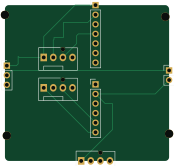
About the FPGA-Accelerated-Personal-Health-Companion-Edge-Disaster-Monitor PCB
FPGA-Accelerated-Personal-Health-Companion-Edge-Disaster-Monitor is an open source PCB design by novafang23, published on GitHub under the MIT license. It is a 2-layer board measuring 43.5 × 41.3 mm, with 7 components from 6 distinct parts.
By type, the board carries 6 connectors and 1 switch.
It belongs with the audio designs in this gallery.
From the project
An end-to-end heterogeneous System-on-Chip (SoC) combining synthesizable Verilog hardware acceleration and an on-device TinyML neural network to provide real-time, cloud-free physiological risk prediction during extreme environmental disasters (heat waves, air pollution smog, and floods).
RTL and synthesis evidence for the ShrikeFi target: an ESP32-S3 plus a Renesas ForgeFPGA (1120 five-input LUTs) connected by a 4-wire SPI link. The port is implemented — see docs/MIGRATION.md.
forgefpgappgtop.v instantiates movingaverage8tap and ppgpeakdetector from hardware/common/. It deliberately does not contain inline copies of them.
The Renesas toolchain needs one flat source set, which is the only reason duplication exists at all. That duplication is generated, not maintained by hand:
FPGA-Accelerated-Personal-Health-Companion-Edge-Disaster-Monitor bill of materials (BOM)
7 components, 6 distinct parts — part numbers from the project's BOM.
| Qty | Part | Footprint | Refs |
|---|---|---|---|
| 1 | USB4110-GF-A Conn_01x04_Pin GCT | FanPinHeader_1x04_P2.54mm_Vertical | J1 |
| 1 | Conn_01x07_Pin | PinHeader_1x07_P2.54mm_Vertical | J2 |
| 2 | Conn_01x04_Pin | FanPinHeader_1x04_P2.54mm_Vertical | J3, J5 |
| 1 | Conn_01x06_Pin | PinHeader_1x06_P2.54mm_Vertical | J4 |
| 1 | Conn_01x02_Pin | PinHeader_1x02_P2.54mm_Vertical | J6 |
| 1 | SW_SPDT | PinHeader_1x03_P2.54mm_Vertical | SW1 |
FPGA-Accelerated-Personal-Health-Companion-Edge-Disaster-Monitor design files
The KiCad project lives in the novafang23/FPGA-Accelerated-Personal-Health-Companion-Edge-Disaster-Monitor repository on GitHub; these links point at the commit this page was built from.
FPGA-Accelerated-Personal-Health-Companion-Edge-Disaster-Monitor: common questions
How big is the FPGA-Accelerated-Personal-Health-Companion-Edge-Disaster-Monitor PCB?
The FPGA-Accelerated-Personal-Health-Companion-Edge-Disaster-Monitor measures 43.5 × 41.3 mm, has 2 copper layers and is 1.6 mm thick.
How many components are on the FPGA-Accelerated-Personal-Health-Companion-Edge-Disaster-Monitor?
7 components, from 6 distinct parts, with part numbers taken from the project's own BOM. The full bill of materials is listed on this page.
Where can I download the FPGA-Accelerated-Personal-Health-Companion-Edge-Disaster-Monitor design files?
From the novafang23/FPGA-Accelerated-Personal-Health-Companion-Edge-Disaster-Monitor repository on GitHub, which has the KiCad layout, the schematic and the BOM; the links under Design files point to each one.
Can I use the FPGA-Accelerated-Personal-Health-Companion-Edge-Disaster-Monitor design in my own project?
Yes, under the terms of its MIT license, which novafang23 chose for the repository.
Similar boards
KLOR
GEIGEIGEIST
160.2 × 118.3 mm79 parts2LGPL-3.01.2k
ButtonsLEDs
shanteacontrols
390 × 37 mm82 parts2LApache-2.0956
USB
52 × 12.6 mm6 parts2LApache-2.0956
Pots
390 × 93 mm75 parts2LApache-2.0956
PicoGUS Hand386
polpo
29.2 × 75.2 mm43 parts4LGPL-2.0800
Snark barker
schlae
231.1 × 106.7 mm193 parts2LNo license687