
PiE team flag

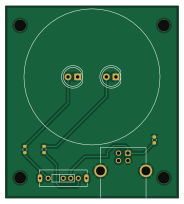
About the PiE team flag PCB
PiE team flag is an open source PCB design by pioneers, published on GitHub. It is a 2-layer board measuring 45.7 × 50.8 mm, with 7 components from 7 distinct parts.
By type, the board carries 2 LEDs, 2 resistors, 1 connector, 1 switch and 1 capacitor.
From the project
PiElectrical Work and Documentation
This is the working repo for PiElectrical teams
1. ToDo 2. Repo Structure 3. Setup 4. Work Flow 5. How to Create a Gerber 6. Docu Packets 7. FAQ 8. Useful Links 9. Standards
Boards: Contains all necessary information about each board, including KiCad (and old Eagle) files, arduino test files, and board specific documentation.
Bootloaders: Contains the files necessary to burn the bootloader for boards identifying as Leonardo (Atmega32u4).
PiE team flag bill of materials (BOM)
7 components, 7 distinct parts — part numbers from the project's BOM.
| Qty | Part | Footprint | Refs |
|---|---|---|---|
| 1 | USB_B | OST_USB-B1HSB6 | J1 |
| 1 | SW_SP3T | XKB Connectivity SS13D75L3 | SW1 |
| 1 | YEL | LED_D5.0mm | LED1 |
| 1 | BLU | LED_D5.0mm | LED2 |
| 1 | C2932475 .1uF | C_0603_1608Metric | C1 |
| 1 | C728625 145 | R_0603_1608Metric | R1 |
| 1 | C336845 90 | R_0603_1608Metric | R2 |
PiE team flag design files
The KiCad project lives in the pioneers/PiElectrical repository on GitHub; these links point at the commit this page was built from.
PiE team flag: common questions
How big is the PiE team flag PCB?
The PiE team flag measures 45.7 × 50.8 mm, has 2 copper layers and is 1.6 mm thick.
How many components are on the PiE team flag?
7 components, from 7 distinct parts, with part numbers taken from the project's own BOM. The full bill of materials is listed on this page.
Where can I download the PiE team flag design files?
From the pioneers/PiElectrical repository on GitHub, which has the KiCad layout, the schematic and the BOM; the links under Design files point to each one.
Can I use the PiE team flag design in my own project?
The repository has no license, so all rights stay with pioneers. Use it as a reference, and ask the author before reusing the design.
More boards in PiElectrical
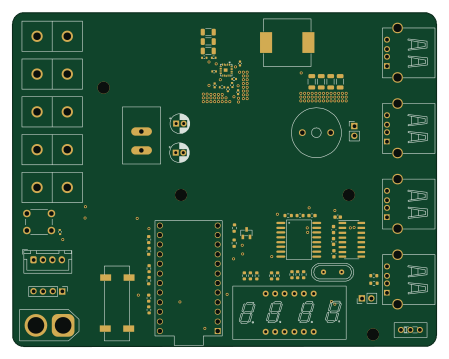
PDB
112.1 × 88.3 mm72 parts2LNo license8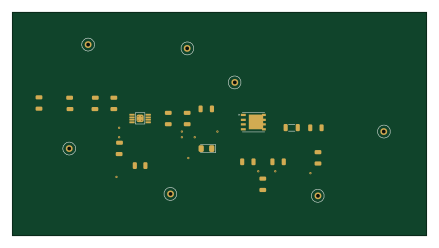
Gabesam board
109.5 × 59 mm25 parts2LNo license8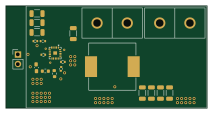
DC-DC converter v2
53.3 × 27 mm21 parts2LNo license8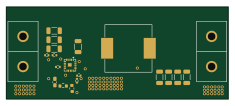
Test Board
58.8 × 24.5 mm20 parts2LNo license8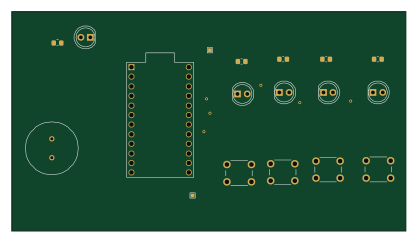
Simon Says
104.4 × 58.1 mm16 parts2LNo license8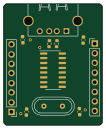
USBTTL
26 × 32 mm11 parts2LNo license8
Turbo
32.4 × 29.9 mm7 parts2LNo license8
Servocontrollerproject
40.3 × 52.4 mm5 parts2LNo license8
Ultrasonic
40.5 × 45.8 mm4 parts2LNo license8