
Wifire16

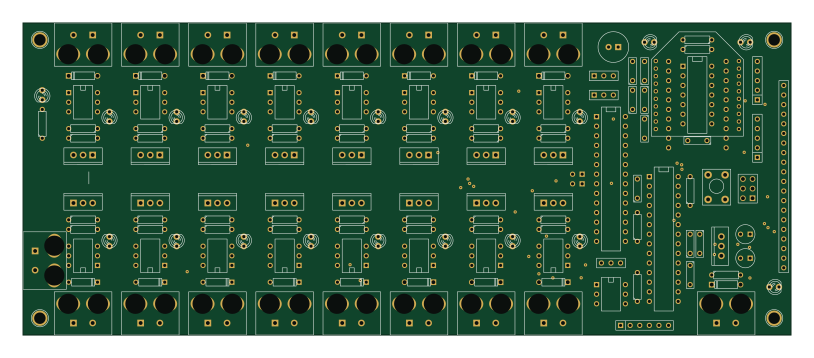
About the Wifire16 PCB
Wifire16 is an open source AVR/Arduino PCB design by propane-and-electrons, published on GitHub. It is a board measuring 203.2 × 82.6 mm, with 152 components from 59 distinct parts.
Its main chip is the ATMEGA328, from the AVR/Arduino family. Other key parts include the 4N35, TLC5940, MCP1700 3V3, 74AHC125 and LM7805. By type, the board carries 39 resistors, 27 connectors, 26 diodes, 23 ICs, 16 transistors and 13 capacitors.
It belongs with the iot & wireless designs in this gallery.
From the project
16 channel Arduino-compatible wireless SSR.
After I wired up 16 MOSFET + optoisolator circuits on perfboard for Flux and Fire, I swore I was never going to do it by hand again. When it came time to make a similar circuit for Super Street Fire, I decided the only option was to make a PCB to wirelessly control 16 flame effects. The end result: the wifire16 board.
Arduino compatible Programmable via 6-pin FTDI header or 6-pin ICSP header 16 PWM-capable DC load channels switched via MOSFET Wireless support with XBee or compatible radio, e.g. RN-XV WiFly All ATMega I/O pins are broken out on the board DC load power is optoisolated from the…
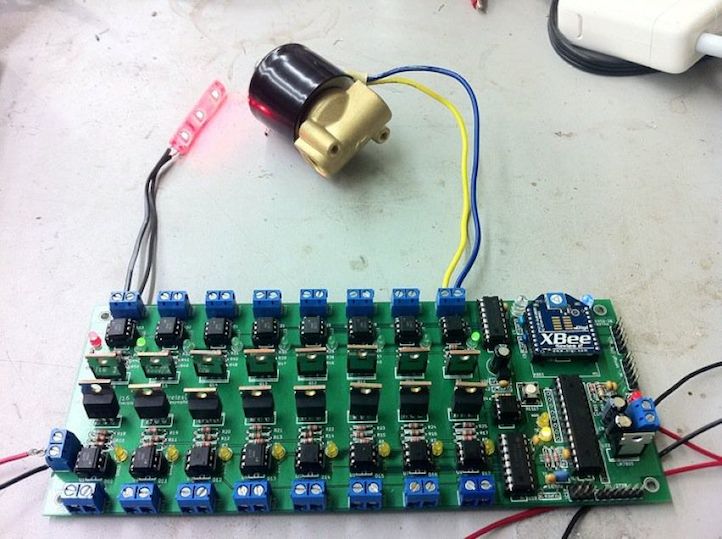
Main components on the Wifire16
Wifire16 bill of materials (BOM)
152 components, 59 distinct parts — part numbers from the project's BOM.
| Qty | Part | Footprint | Refs |
|---|---|---|---|
| 17 | 4N35 | DIP-6__300 | U1, U2, U3, U4, U5, U6, U7, U8 +9 |
| 1 | TLC5940 | DIP-28__300 | U18 |
| 1 | MCP1700 3V3 | SIL-3 | U19 |
| 1 | 74AHC125 | DIP-14__300 | U20 |
| 1 | LM7805 | 7805 | U21 |
| 1 | ATMEGA328 | DIP-28__300 | U22 |
| 1 | MCP1702 1V5 | SIL-3 | U23 |
| 16 | IRF510 | TO220GDS_VERT | Q1, Q2, Q3, Q4, Q5, Q6, Q7, Q8 +8 |
| 1 | 16MHz | SIL-3 | Y1 |
| 1 | SOL1 | PP-2H-5MMSCREWTERM | P1 |
| 1 | SOL2 | PP-2H-5MMSCREWTERM | P2 |
| 1 | SOL3 | PP-2H-5MMSCREWTERM | P3 |
| 1 | SOL4 | PP-2H-5MMSCREWTERM | P4 |
| 1 | SOL5 | PP-2H-5MMSCREWTERM | P5 |
| 1 | SOL6 | PP-2H-5MMSCREWTERM | P6 |
| 1 | SOL7 | PP-2H-5MMSCREWTERM | P7 |
| 1 | SOL8 | PP-2H-5MMSCREWTERM | P8 |
| 1 | SOL9 | PP-2H-5MMSCREWTERM | P9 |
| 1 | SOL10 | PP-2H-5MMSCREWTERM | P10 |
| 1 | SOL11 | PP-2H-5MMSCREWTERM | P11 |
Show 39 more
| Qty | Part | Footprint | Refs |
|---|---|---|---|
| 1 | SOL12 | PP-2H-5MMSCREWTERM | P12 |
| 1 | SOL13 | PP-2H-5MMSCREWTERM | P13 |
| 1 | SOL14 | PP-2H-5MMSCREWTERM | P14 |
| 1 | SOL15 | PP-2H-5MMSCREWTERM | P15 |
| 1 | SOL16 | PP-2H-5MMSCREWTERM | P16 |
| 1 | SOLPWR | PP-2H-5MMSCREWTERM | P17 |
| 1 | TLC IN | SIL-5 | P18 |
| 1 | TLC OUT | SIL-5 | P19 |
| 1 | TTL-232R | SIL-6 | P20 |
| 1 | ICSP | pin_array_3x2 | P21 |
| 1 | XBEE_1 | SIL-10 | P22 |
| 1 | XBEE_2 | SIL-10 | P23 |
| 1 | PORTC | SIL-6 | P24 |
| 1 | PORTD | SIL-8 | P25 |
| 1 | PORTB | SIL-6 | P26 |
| 1 | POWER | PP-2H-5MMSCREWTERM | P27 |
| 4 | SCREWHOLE | 1pin | H1, H2, H3, H4 |
| 1 | POWER | SIL-2 | JP1 |
| 1 | GROUND | SIL-2 | JP2 |
| 1 | RESET | SW-6MM-4PIN | SW1 |
| 17 | 1N4004 | D3 | D1, D3, D5, D7, D9, D11, D13, D15 +9 |
| 1 | SOL5 | LED-3MM | D10 |
| 1 | SOL6 | LED-3MM | D12 |
| 1 | SOL7 | LED-3MM | D14 |
| 1 | SOL8 | LED-3MM | D16 |
| 1 | SOL13 | LED-3MM | D26 |
| 1 | SOL14 | LED-3MM | D28 |
| 1 | SOL15 | LED-3MM | D30 |
| 1 | SOL16 | LED-3MM | D32 |
| 1 | SOLPWR | LED-3MM | D33 |
| 6 | 0.1uF | C2 | C1, C2, C3, C4, C6, C11 |
| 1 | 100uF | C1V8 | C5 |
| 3 | 1uF | C2 | C7, C12, C13 |
| 1 | 8.2pF | C2 | C8 |
| 2 | 47uF | C1V5 | C9, C10 |
| 17 | 10k | R3 | R1, R3, R5, R7, R9, R11, R13, R15 +9 |
| 20 | 1k | R3 | R2, R4, R6, R8, R10, R12, R14, R16 +12 |
| 1 | 2.2k | R3 | R33 |
| 1 | 4k | R3 | R35 |
Wifire16 design files
The KiCad project lives in the propane-and-electrons/wifire16 repository on GitHub; these links point at the commit this page was built from.
Wifire16: common questions
What microcontroller does the Wifire16 use?
The Wifire16 is built around the ATMEGA328, from the AVR/Arduino family.
How big is the Wifire16 PCB?
The Wifire16 measures 203.2 × 82.6 mm and is 1.6002 mm thick.
How many components are on the Wifire16?
152 components, from 59 distinct parts, with part numbers taken from the project's own BOM. The full bill of materials is listed on this page.
Where can I download the Wifire16 design files?
From the propane-and-electrons/wifire16 repository on GitHub, which has the KiCad layout and the BOM; the links under Design files point to each one.
Can I use the Wifire16 design in my own project?
The repository has no license, so all rights stay with propane-and-electrons. Use it as a reference, and ask the author before reusing the design.
Can I test firmware for the Wifire16 without the hardware?
Yes. HardLabs builds a simulation of the board from its netlist and BOM, so you can run and debug AVR/Arduino firmware against it before you order a PCB.
Similar boards
 AVR/Arduino
Magspoof
samyk
35 × 29 mm11 parts2LNo license4.2k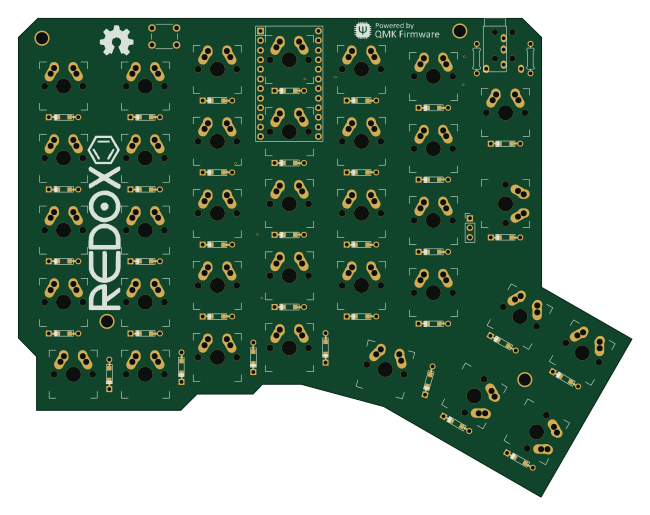 AVR/Arduino
Redox keyboard
mattdibi
162.2 × 126.5 mm77 parts2LMIT2.0k AVR/Arduino
Labrador
espotek-org
36.8 × 34.7 mm75 parts2LNo license1.2k AVR/Arduino
V4
stuartpittaway
30 × 50 mm38 parts2LCC-BY-NC-4.01.1k AVR/Arduino
ModuleV450
30 × 61.4 mm39 parts2LCC-BY-NC-4.01.1k AVR/Arduino
Discipline
coseyfannitutti
304.9 × 122.8 mm170 parts2LCC-BY-NC-4.01.0k