
Solar proa network server

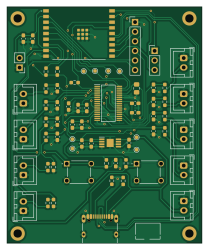
About the Solar proa network server PCB
Solar proa network server is an open source ESP32 PCB design by shipshape-marine, published on GitHub. It is a 2-layer board measuring 51.5 × 62.5 mm, with 59 components from 29 distinct parts.
Its main chip is the ESP32-C3-WROOM-02-H4, from the ESP32 family. Other key parts include the TLV76733DGNR and ADS8688. By type, the board carries 22 capacitors, 19 resistors, 13 connectors, 3 ICs and 2 switches.
It belongs with the power & battery, sensors and iot & wireless designs in this gallery.
From the project
ESP32 microcontrollers is chosed for its low cost, low power consumption, and ease of use. It is also widely supported by the Arduino IDE and has a large community for support.
ESP32 microcontrollers is chosed for its low cost, low power consumption, and ease of use. It is also widely supported by the Arduino IDE and has a large community for support.
In comparison: - Arduino: Low cost, low power consumption but large in size and limited in processing power. - STM32: Low cost, low power consumption, but requires more complex setup and programming. - Raspberry Pi: High processing power, but high cost and power consumption. Not suitable for low power applications.
Main components on the Solar proa network server
Solar proa network server bill of materials (BOM)
59 components, 29 distinct parts — part numbers from the project's BOM.
| Qty | Part | Footprint | Refs |
|---|---|---|---|
| 1 | TLV76733DGNR | SOP65P490X110-9N | IC1 |
| 1 | ESP32-C3-WROOM-02-H4 | ESP32C3WROOM02H4 | IC2 |
| 1 | ADS8688 | SOP50P640X120-38N | U3 |
| 1 | USB_C_RECEPTACLE_USB2.0_16P USB_C_Receptacle_USB2.0_16P | USB_C_Receptacle_XKB_U262-16XN-4BVC11 | J1 |
| 1 | GPIO | PinHeader_1x03_P2.54mm_Vertical | J2 |
| 1 | Exposed_UART | PinHeader_1x06_P2.54mm_Vertical | J6 |
| 1 | BATT1_V Batt1_V | JST_XH_B2B-XH-A_1x02_P2.50mm_Vertical | J7 |
| 1 | BATT2_V Batt2_V | JST_XH_B2B-XH-A_1x02_P2.50mm_Vertical | J8 |
| 1 | M_OUT/B1_IN M_OUT/B1_In | JST_XH_B2B-XH-A_1x02_P2.50mm_Vertical | J9 |
| 1 | L_I/B1_OUT L_I/B1_Out | JST_XH_B2B-XH-A_1x02_P2.50mm_Vertical | J10 |
| 1 | B1_NET/B2_IN B1_Net/B2_In | JST_XH_B2B-XH-A_1x02_P2.50mm_Vertical | J11 |
| 1 | B2_NET/B2_OUT B2_Net/B2_Out | JST_XH_B2B-XH-A_1x02_P2.50mm_Vertical | J12 |
| 1 | AIN_4 | JST_XH_B2B-XH-A_1x02_P2.50mm_Vertical | J13 |
| 1 | AIN_5 | JST_XH_B2B-XH-A_1x02_P2.50mm_Vertical | J14 |
| 1 | 5V_INPUT 5V_Input | JST_XH_B2B-XH-A_1x02_P2.50mm_Vertical | J15 |
| 1 | 3.3V_OUTPUT 3.3V_Output | PinHeader_1x02_P2.54mm_Vertical | J16 |
| 1 | BOOT_Btn | TS0266100BK100LCRD | SW1 |
| 1 | EN_Btn | TS0266100BK100LCRD | SW2 |
| 6 | 1UF 1uF YAGEO | C_0603_1608Metric_Pad1.08x0.95mm_HandSolder | C2, C4, C7, C9, C10, C13 |
| 1 | 4.7UF 4.7uF Samsung Electro-Mechanics | C_0603_1608Metric_Pad1.08x0.95mm_HandSolder | C3 |
Show 9 more
| Qty | Part | Footprint | Refs |
|---|---|---|---|
| 5 | 10UF 10uF FH(Guangdong Fenghua Advanced Tech) | C_0603_1608Metric_Pad1.08x0.95mm_HandSolder | C5, C8, C12, C20, C23 |
| 1 | 100NF 100nF YAGEO | C_0603_1608Metric_Pad1.08x0.95mm_HandSolder | C6 |
| 1 | 10UF 10uF FH(Guangdong Fenghua Advanced Tech) | C_0805_2012Metric_Pad1.18x1.45mm_HandSolder | C11 |
| 8 | 4.7NF 4.7nF | C_0603_1608Metric_Pad1.08x0.95mm_HandSolder | C14, C15, C16, C17, C18, C19, C21, C22 |
| 2 | 5.1KΩ UNI-ROYAL(Uniroyal Elec) | R_0603_1608Metric_Pad0.98x0.95mm_HandSolder | R2, R20 |
| 5 | 10kΩ UNI-ROYAL(Uniroyal Elec) | R_0603_1608Metric_Pad0.98x0.95mm_HandSolder | R3, R4, R5, R6, R7 |
| 8 | 1kΩ UNI-ROYAL(Uniroyal Elec) | R_0603_1608Metric_Pad0.98x0.95mm_HandSolder | R8, R9, R10, R11, R12, R13, R14, R15 |
| 2 | 100kΩ UNI-ROYAL(Uniroyal Elec) | R_0603_1608Metric_Pad0.98x0.95mm_HandSolder | R16, R18 |
| 2 | 20kΩ UNI-ROYAL(Uniroyal Elec) | R_0603_1608Metric_Pad0.98x0.95mm_HandSolder | R17, R19 |
Solar proa network server design files
The KiCad project lives in the shipshape-marine/solar_proa_network_server repository on GitHub; these links point at the commit this page was built from.
- LayoutHardware Schematics/Electrical Schematics/ADC Power Sensor Design/Sensor Reader V4/Sensor Reader V4.kicad_pcb
- SchematicHardware Schematics/Electrical Schematics/ADC Power Sensor Design/Sensor Reader V4/Sensor Reader V4.kicad_sch
- BOMHardware Schematics/Electrical Schematics/ADC Power Sensor Design/Sensor Reader V4/jlcpcb/production_files/BOM-Sensor Reader V4.csv
Solar proa network server: common questions
What microcontroller does the Solar proa network server use?
The Solar proa network server is built around the ESP32-C3-WROOM-02-H4, from the ESP32 family.
How big is the Solar proa network server PCB?
The Solar proa network server measures 51.5 × 62.5 mm, has 2 copper layers and is 1.6 mm thick.
How many components are on the Solar proa network server?
59 components, from 29 distinct parts, with part numbers taken from the project's own BOM. The full bill of materials is listed on this page.
Where can I download the Solar proa network server design files?
From the shipshape-marine/solar_proa_network_server repository on GitHub, which has the KiCad layout, the schematic and the BOM; the links under Design files point to each one.
Can I use the Solar proa network server design in my own project?
The repository has no license, so all rights stay with shipshape-marine. Use it as a reference, and ask the author before reusing the design.
Can I test firmware for the Solar proa network server without the hardware?
Yes. HardLabs builds a simulation of the board from its netlist and BOM, so you can run and debug ESP32 firmware against it before you order a PCB.
Similar boards
 ESP32
ESP32Open Book Abridged Edition
joeycastillo
85 × 115 mm65 parts2LCC-BY-SA-4.08.1k ESP32
ESP32Powertrain
byrantech
64 × 45.4 mm171 parts4LMIT4.3k ESP32
ESP32Esp32 minimal
atopile
36.2 × 26.8 mm20 parts2LMIT4.0k ESP32
ESP32Badge
56.3 × 39 mm239 parts4LMIT4.0k ESP32
ESP32Controller
StuckAtPrototype
29 × 74 mm58 parts4LApache-2.03.8k ESP32
ESP32Racer
36 × 50.2 mm70 parts4LApache-2.03.8k