
Robo

About the Robo PCB
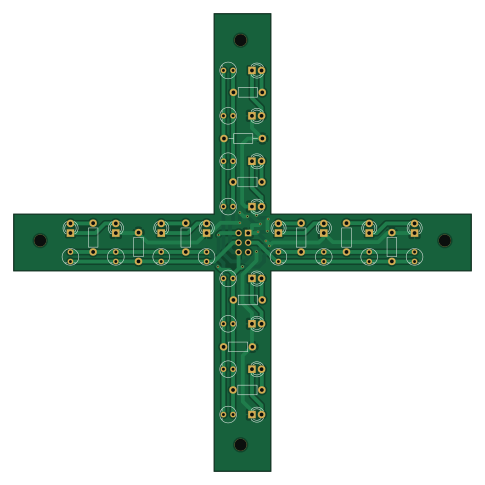
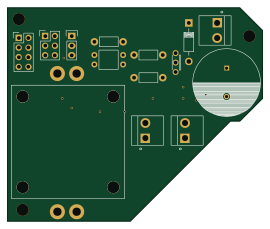
Robo is an open source PCB design by takeyamayuki, published on GitHub under the MIT license. It is a 2-layer board measuring 121 × 121 mm, with 45 components from 6 distinct parts.
By type, the board carries 16 transistors, 16 diodes, 12 resistors and 1 connector.
It belongs with the robotics & motion designs in this gallery.
From the project
Board data of Team NTK that participated in the RoboCup Junior 2017 Kanto Tournament
ロボットの動作状況は以下のYoutube再生リストから確認できます。 https://www.youtube.com/playlist?list=PLkEBRGnKNUILFJv4zKvQkQi69NoT-_FYg
Robo bill of materials (BOM)
45 components, 6 distinct parts.
| Qty | Part | Footprint | Refs |
|---|---|---|---|
| 16 | NJL7502L | NJL7502 | Q1, Q2, Q3, Q4, Q5, Q6, Q7, Q8 +8 |
| 1 | CONN_01X06 | Pin_Header_Straight_2x03 | P7 |
| 16 | LED | LED-3MM | D2, D3, D4, D5, D6, D7, D8, D9 +8 |
| 1 | 10k | Resistor_Horizontal_RM10mm | R19 |
| 8 | 51 | Resistor_Horizontal_RM7mm | R20, R21, R23, R24, R26, R27, R29, R30 |
| 3 | 10k | Resistor_Horizontal_RM7mm | R22, R25, R28 |
Robo design files
The KiCad project lives in the takeyamayuki/RCJ_Kanto_Soccer2017_Board repository on GitHub; these links point at the commit this page was built from.
- Layoutrobo.kicad_pcb
Robo: common questions
How big is the Robo PCB?
The Robo measures 121 × 121 mm, has 2 copper layers and is 1.6 mm thick.
How many components are on the Robo?
45 components, from 6 distinct parts. The full bill of materials is listed on this page.
Where can I download the Robo design files?
From the takeyamayuki/RCJ_Kanto_Soccer2017_Board repository on GitHub, which has the KiCad layout; the links under Design files point to each one.
Can I use the Robo design in my own project?
Yes, under the terms of its MIT license, which takeyamayuki chose for the repository.
More boards in RCJ_Kanto_Soccer2017_Board
Similar boards
Stack chan
stack-chan
50 × 50 mm33 parts2LApache-2.01.7k
Cube batteryboard
willem-pennings
95 × 95 mm4 parts2LGPL-3.01.1k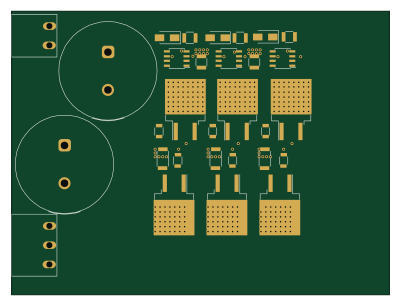
Trollerv2
rene-dev
100 × 75 mm33 parts4LGPL-3.0979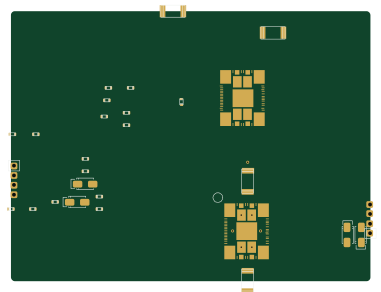
Powerstep
95.2 × 71.5 mm28 parts4LGPL-3.0979
11ua
57.3 × 19 mm26 parts2LGPL-3.0979
Diff driver
32 × 22 mm14 parts2LGPL-3.0979