
Zulu A7

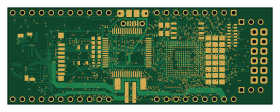
About the Zulu A7 PCB
Zulu A7 is an open source FPGA PCB design by tambechristian, published on GitHub under the Custom license license. It is a 6-layer board measuring 69.9 × 25.4 mm, with 177 components from 65 distinct parts.
Its main chip is the XC7A35T-2CPG236I, from the FPGA family. Other key parts include the FT2232HL USB-UART/JTAG Bridge, AS4C32M16SB-7TCN, W25Q128JVSIQ, SC189ZSKTRT and SC189LSKTRT. By type, the board carries 86 capacitors, 57 resistors, 13 ICs, 7 inductors, 5 LEDs and 4 crystals.
It belongs with the power & battery and usb & debug tools designs in this gallery.
From the project
Zulu A7 is a USB FPGA board built around an AMD/Xilinx Artix-7 XC7A35T-2CPG236I. An FTDI FT2232HL bridge provides JTAG (channel A) and a UART (channel B) over one micro-USB port. The board carries 64 MB of SDRAM, a 128 Mbit quad-SPI configuration flash, a microSD socket, a Pmod h
Zulu A7 is a USB FPGA board built around an AMD/Xilinx Artix-7 XC7A35T-2CPG236I. An FTDI FT2232HL bridge provides JTAG (channel A) and a UART (channel B) over one micro-USB port. The board carries 64 MB of SDRAM, a 128 Mbit quad-SPI configuration flash, a microSD socket, a Pmod host header and a 40-pin breadboard header. It runs from USB through a single-cell LiPo charger with power path and three buck regulators (3.3 V, 1.8 V and 1.0 V). The PCB is a 69.85 x 25.40 mm, six-layer HDI board.
Main components on the Zulu A7
Zulu A7 bill of materials (BOM)
177 components, 65 distinct parts — part numbers from the project's BOM.
| Qty | Part | Footprint | Refs |
|---|---|---|---|
| 1 | XC7A35T-2CPG236I AMD/Xilinx | XC7A35T-CPG236 | U1 |
| 1 | FT2232HL USB-UART/JTAG Bridge FTDI | FT2232HL-LQFP64 | U2 |
| 1 | AS4C32M16SB-7TCN Alliance Memory | TSOPII-54 | U3 |
| 1 | W25Q128JVSIQ Winbond | SOIC-8_208MIL | U4 |
| 1 | SC189ZSKTRT Semtech | SOT23-5 | U5 |
| 1 | SC189LSKTRT Semtech | SOT23-5 | U6 |
| 1 | SC189ASKTRT Semtech | SOT23-5 | U7 |
| 1 | BQ24232 LiPo charger + power path Texas Instruments | VQFN16-3X3-RGT | U8 |
| 1 | 93LC46BT-I/SN Microchip | SPI-8_SOIC_150 | U10 |
| 1 | CC_CC | CC_CC | U$2 |
| 1 | CC_BY | CC_BY | U$3 |
| 1 | CC_SA | CC_SA | U$4 |
| 1 | CC_COPYRIGHT | CC_COPYRIGHT | U$5 |
| 1 | 12MHz 10ppm (FPGA + FT2232HL) ECS | 32X25 | Q1 |
| 1 | Molex 105017-0001 Micro-USB-B Molex | MOLEX-105017-0001 | X1 |
| 1 | ZULU-CONN Sullins | ZULU-DIP37 | X2 |
| 1 | DM3D-SF Hirose | DM3D-SF | X3 |
| 1 | JST PH 2-pin, 1S LiPo JST | JST-B2B-PH-SM4-TB | X4 |
| 1 | Pmod 2x6 Sullins | 2X06 | J1 |
| 1 | JTAG TCK/TMS/GND | 1X03-NOSILK | JP3 |
Show 45 more
| Qty | Part | Footprint | Refs |
|---|---|---|---|
| 1 | JTAG TDI/TDO/3V3 | 1X03-NOSILK | JP4 |
| 1 | 19-337/R6GHBHC-A01/2T Everlight | EVERLIGHT-19-337 | LD0 |
| 3 | red Lite-On | LED0603 | LD1, LD2, LD4 |
| 2 | green Lite-On | LED0603 | LD3, LD5 |
| 3 | 1.5UH 1.5uH Murata | IND2520 | L1, L2, L3 |
| 4 | FB 600R Murata | IND0603 | L4, L5, L6, L7 |
| 9 | 0.1UF 0.1uF Murata | C0402 | C3, C4, C5, C6, C7, C8, C9, C11 +1 |
| 1 | 10UF 10uF Murata | C0603 | C13 |
| 2 | 1NF 1nF Murata | C0402 | C36, C37 |
| 1 | 0.01UF 0.01uF Murata | C0201 | C38 |
| 3 | 100nF Murata | C0201 | C40, C41, C123 |
| 1 | 10uF 10V Samsung | C0805 | C78 |
| 13 | 22UF 22uF Murata | C0805 | C80, C85, C86, C93, C97, C98, C140, C141 +5 |
| 2 | 22UF 22uF Samsung | C0603 | C82, C84 |
| 13 | 4.7UF 4.7uF Murata | C0603 | C87, C88, C94, C99, C100, C101, C102, C103 +5 |
| 22 | 0.47UF 0.47uF Murata | C0201 | C89, C90, C91, C92, C95, C96, C107, C108 +14 |
| 1 | 470NF 470nF Samsung | C0402 | C124 |
| 14 | 0.1uF Murata | C0201 | C133, C134, C135, C136, C137, C138, C152, C153 +6 |
| 1 | 4.7UF 4.7uF Taiyo Yuden | C0402 | C139 |
| 3 | 10uF Samsung | C0805 | C147, C148, C149 |
| 1 | 4.7K CTS | 742C043 | R1 |
| 4 | 4.7K Yageo | R0201 | R2, R6, R7, R99 |
| 1 | 100 CTS | 742C163 | R4 |
| 1 | 5.1K Yageo | R0201 | R5 |
| 2 | 2.32K Yageo | R0201 | R10, R14 |
| 5 | 1K Yageo | R0201 | R11, R15, R20, R22, R23 |
| 2 | 140 Yageo | R0201 | R12, R16 |
| 2 | 845 Yageo | R0201 | R13, R17 |
| 1 | 12K 1% Yageo | R0402 | R18 |
| 9 | 10K Yageo | R0201 | R19, R90, R91, R92, R93, R94, R96, R97 +1 |
| 1 | 1K Yageo | R0402 | R21 |
| 2 | 33 Yageo | R0201 | R24, R25 |
| 8 | 200 Yageo | R0201 | R26, R27, R28, R29, R30, R31, R32, R33 |
| 1 | 4.7K CTS | 742C083 | R34 |
| 1 | 4.7K Yageo | R0402 | R35 |
| 1 | 680 Yageo | R0402 | R78 |
| 2 | 33 Yageo | R0402 | R80, R82 |
| 3 | 330 Yageo | R0402 | R81, R83, R84 |
| 3 | 10K Yageo | R0402 | R85, R86, R106 |
| 1 | 2.21K 2.21k Yageo | R0201 | R101 |
| 1 | 3.57K Yageo | R0402 | R102 |
| 1 | 3.09K Yageo | R0402 | R103 |
| 1 | 56.2K Yageo | R0402 | R104 |
| 1 | 4.32K Yageo | R0402 | R105 |
| 2 | 1.5K Yageo | R0402 | R107, R108 |
Zulu A7 design files
The KiCad project lives in the tambechristian/Zulu_A7 repository on GitHub; these links point at the commit this page was built from.
Zulu A7: common questions
What microcontroller does the Zulu A7 use?
The Zulu A7 is built around the XC7A35T-2CPG236I, from the FPGA family.
How big is the Zulu A7 PCB?
The Zulu A7 measures 69.9 × 25.4 mm, has 6 copper layers and is 1.588 mm thick.
How many components are on the Zulu A7?
177 components, from 65 distinct parts, with part numbers taken from the project's own BOM. The full bill of materials is listed on this page.
Where can I download the Zulu A7 design files?
From the tambechristian/Zulu_A7 repository on GitHub, which has the KiCad layout, the schematic and the BOM; the links under Design files point to each one.
Can I use the Zulu A7 design in my own project?
It is published under Custom license, which limits how it may be reused; read the license before building on it.
Can I test firmware for the Zulu A7 without the hardware?
Yes. HardLabs builds a simulation of the board from its netlist and BOM, so you can run and debug FPGA firmware against it before you order a PCB.
Similar boards
 FPGA
Base board
GlasgowEmbedded
80 × 49 mm222 parts4L0BSD2.2k FPGA
Thunderscope Rev5.3
EEVengers
122.5 × 103.5 mm817 parts6LMIT1.3k FPGA
Usb sniffer
ataradov
58.2 × 38.1 mm86 parts2LBSD-3-Clause1.3k FPGA
Tomu, I'm
theacodes
13 × 9.4 mm40 parts4LMIT1.1k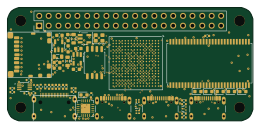 FPGA
Icepi zero
cheyao
65 × 30 mm143 parts4LSHL-2.1865 FPGA
Gcvideo
ikorb
49 × 30 mm44 parts4LNo license765