
Plume

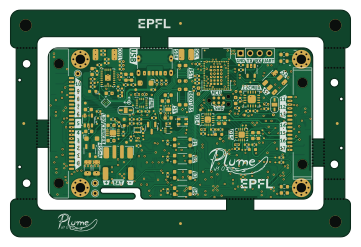
About the Plume PCB
Plume is an open source STM32 PCB design by theohg, published on GitHub. It is a 8-layer board measuring 90 × 60 mm, with 257 components from 51 distinct parts.
Its main chip is the STM32WB5MMGH6TR, from the STM32 family. Other key parts include the SN74AHCT1G125DRLR, REG71050DRVR, DRV8214RTER, BQ29737DSER and MCP73831T-2ACI/MC. By type, the board carries 100 capacitors, 92 resistors, 28 ICs, 20 LEDs, 7 switches and 4 transistors.
It belongs with the iot & wireless, power & battery and sensors designs in this gallery.
From the project
KiCad design files and STM32/ESP32 firmware for the Plume project.
Plume was designed by Théo Heng for the Integrated Actuators Laboratory (LAI) in the context of a master semester project. The goal is to develop a microcontroller-based system to independently control a motor array in a reconfigurable insole designed for patients with diabetes, redistributing plantar pressure without the use of position sensors.
This board is capable to drive and control in position up to 18 Brushed DC motors total and up to 9 simultaneously, without position sensors. This is achieved thanks to the ripple counting technique, integrated in the DRV8214 drivers.

Main components on the Plume
Plume bill of materials (BOM)
257 components, 51 distinct parts — part numbers from the project's BOM.
| Qty | Part | Footprint | Refs |
|---|---|---|---|
| 1 | SN74AHCT1G125DRLR Texas Instruments | SOT-553 | IC901 |
| 1 | REG71050DRVR Texas Instruments | WSON-6-1EP_2x2mm_P0.65mm_EP1x1.6mm | IC902 |
| 18 | DRV8214RTER Texas Instruments | WQFN-16-1EP_3x3mm_P0.5mm_EP1.68x1.68mm_ThermalVias | IC1201, IC1301, IC1401, IC1501, IC1601, IC1701, IC1801, IC1901 +10 |
| 1 | STM32WB5MMGH6TR STMicroelectronics | ST-SiP-LGA-86-11x7.3mm | U401 |
| 1 | BQ29737DSER Texas Instruments | WSON-6_1.5x1.5mm_P0.5mm | U501 |
| 1 | MCP73831T-2ACI/MC Microchip Technology | DFN_2x3mm | U502 |
| 1 | BQ51013CQWRHLRQ1 Texas Instruments | Texas_VQFN-RHL-20 | U601 |
| 1 | TPS3839G33DQNR Texas Instruments | Texas_X2SON-4_1x1mm_P0.65mm | U701 |
| 1 | TPS7A0233DBVR Texas Instruments | SOT-23-5-TEXAS | U702 |
| 1 | PCA9546ARGVR Texas Instruments | Texas_RSA_VQFN-16-1EP_4x4mm_P0.65mm_EP2.16x2.16mm | U801 |
| 1 | BMI270 Bosch Sensortec | Bosch_LGA-14_3x2.5mm_P0.5mm | U1001 |
| 1 | IRLML6344TRPBF NMOS IRLML6344TRPBF SOT-23 Infineon Technologies | SOT-23 | Q501 |
| 1 | CSD85302L Texas Instruments | CSD85302L | Q502 |
| 1 | CSD75207W15 Texas Instruments | Texas_DSBGA-9_1.62x1.58mm_Layout3x3_P0.5mm | Q601 |
| 1 | SI2365EDS-T1-GE3 PMOS SI2365EDS-T1-GE3 Vishay Semiconductors | SOT-23-3 | Q701 |
| 1 | S2B-PH-SM4-TB(LF)(SN) S2B-PH-SM4-TB JST Commercial | CONN_S2B-PH-SM4-TB_JST | J502 |
| 1 | USB4125-GF-A USB_C_Receptacle_PowerOnly_6P GCT | USB4125-GF-A | J602 |
| 6 | KMR232NG ULC LFS KMR232NG ULC C&K | SW_KMR232NGULCLFS | SW401, SW402, SW404, SW405, SW406, SW407 |
| 1 | CAS-D20TA1 CAS-D20A1 Nidec Components | CAS-D2xx | SW403 |
| 2 | APT1608CGCK GREEN Kingbright | LED_0603_KingBright | LED501, LED601 |
Show 31 more
| Qty | Part | Footprint | Refs |
|---|---|---|---|
| 18 | APTD1608LQBC/D BLUE Kingbright | LED_0603_KingBright | LED1201, LED1301, LED1401, LED1501, LED1601, LED1701, LED1801, LED1901 +10 |
| 1 | ESDS314DBVR ESDS314 Texas Instruments | SOT-23-5-TEXAS | D401 |
| 1 | SMF5.0A TVS SMF5.0A Littelfuse | D_SOD-123FL | D601 |
| 1 | PMEG60T20ELRX Schottky 1N5819W Nexperia | Nexperia_CFP3_SOD-123W | D701 |
| 1 | IN-PI22TAT5R5G5B Inolux | INPI22TAT5R5G5B | D901 |
| 35 | CL05B104KO5VPNC 100n X7R 16V Samsung Electro-Mechanics | C_0402_1005Metric | C401, C402, C407, C408, C409, C410, C504, C505 +27 |
| 3 | GRM188Z71C475KE21D 4u7 X7R 16V Murata Electronics | C_0603_1608Metric | C403, C503, C506 |
| 2 | MSASE31LBB5476MTNA01 47u X5R 16V TAIYO YUDEN | C_1206_3216Metric | C501, C502 |
| 23 | GRM188R61C106MAALD 10u X5R 16V Murata Electronics | C_0603_1608Metric | C602, C617, C618, C702, C703, C1201, C1301, C1401 +15 |
| 2 | CGA3E1X7R1C105K080AC 1u X7R 16V TDK | C_0603_1608Metric | C603, C802 |
| 3 | GRM1555C1E103JE01J 10n C0G 25V Murata Electronics | C_0402_1005Metric | C606, C609, C615 |
| 2 | GRT155R61E474KE01D 470n X5R 25V Murata Electronics | C_0402_1005Metric | C607, C613 |
| 2 | GCM155R71E223KA55D 22n X7R 25V Murata Electronics | C_0402_1005Metric | C608, C614 |
| 1 | CGA2B3X7R1E154K050BB 150n X7R 25V TDK | C_0402_1005Metric | C610 |
| 1 | TMF105B7222KVHF 2n2 X7R 25V TAIYO YUDEN | C_0402_1005Metric | C611 |
| 1 | VJ0402Y391JXXCW1BC 390pF X7R 25V Vishay / Vitramon | C_0402_1005Metric | C612 |
| 1 | CGA3E2X7R1C224K080AA 220n X7R 16V TDK | C_0603_1608Metric | C901 |
| 2 | GRM188Z71C225KE43D 2u2 X7R 16V Murata Electronics | C_0603_1608Metric | C902, C904 |
| 18 | C0603C104J5RACAUTO 100n X7R 50V KEMET | C_0603_1608Metric | C1202, C1302, C1402, C1502, C1602, C1702, C1802, C1902 +10 |
| 4 | C0603C102KDRACTU 1n X7R 1kV KEMET | C_0603_1608Metric | C3001, C3002, C3003, C3004 |
| 22 | RK73H1ETTP3300F 330R 1% KOA Speer | R_0402_1005Metric | R401, R501, R505, R601, R1202, R1302, R1402, R1502 +14 |
| 5 | RK73H1ETTPB1002F 10k 1% KOA Speer | R_0402_1005Metric | R402, R503, R605, R606, R608 |
| 2 | RK73H1ETTP22R0F 22R 1% KOA Speer | R_0402_1005Metric | R403, R405 |
| 24 | ERJ-2RKF1003X 100k 1% Panasonic | R_0402_1005Metric | R404, R406, R509, R701, R801, R901, R1203, R1303 +16 |
| 9 | RK73H1ETTP3001F 3k 1% KOA Speer | R_0402_1005Metric | R502, R802, R803, R804, R805, R806, R807, R1001 +1 |
| 2 | RK73H1ETTP2201F 2k2 1% KOA Speer | R_0402_1005Metric | R504, R508 |
| 2 | RK73H1ETTP4994F 4M99 1% KOA Speer | R_0402_1005Metric | R506, R507 |
| 2 | RK73H1ETTP5101F 5k1 1% KOA Speer | R_0402_1005Metric | R602, R603 |
| 2 | CRCW0402196RFKED 196R 1% Vishay / Dale | R_0402_1005Metric | R604, R607 |
| 18 | CRCW0402680RFKEDC 680R 1% Vishay / Dale | R_0402_1005Metric | R1201, R1301, R1401, R1501, R1601, R1701, R1801, R1901 +10 |
| 4 | RC0603FR-100RL 0R 1% YAGEO | R_0603_1608Metric | R3001, R3002, R3003, R3004 |
Plume design files
The KiCad project lives in the theohg/Plume repository on GitHub; these links point at the commit this page was built from.
- LayoutPlume.kicad_pcb
- SchematicPlume.kicad_sch
- BOMManufacturing/Assembly/Plume_bom_1.0.csv
Plume: common questions
What microcontroller does the Plume use?
The Plume is built around the STM32WB5MMGH6TR, from the STM32 family.
How big is the Plume PCB?
The Plume measures 90 × 60 mm, has 8 copper layers and is 1.694 mm thick.
How many components are on the Plume?
257 components, from 51 distinct parts, with part numbers taken from the project's own BOM. The full bill of materials is listed on this page.
Where can I download the Plume design files?
From the theohg/Plume repository on GitHub, which has the KiCad layout, the schematic and the BOM; the links under Design files point to each one.
Can I use the Plume design in my own project?
The repository has no license, so all rights stay with theohg. Use it as a reference, and ask the author before reusing the design.
Can I test firmware for the Plume without the hardware?
Yes. HardLabs builds a simulation of the board from its netlist and BOM, so you can run and debug STM32 firmware against it before you order a PCB.
Similar boards
 STM32
LumenPnP Motherboard
opulo-inc
149 × 95 mm296 parts4LCC-BY-SA-4.03.7k STM32
Type g
google
169 × 30 mm24 parts2LApache-2.02.9k STM32
Base
52.3 × 52.3 mm36 parts2LApache-2.02.9k STM32
Main panel
234 × 84 mm26 parts4LApache-2.02.9k STM32
Type a
150 × 30 mm14 parts2LApache-2.02.9k STM32
Type c
188 × 30 mm17 parts2LApache-2.02.9k