
Avionics final 260706

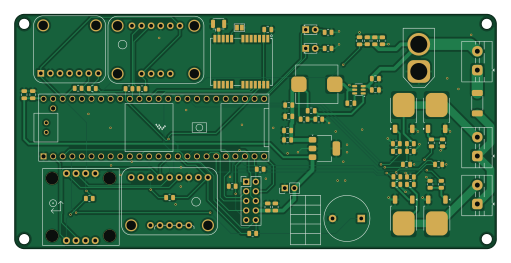
About the Avionics final 260706 PCB
Avionics final 260706 is an open source NXP PCB design by TUSI-KHU, published on GitHub under the Apache-2.0 license. It is a 2-layer board measuring 127.5 × 62 mm, with 67 components from 40 distinct parts.
Its main chip is the TEENSY4.1, from the NXP family. Other key parts include the 4692, SEN-14480, 1893, 4479 and NEO-M9N-00B. By type, the board carries 27 resistors, 16 capacitors, 8 ICs, 4 transistors, 2 connectors and 2 diodes.
It belongs with the rf & radio, sensors and robotics & motion designs in this gallery.
From the project
Embedded flight controller for the 2026 NURA competition.
Teensy 4.1 flight-computer firmware for the 2026 NURA rocket avionics stack.
The current codebase is built around a small cooperative scheduler, explicit state stores, hardware abstraction layers, and a lightweight LoRa telemetry/control protocol. It is still an active integration project: sensor acquisition, LoRa protocol work, mock telemetry, and ground-side receiver tests are in the repository, while flight rules, logging outputs, and final hardware validation are still being tightened.
Main components on the Avionics final 260706
Avionics final 260706 bill of materials (BOM)
67 components, 40 distinct parts — part numbers from the project's BOM.
| Qty | Part | Footprint | Refs |
|---|---|---|---|
| 1 | 4692 Adafruit_LSM6DSO32 Adafruit | LSM6DSOX | U1 |
| 1 | SEN-14480 Sparkfun_H3LIS331DL SparkFun | Sparkfun_H3LIS331DL | U2 |
| 1 | 1893 Adafruit_MPC3315A2 Adafruit | Adafruit_MPC3315A2 | U3 |
| 1 | TEENSY4.1 Teensy4.1 PJRC / SparkFun | Teensy41 | U4 |
| 1 | 4479 LIS3MDL Adafruit | Adafruit_LIS3MDL | U5 |
| 1 | NEO-M9N-00B U-BLOX | GPSM-SMD_24P-L16.0-W12.2-P1.10-BL | U6 |
| 1 | MCP1825S-5002E/AB MCP1826S-5002 Microchip Technology | SOT-223-3_TabPin2 | U8 |
| 1 | AP63200WU-7 Diodes Incorporated | TSOT-23-6 | U9 |
| 4 | IRLR8726 TECH PUBLIC | TO-252-2 | Q1, Q2, Q3, Q4 |
| 1 | U.FL-R-SMT-1(10) HRS / Hirose | U.FL_Hirose_U.FL-R-SMT-1_Vertical | J1 |
| 1 | Conn_LoRA | PinHeader_2x05_P2.54mm_Vertical | J3 |
| 1 | Buzzer TBD | Buzzer_12x9.5RM7.6 | BZ1 |
| 1 | 0453005.MR 5A Littelfuse | Fuse_2410_6127Metric | F1 |
| 1 | GPS_RST N/A | SolderJumper-2_P1.3mm_Open_Pad1.0x1.5mm | JP1 |
| 1 | XT60 | AMASS_XT60-F_1x02_P7.20mm_Vertical | J_POWER1 |
| 2 | IGNITER_5R6 | TerminalBlock_MaiXu_MX126-5.0-02P_1x02_P5.00mm | J_PYRO1, J_PYRO2 |
| 1 | ARM MaiXu / equivalent | TerminalBlock_MaiXu_MX126-5.0-02P_1x02_P5.00mm | SW1 |
| 1 | WP710A10ID LED Kingbright | LED_D1.8mm_W3.3mm_H2.4mm | D1 |
| 1 | WP710A10SGD LED Kingbright | LED_D1.8mm_W3.3mm_H2.4mm | D2 |
| 1 | FXL1050-100-M 10uH cjiang / Changjiang Microelectronics | L_Changjiang_FXL1050 | L1 |
Show 20 more
| Qty | Part | Footprint | Refs |
|---|---|---|---|
| 1 | CL21B105KBFNNNE 1u Samsung Electro-Mechanics | C_0805_2012Metric | C1 |
| 7 | CC0805KRX7R9BB104 100n YAGEO | C_0805_2012Metric | C4, C6, C7, C9, C11, C15, C21 |
| 1 | CL21C101JBANNNC 100p Samsung Electro-Mechanics | C_0805_2012Metric | C5 |
| 1 | CL21A106KAYNNNE 10u Samsung Electro-Mechanics | C_0805_2012Metric | C8 |
| 4 | CL21A226MAQNNNE 22u Samsung Electro-Mechanics | C_0805_2012Metric | C10, C12, C13, C14 |
| 1 | 100n | C_0805_2012Metric | C30 |
| 1 | 10u | C_0805_2012Metric | C31 |
| 2 | 0805W8F3303T5E 330k UNI-ROYAL | R_0805_2012Metric | R3, R15 |
| 2 | 0805W8F6802T5E 68k UNI-ROYAL | R_0805_2012Metric | R4, R16 |
| 1 | 0805W8F1803T5E 180k UNI-ROYAL | R_0805_2012Metric | R5 |
| 4 | 0805W8F1000T5E 100 UNI-ROYAL | R_0805_2012Metric | R6, R9, R17, R19 |
| 4 | 0805W8F1003T5E 100k UNI-ROYAL | R_0805_2012Metric | R7, R10, R18, R20 |
| 1 | 0805W8F3002T5E 30k UNI-ROYAL | R_0805_2012Metric | R8 |
| 1 | 0805W8F1503T5E 150k UNI-ROYAL | R_0805_2012Metric | R11 |
| 1 | 0805W8F1001T5E 1k UNI-ROYAL | R_0805_2012Metric | R12 |
| 1 | 0805W8F3302T5E 33k UNI-ROYAL | R_0805_2012Metric | R14 |
| 4 | 0805W8F4701T5E 4.7k UNI-ROYAL | R_0805_2012Metric | R21, R22, R23, R24 |
| 2 | 0805W8F2200T5E 220 UNI-ROYAL | R_0805_2012Metric | R25, R26 |
| 3 | 4.7k | R_0805_2012Metric | R27, R28, R29 |
| 1 | 100k | R_0805_2012Metric | R30 |
Avionics final 260706 design files
The KiCad project lives in the TUSI-KHU/2026-nura-avionics repository on GitHub; these links point at the commit this page was built from.
Avionics final 260706: common questions
What microcontroller does the Avionics final 260706 use?
The Avionics final 260706 is built around the TEENSY4.1, from the NXP family.
How big is the Avionics final 260706 PCB?
The Avionics final 260706 measures 127.5 × 62 mm, has 2 copper layers and is 1.6 mm thick.
How many components are on the Avionics final 260706?
67 components, from 40 distinct parts, with part numbers taken from the project's own BOM. The full bill of materials is listed on this page.
Where can I download the Avionics final 260706 design files?
From the TUSI-KHU/2026-nura-avionics repository on GitHub, which has the KiCad layout, the schematic and the BOM; the links under Design files point to each one.
Can I use the Avionics final 260706 design in my own project?
Yes, under the terms of its Apache-2.0 license, which TUSI-KHU chose for the repository.
Can I test firmware for the Avionics final 260706 without the hardware?
Yes. HardLabs builds a simulation of the board from its netlist and BOM, so you can run and debug NXP firmware against it before you order a PCB.
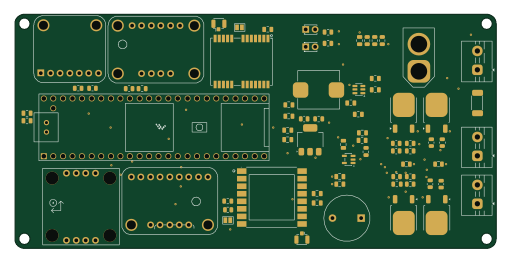
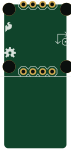
More boards in 2026-nura-avionics
Similar boards
 NXP
NXP32Bit shift register
MaltWhiskey
100 × 54 mm56 parts4LNo license763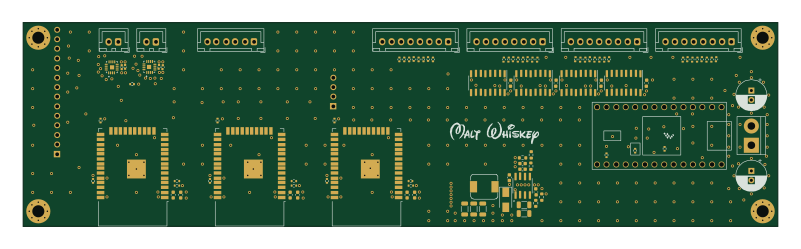 NXP
NXPMega-Cube-Board
200 × 54 mm100 parts4LNo license763 NXP
NXPMCL64
MicroCoreLabs
39.3 × 61.8 mm9 parts4LNo license532 NXP
NXPROM Emulator
21.5 × 37.1 mm5 parts2LNo license532 NXP
NXPMCLZ8
37.1 × 61.5 mm6 parts4LNo license532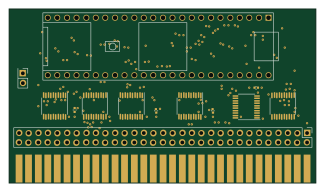 NXP
NXPXTMAX
81 × 46 mm14 parts4LNo license532