
Picalor

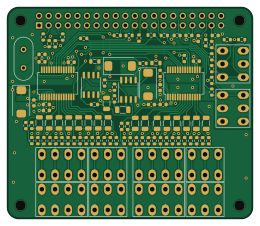
About the Picalor PCB
Picalor is an open source Raspberry Pi PCB design by ul-gh, published on GitHub under the GPL-3.0 license. It is a 4-layer board measuring 65 × 56 mm, with 112 components from 20 distinct parts.
Its main chip is the Raspberry_Pi_2_3, from the Raspberry Pi family. Other key parts include the ADS1256IDB, LM358 and LM336BM-2.5. By type, the board carries 59 resistors, 35 capacitors, 11 connectors, 4 ICs, 2 inductors and 1 crystal.
It belongs with the sensors designs in this gallery.
From the project
Picalor - Multi-Channel Heat Balance Calorimetry on the Raspberry Pi
Thermal power (or heat flow) measurement of one segmented or multiple individual liquid-cooled or liquid-heated systems under the assumption that the enthalpy difference of the fluid entering and exiting each system per unit of time is equal to the energy dissipated or released by the system.
Quasi-isothermal condition can be achieved by using a sufficiently high flow rate. Accurate heat flow measurements under these conditions require very sensitive and robust differential temperature sensing.
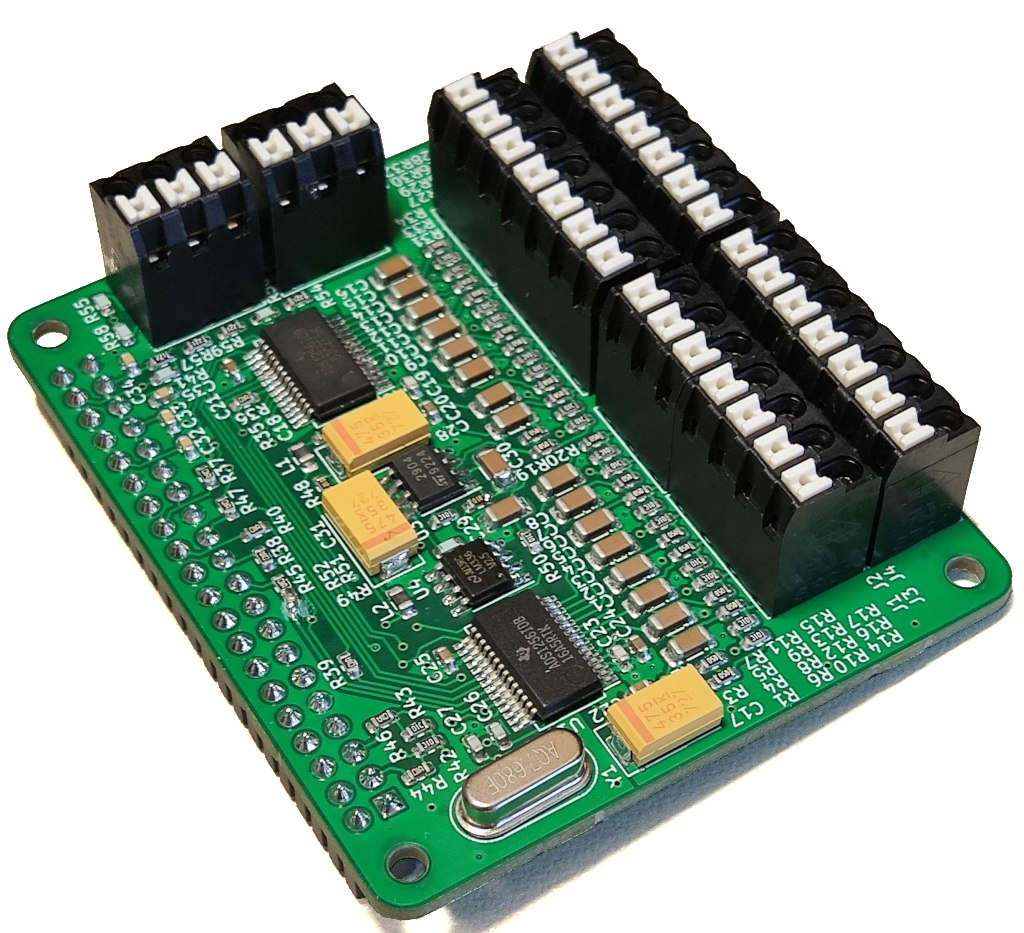
Main components on the Picalor
Picalor bill of materials (BOM)
112 components, 20 distinct parts.
| Qty | Part | Footprint | Refs |
|---|---|---|---|
| 2 | ADS1256IDB | SSOP-28_5.3x10.2mm_P0.65mm | U1, U2 |
| 1 | LM358 | SO-8_3.9x4.9mm_P1.27mm | U3 |
| 1 | LM336BM-2.5 | SO-8_3.9x4.9mm_P1.27mm | U4 |
| 1 | 7.68M | Crystal_HC49-4H_Vertical | Y1 |
| 4 | AST21304 | TerminalBlock_MetzConnect_AST21304 | J1, J3, J5, J7 |
| 6 | AST21303 | TerminalBlock_MetzConnect_AST21303 | J2, J4, J6, J8, J10, J11 |
| 1 | Raspberry_Pi_2_3 | PinSocket_2x20_P2.54mm_Vertical | J9 |
| 2 | BLM21AG102 | L_0805_2012Metric | L1, L2 |
| 18 | 1u | C_1206_3216Metric | C1, C2, C3, C4, C5, C6, C7, C8 +10 |
| 3 | T491D 47U | CP_EIA-7343-31_Kemet-D | C17, C28, C31 |
| 6 | 100n | C_0603_1608Metric | C18, C20, C21, C22, C24, C25 |
| 2 | 100p | C_0603_1608Metric | C19, C23 |
| 2 | 47p | C_0603_1608Metric | C26, C27 |
| 4 | 10n | C_0603_1608Metric | C32, C33, C34, C35 |
| 20 | 10k | R_0603_1608Metric | R1, R4, R6, R8, R10, R12, R14, R16 +12 |
| 18 | 1k1 | R_0603_1608Metric | R2, R3, R5, R7, R9, R11, R13, R15 +10 |
| 3 | 10 | R_0603_1608Metric | R35, R48, R51 |
| 9 | 100 | R_0603_1608Metric | R36, R37, R38, R39, R40, R44, R45, R46 +1 |
| 5 | 2k2 | R_0603_1608Metric | R41, R49, R53, R55, R58 |
| 4 | 220 | R_0603_1608Metric | R54, R56, R57, R59 |
Picalor design files
The KiCad project lives in the ul-gh/Picalor repository on GitHub; these links point at the commit this page was built from.
Picalor: common questions
What microcontroller does the Picalor use?
The Picalor is built around the Raspberry_Pi_2_3, from the Raspberry Pi family.
How big is the Picalor PCB?
The Picalor measures 65 × 56 mm, has 4 copper layers and is 4.69 mm thick.
How many components are on the Picalor?
112 components, from 20 distinct parts. The full bill of materials is listed on this page.
Where can I download the Picalor design files?
From the ul-gh/Picalor repository on GitHub, which has the KiCad layout and the schematic; the links under Design files point to each one.
Can I use the Picalor design in my own project?
Yes, under the terms of its GPL-3.0 license, which ul-gh chose for the repository.
Can I test firmware for the Picalor without the hardware?
Yes. HardLabs builds a simulation of the board from its netlist and BOM, so you can run and debug Raspberry Pi firmware against it before you order a PCB.
Similar boards
 Raspberry Pi
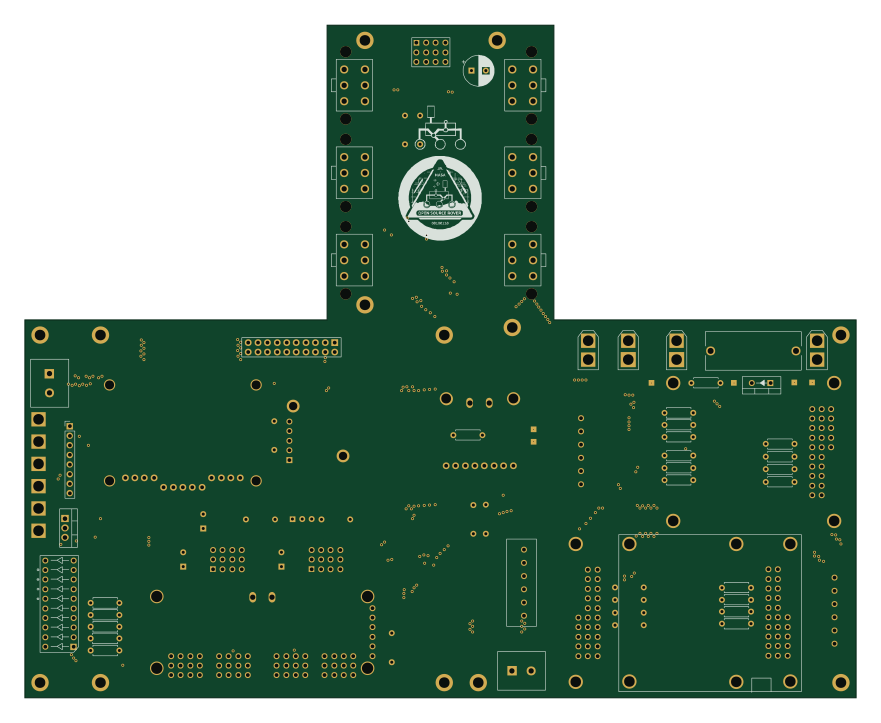
Open source rover
nasa-jpl
220 × 178 mm144 parts2LApache-2.09.7k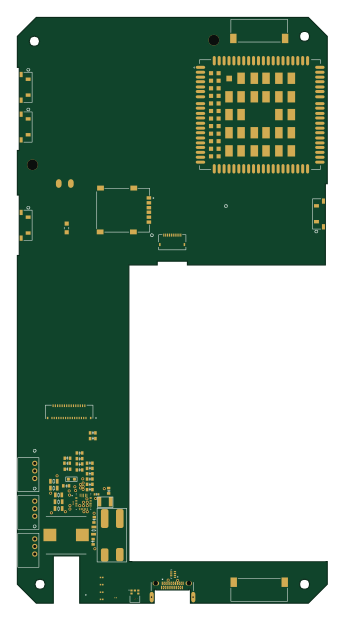 Raspberry Pi
SPIRIT
SPIRIT-org
82 × 155 mm130 parts6LCERN-OHL-S-2.01.3k Raspberry Pi
CM5RevEng
schlae
55 × 40 mm417 parts10LNo license1.0k Raspberry Pi
Haxo hw
cardonabits
102.4 × 211.3 mm38 parts2LCustom license672 Raspberry Pi
Desktop 50 Pin TopConn
BlueSCSI
89.2 × 82.6 mm103 parts2LGPL-3.0449 Raspberry Pi
PowerBook
74.5 × 56.3 mm78 parts2LGPL-3.0449