
Tide clock

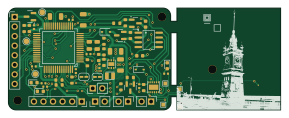
About the Tide clock PCB
Tide clock is an open source STM32 PCB design by weberel, published on GitHub under the CERN-OHL-W-2.0 license. It is a 2-layer board measuring 72.3 × 27 mm, with 55 components from 31 distinct parts.
Its main chip is the STM32F411RET6, from the STM32 family. Other key parts include the VLS201610CX-2R2M-1, DS3231MZ+, TPS61099DRVR and ST25DV04K-JFR6D3. By type, the board carries 19 resistors, 15 capacitors, 6 ICs, 5 connectors, 5 diodes and 4 transistors.
It belongs with the displays & leds and power & battery designs in this gallery.
From the project
A battery-powered e-paper display showing tide times for Margate, UK.
A battery-powered e-paper display showing tide times. Configurable for any coastal location. This device does not need an internet or bluetooth connection as all data is calculated on the device itself from a given time and location. Thanks to the display type and slow refreshrate with long sleep cycles this device can operate on two AA-batteries for at least 3 years.
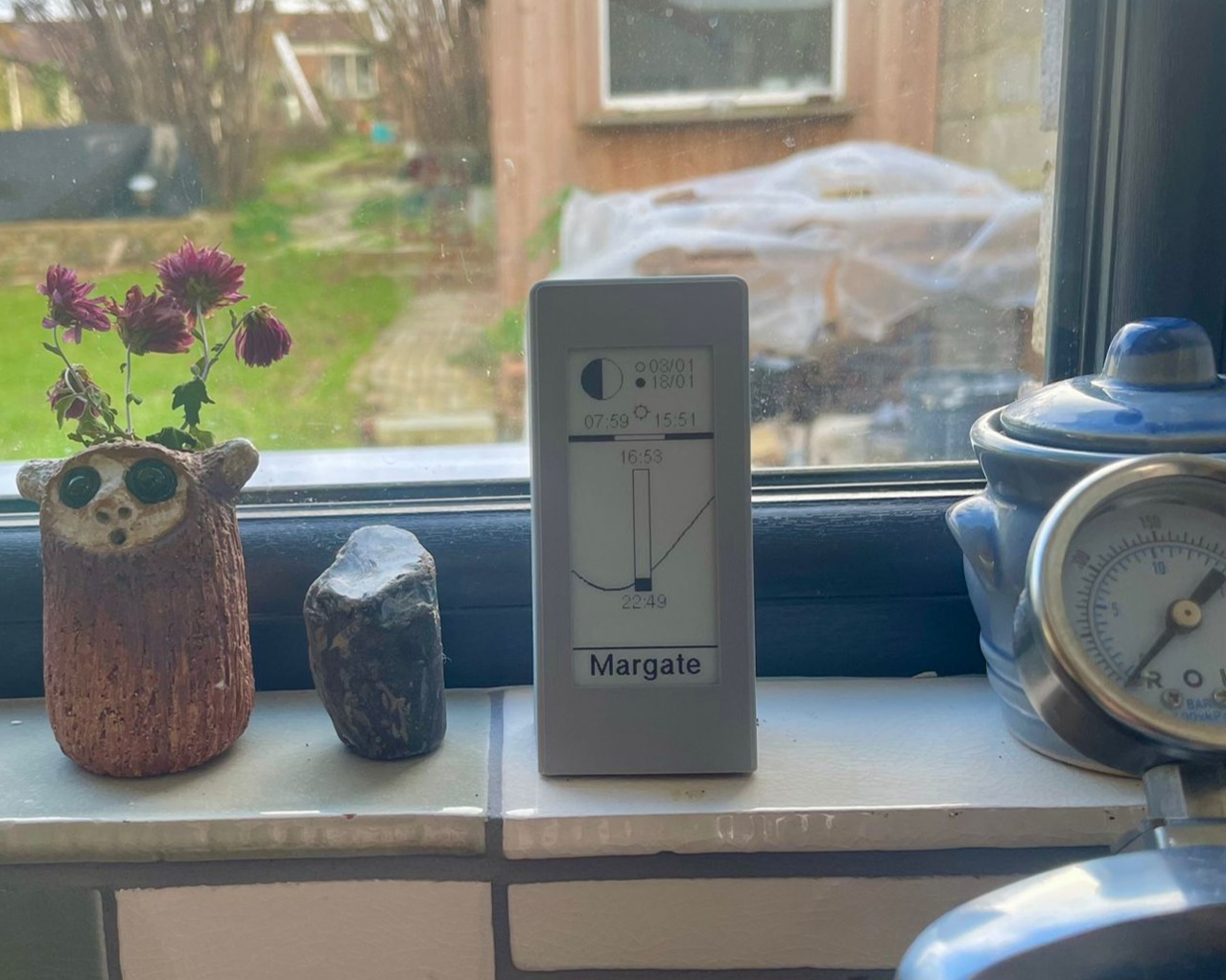
Main components on the Tide clock
Tide clock bill of materials (BOM)
55 components, 31 distinct parts — part numbers from the project's BOM.
| Qty | Part | Footprint | Refs |
|---|---|---|---|
| 1 | VLS201610CX-2R2M-1 | IND-SMD_L2.0-W1.6 | U1 |
| 1 | DS3231MZ+ | SOIC-8_L4.9-W3.9-P1.27-LS6.0-BL | U2 |
| 1 | TPS61099DRVR | WSON-6_L2.0-W2.0-P0.65-TL-EP | U3 |
| 1 | ~ | PinHeader_1x08_P2.54mm_Vertical | U5 |
| 1 | STM32F411RET6 | LQFP-64_L10.0-W10.0-P0.50-LS12.0-BL | U6 |
| 1 | ST25DV04K-JFR6D3 | UDFN-12_L3.0-W3.0-P0.50-TR-EP | U7 |
| 3 | AO3401A Alpha & Omega Semicon | Q_SOT-23 | Q1, Q2, Q6 |
| 1 | AO3401A Alpha & Omega Semicon | Q_SOT-23 | Q8 |
| 4 | Conn_01x02_Pin | PinHeader_1x02_P2.54mm_Vertical | J1, J2, J3, J5 |
| 1 | Conn_01x06_Pin | PinSocket_1x06_P2.54mm_Vertical | J4 |
| 1 | Antenna_Dipole | NFC_COIL | AE1 |
| 1 | C2286 Red Hubei KENTO Elec | D_0603 | D1 |
| 1 | C2286 1N5819WS Guangdong Hottech | D_SOD-323 | D2 |
| 1 | Yellow Foshan NationStar Optoelectronics | D_0603 | D3 |
| 1 | 1N5819WS Guangdong Hottech | D_SOD-323 | D4 |
| 1 | Red Hubei KENTO Elec | D_0603 | D5 |
| 2 | 100NF 100nF YAGEO | C_0603 | C1, C14 |
| 1 | 220NF 10nF Samsung Electro-Mechanics | C_0402 | C2 |
| 5 | 100NF 100nF Samsung Electro-Mechanics | C_0402 | C3, C4, C5, C6, C10 |
| 1 | 1UF 1uF Samsung Electro-Mechanics | C_0805 | C7 |
Show 11 more
| Qty | Part | Footprint | Refs |
|---|---|---|---|
| 1 | 100NF 100nF Samsung Electro-Mechanics | C_0805 | C8 |
| 2 | 4.7UF 4.7uF FH(Guangdong Fenghua Advanced Tech) | C_1206 | C9, C15 |
| 1 | 100PF 100pF FH(Guangdong Fenghua Advanced Tech) | C_0402 | C11 |
| 2 | 10UF 10uF Samsung Electro-Mechanics | C_1206 | C12, C13 |
| 7 | 100kΩ UNI-ROYAL(Uniroyal Elec) | R_0603 | R1, R7, R8, R13, R14, R17, R22 |
| 3 | 1kΩ UNI-ROYAL(Uniroyal Elec) | R_0603 | R2, R12, R21 |
| 3 | 10kΩ UNI-ROYAL(Uniroyal Elec) | R_0402 | R3, R18, R20 |
| 1 | 47kΩ UNI-ROYAL(Uniroyal Elec) | R_0603 | R4 |
| 3 | 10kΩ UNI-ROYAL(Uniroyal Elec) | R_0603 | R6, R9, R10 |
| 1 | 1MΩ UNI-ROYAL(Uniroyal Elec) | R_0603 | R11 |
| 1 | 470kΩ UNI-ROYAL(Uniroyal Elec) | R_0603 | R15 |
Tide clock design files
The KiCad project lives in the weberel/tide-clock repository on GitHub; these links point at the commit this page was built from.
Tide clock: common questions
What microcontroller does the Tide clock use?
The Tide clock is built around the STM32F411RET6, from the STM32 family.
How big is the Tide clock PCB?
The Tide clock measures 72.3 × 27 mm, has 2 copper layers and is 1.6 mm thick.
How many components are on the Tide clock?
55 components, from 31 distinct parts, with part numbers taken from the project's own BOM. The full bill of materials is listed on this page.
Where can I download the Tide clock design files?
From the weberel/tide-clock repository on GitHub, which has the KiCad layout, the schematic and the BOM; the links under Design files point to each one.
Can I use the Tide clock design in my own project?
Yes, under the terms of its CERN-OHL-W-2.0 license, which weberel chose for the repository.
Can I test firmware for the Tide clock without the hardware?
Yes. HardLabs builds a simulation of the board from its netlist and BOM, so you can run and debug STM32 firmware against it before you order a PCB.
Similar boards
 STM32
STM32LumenPnP Motherboard
opulo-inc
149 × 95 mm296 parts4LCC-BY-SA-4.03.7k STM32
STM32AxxSolder
AxxAxx
39 × 82.5 mm122 parts2LGPL-3.01.7k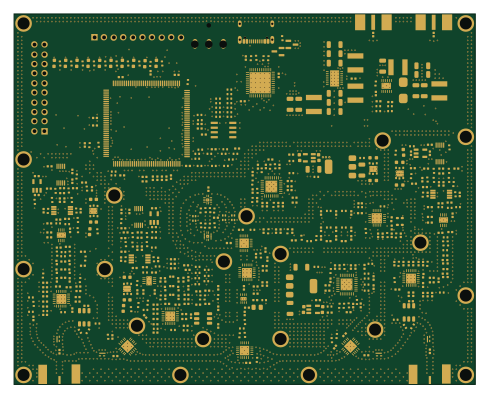 STM32
STM32LibreVNA
jankae
122 × 98 mm592 parts6LGPL-3.01.6k STM32
STM32AIOC
skuep
21 × 31.5 mm47 parts2LMIT1.4k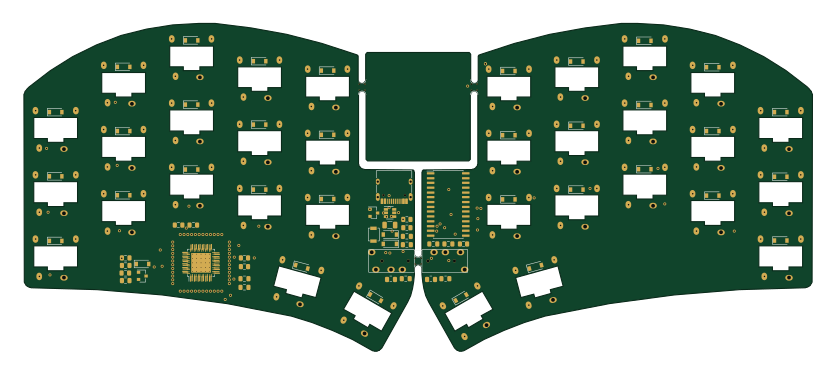 STM32
STM32Ferris
pierrechevalier83
208.8 × 86.8 mm102 parts2LSHL-2.11.3k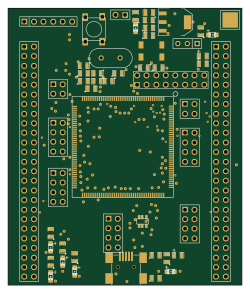 STM32
STM32176 pin board
rusefi
61.8 × 73.2 mm76 parts2LGPL-3.01.2k