
Solar wifi weather station v3.3.5

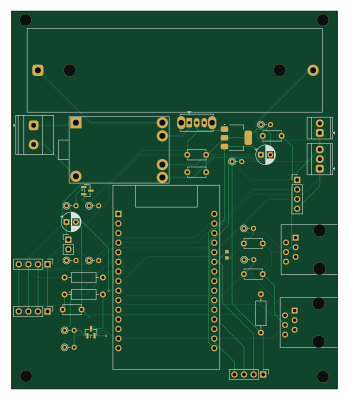
About the Solar wifi weather station v3.3.5 PCB
Solar wifi weather station v3.3.5 is an open source ESP32 PCB design by 3ddruck12, published on GitHub under the CC-BY-NC-4.0 license. It is a 2-layer board measuring 86.2 × 100 mm, with 39 components from 32 distinct parts.
Its main chip is the ESP32_DEVKIT_V1, from the ESP32 family. Other key parts include the TP4056_USB-C_MODUL_1A and TC1262-3.3 (500mA LDO). By type, the board carries 14 resistors, 8 capacitors, 5 connectors, 3 ICs, 2 transistors and 1 battery holder.
It belongs with the iot & wireless, power & battery and sensors designs in this gallery.
From the project
Eigenbau-KiCad-PCB für die Solar WiFi Weather Station v3.3 — Load-Switch, Deep-Sleep-Optimierung, passt in den Stevenson-Screen v3.
DIY PCB for a solar-powered, WiFi-enabled weather station — based on the Open Green Energy / OpenGreenEnergy project Solar Powered WiFi Weather Station, extended with v3.3 changes from the official design wiki.
v3.3 introduces a load switch for sensor power (as in v4), so all sensors are truly powered off during deep sleep:
The board outline (86.23 × 99.95 mm) comes from the official v3.2 Gerber files and fits the existing 3D-printed Stevenson screen mount.
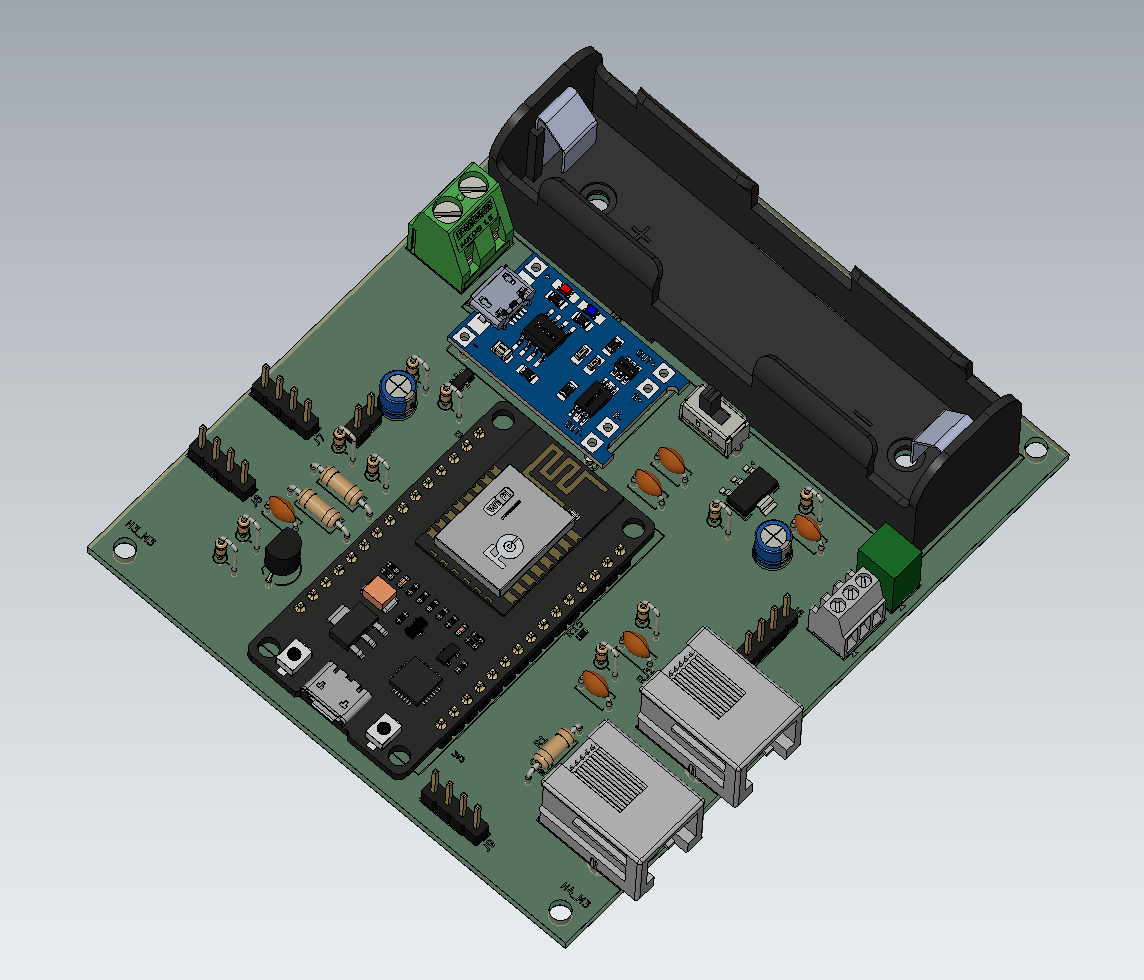
Main components on the Solar wifi weather station v3.3.5
Solar wifi weather station v3.3.5 bill of materials (BOM)
39 components, 32 distinct parts — part numbers from the project's BOM.
| Qty | Part | Footprint | Refs |
|---|---|---|---|
| 1 | ESP32_DEVKIT_V1 | ESP32_DevKit_V1_2x15_Sockets | U3 |
| 1 | TP4056_USB-C_MODUL_1A TP4056_USB-C_Modul_1A | TP4056_USBC_Module | U6 |
| 1 | TC1262-3.3 (500mA LDO) | SOT-223-3_TabPin2 | U7 |
| 1 | C2886430 IRLML6402 / SI2301 (SOT-23) | SOT-23 | Q1 |
| 1 | C8545 2N7002 (SOT-23) | SOT-23 | Q2 |
| 1 | DS18B20_SCHRAUBKLEMME DS18B20_Schraubklemme | TerminalBlock_TE_282834-3_1x03_P2.54mm_Horizontal | J2 |
| 1 | BME280 (VDD SCL SDA GND) | PinHeader_1x04_P2.54mm_Vertical | J6 |
| 1 | UV_Sensor (VDD SCL SDA GND) | PinHeader_1x04_P2.54mm_Vertical | J7 |
| 1 | Lux_Sensor (VDD SCL SDA GND) | PinHeader_1x04_P2.54mm_Vertical | J8 |
| 1 | SHT-10 Bodensensor (VDD DAT SCK GND) | PinHeader_1x04_P2.54mm_Vertical | J9 |
| 1 | BATTERIEHALTER_18650 BatterieHalter_18650 | BatteryHolder_MPD_BK-18650-PC2 | BT1 |
| 1 | JUMPER_I2C_PULLUPS Jumper_I2C_Pullups | PinHeader_1x02_P2.54mm_Vertical | JP1 |
| 1 | RAINSENSOR_RJ11 RainSensor_RJ11 | RJ11_6P6C_MTC6610 | RJ1 |
| 1 | WINDSENSOR_RJ11 WindSensor_RJ11 | RJ11_6P6C_MTC6610 | RJ2 |
| 1 | LDR_Anschluss | TerminalBlock_TE_282834-2_1x02_P2.54mm_Horizontal | RP1 |
| 1 | Solar_In_Schraubklemme | TerminalBlock_Phoenix_MKDS-1,5-2-5.08_1x02_P5.08mm_Horizontal | SC1 |
| 1 | Schiebeschalter_PWR (CK OS102011MS2Q THT) | SW_Slide_SPDT_Straight_CK_OS102011MS2Q | SW1 |
| 1 | 100UF/10V 100uF/10V | CP_Radial_D5.0mm_P2.50mm | C1 |
| 2 | 100NF 100nF | C_Disc_D4.7mm_W2.5mm_P5.00mm | C2, C3 |
| 3 | 1UF 1uF | C_Disc_D4.7mm_W2.5mm_P5.00mm | C4, C5, C6 |
Show 12 more
| Qty | Part | Footprint | Refs |
|---|---|---|---|
| 1 | 22uF (Bulk auf 3V3_SW) | CP_Radial_D5.0mm_P2.50mm | C7 |
| 1 | 100nF (ADC-Filter, optional) | C_Disc_D4.7mm_W2.5mm_P5.00mm | C9 |
| 1 | 10k (Pullup Windfahne) | R_Axial_DIN0207_L6.3mm_D2.5mm_P10.16mm_Horizontal | R1 |
| 1 | 4.7k (DQ-Pullup) | R_Axial_DIN0204_L3.6mm_D1.6mm_P2.54mm_Vertical | R2 |
| 1 | 47K 47k | R_Axial_DIN0207_L6.3mm_D2.5mm_P10.16mm_Horizontal | R3 |
| 1 | 100K 100k | R_Axial_DIN0207_L6.3mm_D2.5mm_P10.16mm_Horizontal | R4 |
| 2 | 4.7K 4.7k | R_Axial_DIN0204_L3.6mm_D1.6mm_P2.54mm_Vertical | R5, R6 |
| 4 | 1k | R_Axial_DIN0204_L3.6mm_D1.6mm_P2.54mm_Vertical | R7, R9, R11, R13 |
| 1 | 10K 10k | R_Axial_DIN0204_L3.6mm_D1.6mm_P2.54mm_Vertical | R8 |
| 1 | 100k (Gate-Pullup, FET sicher AUS) | R_Axial_DIN0204_L3.6mm_D1.6mm_P2.54mm_Vertical | R10 |
| 1 | 100k (Gate-Pulldown) | R_Axial_DIN0204_L3.6mm_D1.6mm_P2.54mm_Vertical | R14 |
| 1 | C98220 10k (SHT10 DAT-Pullup) | R_0603_1608Metric | R15 |
Solar wifi weather station v3.3.5 design files
The KiCad project lives in the 3ddruck12/Solar-wifi-weather-station-v3.3.5 repository on GitHub; these links point at the commit this page was built from.
Solar wifi weather station v3.3.5: common questions
What microcontroller does the Solar wifi weather station v3.3.5 use?
The Solar wifi weather station v3.3.5 is built around the ESP32_DEVKIT_V1, from the ESP32 family.
How big is the Solar wifi weather station v3.3.5 PCB?
The Solar wifi weather station v3.3.5 measures 86.2 × 100 mm, has 2 copper layers and is 1.6 mm thick.
How many components are on the Solar wifi weather station v3.3.5?
39 components, from 32 distinct parts, with part numbers taken from the project's own BOM. The full bill of materials is listed on this page.
Where can I download the Solar wifi weather station v3.3.5 design files?
From the 3ddruck12/Solar-wifi-weather-station-v3.3.5 repository on GitHub, which has the KiCad layout, the schematic and the BOM; the links under Design files point to each one.
Can I use the Solar wifi weather station v3.3.5 design in my own project?
It is published under CC-BY-NC-4.0, which limits how it may be reused; read the license before building on it.
Can I test firmware for the Solar wifi weather station v3.3.5 without the hardware?
Yes. HardLabs builds a simulation of the board from its netlist and BOM, so you can run and debug ESP32 firmware against it before you order a PCB.
Similar boards
 ESP32
ESP32Open Book Abridged Edition
joeycastillo
85 × 115 mm65 parts2LCC-BY-SA-4.08.1k ESP32
ESP32Badge
atopile
56.3 × 39 mm239 parts4LMIT4.0k ESP32
ESP32Esp32 minimal
36.2 × 26.8 mm20 parts2LMIT4.0k ESP32
ESP32Racer
StuckAtPrototype
36 × 50.2 mm70 parts4LApache-2.03.8k ESP32
ESP32Controller
29 × 74 mm58 parts4LApache-2.03.8k ESP32
ESP32Bitaxe
skot
56.5 × 99.8 mm86 parts4LCERN-OHL-S-2.01.4k