
Cd changer emulator

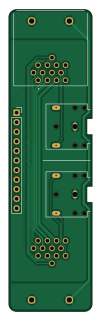
About the Cd changer emulator PCB
Cd changer emulator is an open source PCB design by akreager, published on GitHub under the MIT license. It is a 2-layer board measuring 22 × 80 mm, with 5 components from 3 distinct parts.
It belongs with the audio, dev boards & breakouts and retro computing designs in this gallery.
From the project
Raspberry Pi CD changer emulator for 1990s Kenwood car stereos. Reverse-engineers the 13-pin DIN serial protocol and replaces the changer with a Pi HAT featuring ATtiny1616, PCM5102A DAC, and automotive power management.
This KiCad project implements a passive, pass-through breakout board for the Kenwood KRC-3006 head unit's 13-pin mini DIN connector. The board provides:
- Signal routing between the KRC-3006 and connected CD autochanger. - Accessible test points for bus signal analysis and protocol reverse engineering. - Isolated audio path with independent head unit and changer TRS audio jack connectors.
Cd changer emulator bill of materials (BOM)
5 components, 3 distinct parts.
| Qty | Part | Footprint | Refs |
|---|---|---|---|
| 2 | SDD-130J | CUI_SDD-130J | J1, J2 |
| 1 | Test Points | PinSocket_1x11_P2.54mm_Vertical | J3 |
| 2 | AudioJack3 | Jack_3.5mm_CUI_SJ1-3523N_Horizontal | J4, J5 |
Cd changer emulator design files
The KiCad project lives in the akreager/cd_changer_emulator repository on GitHub; these links point at the commit this page was built from.
Cd changer emulator: common questions
How big is the Cd changer emulator PCB?
The Cd changer emulator measures 22 × 80 mm, has 2 copper layers and is 1.6 mm thick.
How many components are on the Cd changer emulator?
5 components, from 3 distinct parts. The full bill of materials is listed on this page.
Where can I download the Cd changer emulator design files?
From the akreager/cd_changer_emulator repository on GitHub, which has the KiCad layout and the schematic; the links under Design files point to each one.
Can I use the Cd changer emulator design in my own project?
Yes, under the terms of its MIT license, which akreager chose for the repository.
Similar boards
KLOR
GEIGEIGEIST
160.2 × 118.3 mm79 parts2LGPL-3.01.2k
134pin 7-967288-1
rusefi
139.7 × 73.7 mm38 parts2LGPL-3.01.2k
Breakout 60pin EEC-IV
139.7 × 62.2 mm15 parts2LGPL-3.01.2k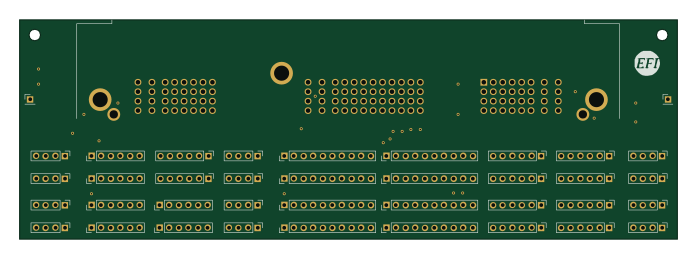
Breakout 112pin Connector
174 × 58 mm39 parts2LGPL-3.01.2k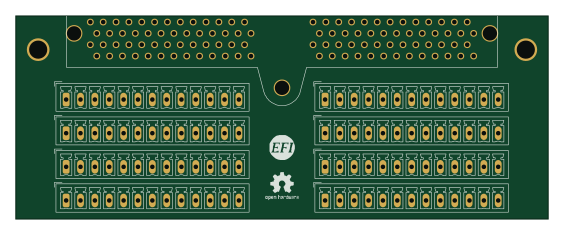
Eecv breakout
140.8 × 53.7 mm9 parts4LGPL-3.01.2k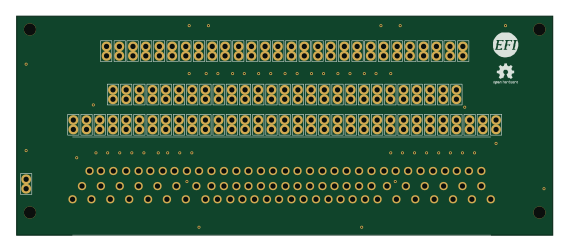
88 Pin Vag Breakout
142 × 58 mm91 parts2LGPL-3.01.2k