
Taiko-256

About the Taiko-256 PCB
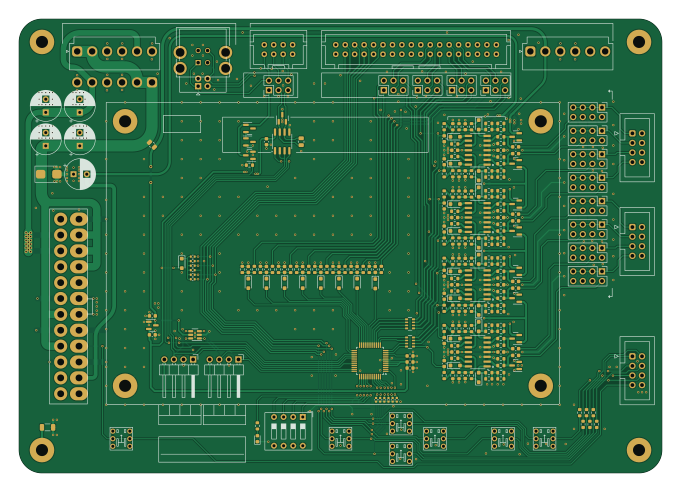
Taiko-256 is an open source STM32 PCB design by AnalogDragon, published on GitHub under the Custom license license. It is a 2-layer board measuring 170 × 120 mm, with 261 components from 52 distinct parts.
Its main chip is the TL084C, from the STM32 family. Other key parts include the XC6206P332MR, SP3485, STM32G030C8T6 and SRV05-4. By type, the board carries 121 resistors, 58 capacitors, 38 diodes, 26 connectors, 8 ICs and 8 switches.
It belongs with the sensors designs in this gallery.
From the project
Taiko JVS for Namco System 256
Previously, running Taiko on Namco System 256 required many accessories, such as a JVS (MINI-JV PCB), a SIF PCB, and an intermediate FUTA PCB, making the setup overly complex. This project's PCB can fully replace the three boards mentioned above. It features two independent Taiko interfaces, an onboard Service button, and supports direct power supply via ATX. Alternatively, this PCB can also be used to replace only the SIF PCB and FUTA PCB while still using the original MINI-JV PCB. However, this does not provide a better experience.
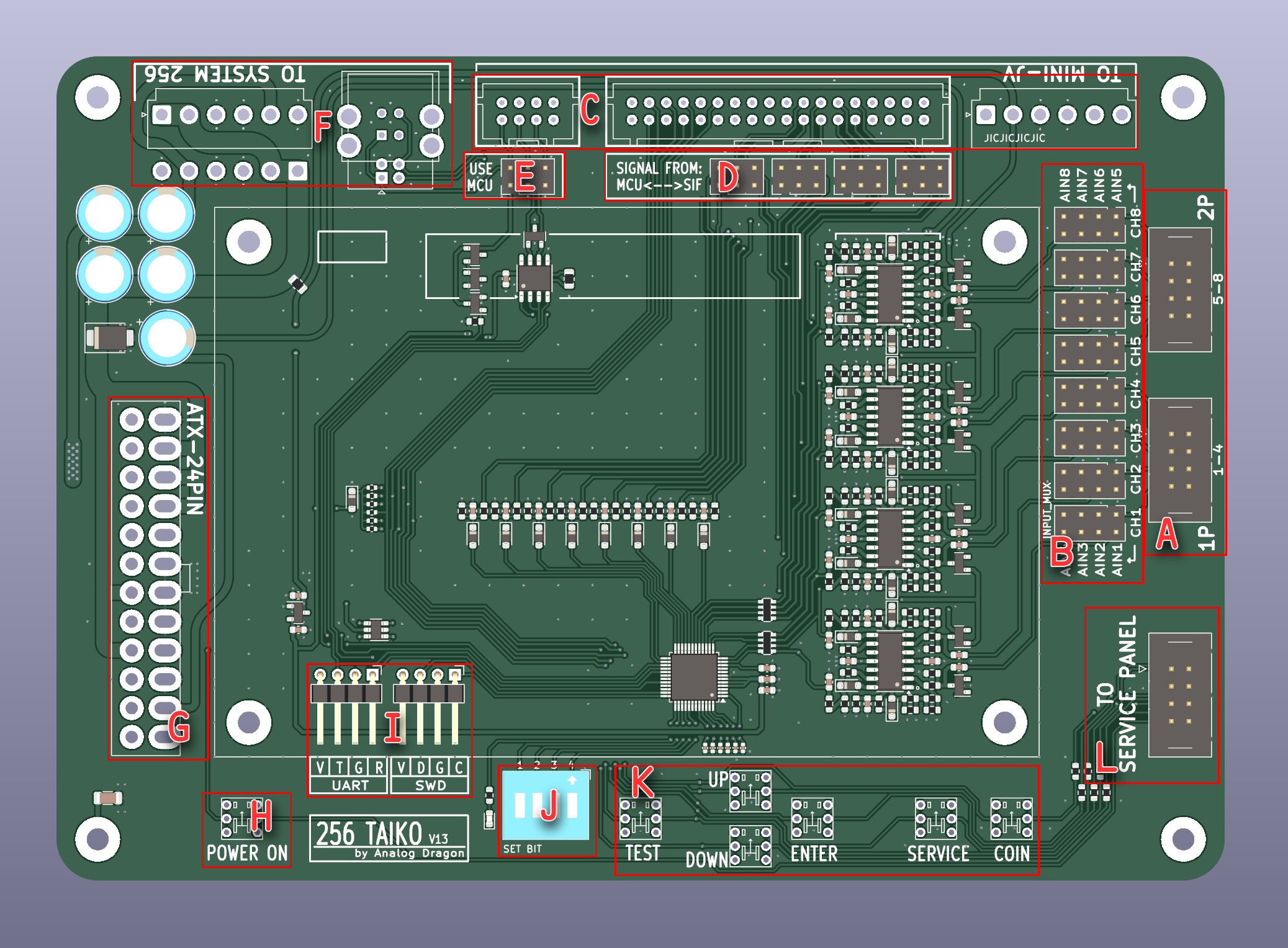
Main components on the Taiko-256
Taiko-256 bill of materials (BOM)
261 components, 52 distinct parts.
| Qty | Part | Footprint | Refs |
|---|---|---|---|
| 1 | XC6206P332MR | SOT-23 | U1 |
| 1 | SP3485 | SOIC-8_3.9x4.9mm_P1.27mm | U2 |
| 4 | TL084C | SO-14_3.9x8.65mm_P1.27mm | U3, U4, U5, U7 |
| 1 | STM32G030C8T6 | LQFP-48_7x7mm_P0.5mm | U6 |
| 1 | SRV05-4 | SOT-23-6 | U8 |
| 1 | AO3400A | SOT-23 | Q2 |
| 1 | Conn_02x04_Odd_Even | B08B-XADSS-N-A | J1 |
| 2 | Conn_01x06 | JST_VH_B6P-VH_1x06_P3.96mm_Vertical | J3, J103 |
| 1 | Conn_02x18_Odd_Even | B36B-XADSS-N-A | J4 |
| 3 | Conn_02x04_Counter_Clockwise | IDC-Header_2x04_P2.54mm_Vertical | J5, J7, J8 |
| 1 | ATX-24 | 5557-2x12 | J6 |
| 8 | Conn_02x04_Counter_Clockwise | PinHeader_2x04_P2.54mm_Vertical | J9, J10, J11, J12, J13, J14, J15, J16 |
| 2 | Conn_01x04 | PinHeader_1x04_P2.54mm_Horizontal | J17, J21 |
| 4 | Conn_02x03_Odd_Even | PinHeader_2x03_P2.54mm_Vertical | J18, J19, J20, J23 |
| 1 | Conn_02x02_Odd_Even | PinHeader_2x03_P2.54mm_Vertical | J22 |
| 1 | Conn_01x06 | JST_VH_B6PS-VH_1x06_P3.96mm_Horizontal | J24 |
| 1 | USB_B | USB_B_OST_USB-B1HSxx_Horizontal | J25 |
| 1 | USB_B | USB_B_TE_5787834_Vertical | J102 |
| 7 | SW_Push_DPDT | switch_6x6 | SW1, SW2, SW3, SW4, SW5, SW6, SW8 |
| 1 | SW_DIP_x04 | SW_DIP_SPSTx04_Slide_9.78x12.34mm_W7.62mm_P2.54mm | SW7 |
Show 32 more
| Qty | Part | Footprint | Refs |
|---|---|---|---|
| 24 | 1N4148WS | D_SOD-323_HandSoldering | D1, D2, D3, D4, D6, D7, D8, D9 +16 |
| 1 | SM712_SOT23 | SOT-23 | D5 |
| 10 | BAT54S/BAV99 | SOT-23 | D10, D11, D12, D13, D23, D24, D25, D26 +2 |
| 1 | SKYBLUE_LED | LED_0603_1608Metric | D15 |
| 1 | SMBJ5.0A | D_SMB | D37 |
| 1 | 1N5819WS | D_SOD-323_HandSoldering | D38 |
| 1 | 120R/100M | R_0805_2012Metric | FB1 |
| 8 | 2.2nF/50V | C_0603_1608Metric | C1, C3, C4, C5, C16, C21, C22, C23 |
| 2 | 10uF/16V | C_0603_1608Metric | C2, C39 |
| 8 | 2.2uF/16V | C_0603_1608Metric | C6, C7, C8, C9, C17, C18, C19, C20 |
| 8 | 4.7uF/16V | C_0603_1608Metric | C10, C11, C12, C15, C24, C25, C26, C35 |
| 1 | 22uF/6.3V | C_0603_1608Metric | C13 |
| 5 | 470uF/25V | CP_Radial_D8.0mm_P3.50mm | C14, C48, C49, C50, C51 |
| 8 | 10nF/50V | C_0603_1608Metric | C27, C28, C29, C30, C31, C32, C33, C34 |
| 10 | 100nF/50V | C_0603_1608Metric | C36, C37, C38, C40, C42, C43, C44, C45 +2 |
| 6 | 100nF/50V | C_0402_1005Metric | C41, C52, C54, C55, C57, C58 |
| 1 | 102/2KV | C_1206_3216Metric | C53 |
| 1 | 1uF/25V | C_0603_1608Metric | C56 |
| 8 | 1M | R_0603_1608Metric | R1, R6, R13, R14, R68, R69, R70, R71 |
| 24 | 1K | R_0603_1608Metric | R2, R3, R4, R5, R15, R16, R17, R18 +16 |
| 8 | 220 | R_0603_1608Metric | R7, R8, R9, R10, R19, R20, R21, R22 |
| 1 | 120R | R_0805_2012Metric | R11 |
| 10 | 4.7K | R_0603_1608Metric | R12, R35, R56, R57, R58, R59, R96, R97 +2 |
| 8 | 3.3K | R_0603_1608Metric | R31, R32, R33, R34, R72, R73, R74, R75 |
| 16 | 200K | R_0603_1608Metric | R36, R38, R40, R42, R44, R46, R48, R50 +8 |
| 8 | NC | R_0603_1608Metric | R37, R39, R41, R43, R77, R79, R81, R83 |
| 8 | 0R | R_0603_1608Metric | R45, R47, R49, R51, R85, R87, R89, R91 |
| 8 | 47R | R_0603_1608Metric | R52, R53, R54, R55, R92, R93, R94, R95 |
| 8 | 10K | R_0603_1608Metric | R60, R61, R62, R63, R100, R101, R102, R103 |
| 6 | 100R | R_0603_1608Metric | R108, R109, R110, R111, R112, R113 |
| 6 | 4.7K | R_0402_1005Metric | R114, R115, R116, R117, R118, R119 |
| 2 | 10K | R_Array_Convex_4x0603 | RN1, RN2 |
Taiko-256 design files
The KiCad project lives in the AnalogDragon/Taiko-256 repository on GitHub; these links point at the commit this page was built from.
- LayoutHW/IO256/IO256.kicad_pcb
- SchematicHW/IO256/IO256.kicad_sch
Taiko-256: common questions
What microcontroller does the Taiko-256 use?
The Taiko-256 is built around the TL084C, from the STM32 family.
How big is the Taiko-256 PCB?
The Taiko-256 measures 170 × 120 mm, has 2 copper layers and is 1.6 mm thick.
How many components are on the Taiko-256?
261 components, from 52 distinct parts. The full bill of materials is listed on this page.
Where can I download the Taiko-256 design files?
From the AnalogDragon/Taiko-256 repository on GitHub, which has the KiCad layout and the schematic; the links under Design files point to each one.
Can I use the Taiko-256 design in my own project?
It is published under Custom license, which limits how it may be reused; read the license before building on it.
Can I test firmware for the Taiko-256 without the hardware?
Yes. HardLabs builds a simulation of the board from its netlist and BOM, so you can run and debug STM32 firmware against it before you order a PCB.
Similar boards
 STM32
STM32LumenPnP Motherboard
opulo-inc
149 × 95 mm296 parts4LCC-BY-SA-4.03.7k STM32
STM32AxxSolder
AxxAxx
39 × 82.5 mm122 parts2LGPL-3.01.7k STM32
STM32AIOC
skuep
21 × 31.5 mm47 parts2LMIT1.4k STM32
STM32Ferris
pierrechevalier83
208.8 × 86.8 mm102 parts2LSHL-2.11.3k STM32
STM32176 pin board
rusefi
61.8 × 73.2 mm76 parts2LGPL-3.01.2k STM32
STM32Brain board STM32F407
61.8 × 73.2 mm69 parts2LGPL-3.01.2k