
Audio balance indicator

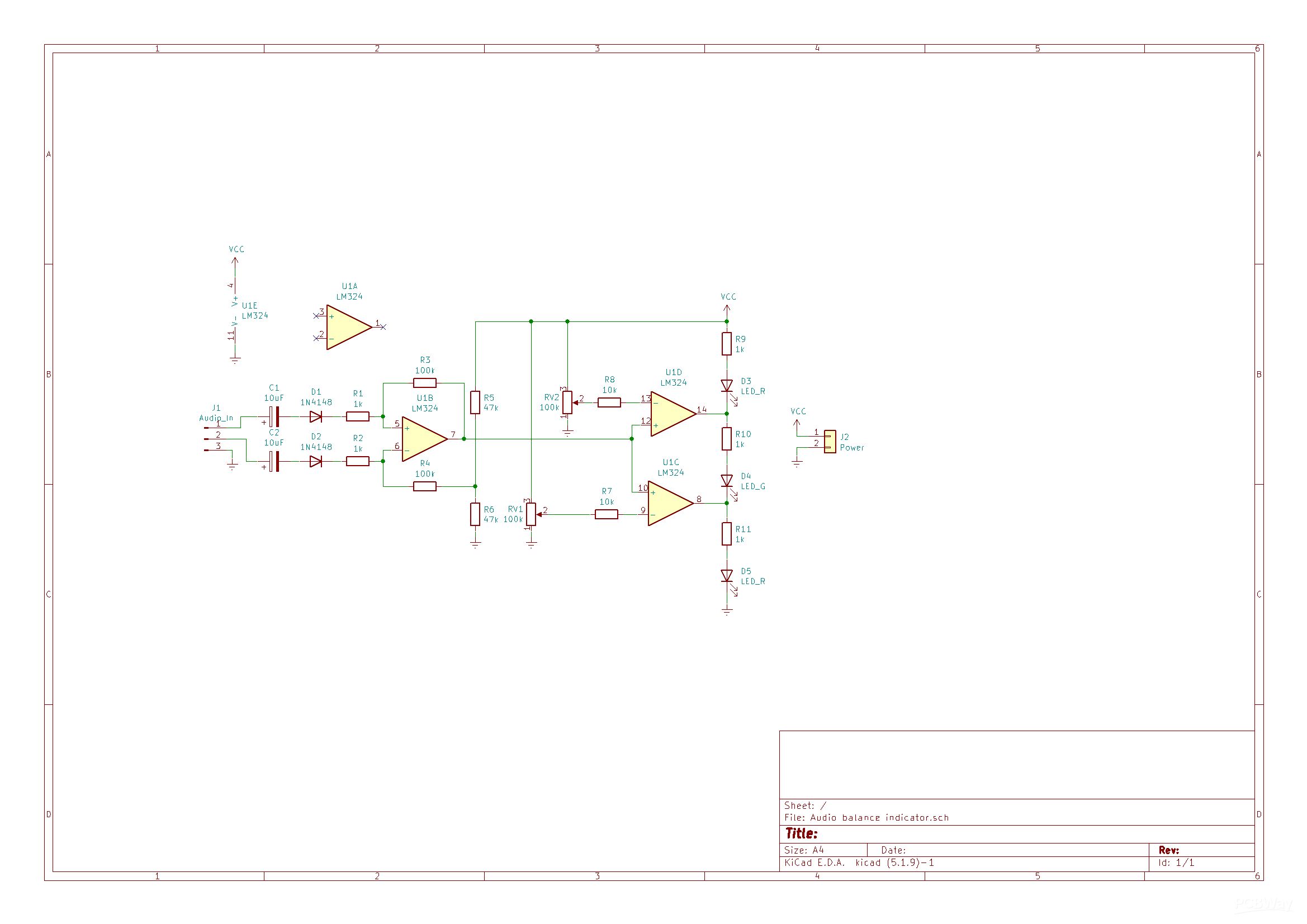
About the Audio balance indicator PCB
Audio balance indicator is an open source PCB design by AndacUnal1, published on GitHub. It is a board, with 15 components from 6 distinct parts.
Other key parts include the LM3914N. By type, the board carries 11 diodes, 1 IC, 1 battery holder and 1 resistor.
It belongs with the audio designs in this gallery.
From the project
Stereo audio balance indicator with KiCad source and PCB manufacturing files.
A stereo audio balance indicator that compares the relative signal levels of the left and right channels and provides a visual LED indication of channel imbalance.
The project was developed as a junior-year analog electronics project and includes the KiCad design source together with PCB manufacturing artifacts.
- Stereo left/right level comparison - LED-based visual indication - Adjustable response through potentiometers - Analog signal-processing design - KiCad schematic source - Gerber manufacturing package
Main components on the Audio balance indicator
Audio balance indicator bill of materials (BOM)
15 components, 6 distinct parts.
| Qty | Part | Footprint | Refs |
|---|---|---|---|
| 1 | LM3914N | DIP-18_W7.62mm | U1 |
| 1 | Battery | BT1 | |
| 1 | R_Potentiometer | RV1 | |
| 10 | LED | D1, D2, D3, D4, D5, D6, D7, D8 +2 | |
| 1 | D | D11 | |
| 1 | R | R1 |
Audio balance indicator design files
The KiCad project lives in the AndacUnal1/audio-balance-indicator repository on GitHub; these links point at the commit this page was built from.
Audio balance indicator: common questions
How many components are on the Audio balance indicator?
15 components, from 6 distinct parts. The full bill of materials is listed on this page.
Where can I download the Audio balance indicator design files?
From the AndacUnal1/audio-balance-indicator repository on GitHub, which has the schematic; the links under Design files point to each one.
Can I use the Audio balance indicator design in my own project?
The repository has no license, so all rights stay with AndacUnal1. Use it as a reference, and ask the author before reusing the design.
Similar boards
KLOR
GEIGEIGEIST
160.2 × 118.3 mm79 parts2LGPL-3.01.2k
ButtonsLEDs
shanteacontrols
390 × 37 mm82 parts2LApache-2.0956
USB
52 × 12.6 mm6 parts2LApache-2.0956
Pots
390 × 93 mm75 parts2LApache-2.0956
PicoGUS Hand386
polpo
29.2 × 75.2 mm43 parts4LGPL-2.0800
Snark barker
schlae
231.1 × 106.7 mm193 parts2LNo license687