
VibrationMonitor-MPU6050

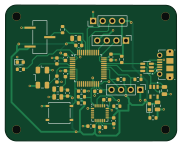
About the VibrationMonitor-MPU6050 PCB
VibrationMonitor-MPU6050 is an open source STM32 PCB design by AnooshZ, published on GitHub under the MIT license. It is a 2-layer board measuring 45.4 × 36 mm, with 40 components from 24 distinct parts.
Its main chip is the STM32F103C8Tx, from the STM32 family. Other key parts include the MPU-6050, TPS7A2033PDBVR and USBLC6-2SC6. By type, the board carries 17 capacitors, 9 resistors, 4 ICs, 4 connectors, 2 switches and 2 diodes.
It belongs with the sensors designs in this gallery.
From the project
Arduino + MPU6050 vibration monitoring system with threshold detection, Python live plotting, and KiCad PCB design.
A real-time vibration monitoring system built around the MPU6050 accelerometer, originally developed using an Arduino UNO and Python, and subsequently redesigned around an STM32F103 microcontroller on a custom-designed PCB.
The project explores embedded systems, sensor interfacing, digital signal processing, PCB design, and hardware debugging.
The original Arduino prototype successfully demonstrated vibration detection, signal filtering, threshold-based LED indication, and real-time Python visualization. The STM32 redesign aims to improve sampling consistency, timing control, and overall…
Main components on the VibrationMonitor-MPU6050
VibrationMonitor-MPU6050 bill of materials (BOM)
40 components, 24 distinct parts.
| Qty | Part | Footprint | Refs |
|---|---|---|---|
| 1 | STM32F103C8Tx | LQFP-48_7x7mm_P0.5mm | U1 |
| 1 | MPU-6050 | InvenSense_QFN-24_4x4mm_P0.5mm | U2 |
| 1 | TPS7A2033PDBVR | DBV0005A-MFG | U3 |
| 1 | USBLC6-2SC6 | SOT-23-6 | U4 |
| 1 | Crystal_GND24 | Crystal_SMD_Abracon_ABM3B-4Pin_5.0x3.2mm | Y2 |
| 3 | Conn_01x04 | PinHeader_1x04_P2.54mm_Vertical | J1, J3, J4 |
| 1 | USB_B_Micro | USB_Micro-B_Molex-105017-0001 | J2 |
| 1 | SW_Push | SMT_FS | SW1 |
| 1 | SW_SPDT | SWITCH_1SCQN | SW2 |
| 1 | LED | LED_0603_1608Metric | D1 |
| 1 | RED | LED_0603_1608Metric | D2 |
| 1 | 120R | L_0603_1608Metric | FB1 |
| 4 | 100nF | C_0603_1608Metric | C1, C2, C3, C4 |
| 2 | 1uF | C_0805_2012Metric | C5, C8 |
| 1 | 4.7uF | C_0805_2012Metric | C6 |
| 2 | 10nF | C_0603_1608Metric | C7, C15 |
| 3 | 0.1uF | C_0603_1608Metric | C9, C11, C13 |
| 2 | 22pF | C_0603_1608Metric | C10, C12 |
| 1 | 2.2nF | C_0603_1608Metric | C14 |
| 2 | 1.0uF | C_0805_2012Metric | C16, C17 |
Show 4 more
| Qty | Part | Footprint | Refs |
|---|---|---|---|
| 2 | 10k | R_0603_1608Metric | R1, R8 |
| 4 | 1.5k | R_0603_1608Metric | R2, R6, R7, R9 |
| 2 | 4.7K | R_0603_1608Metric | R3, R5 |
| 1 | 330 | R_0603_1608Metric | R4 |
VibrationMonitor-MPU6050 design files
The KiCad project lives in the AnooshZ/VibrationMonitor-MPU6050 repository on GitHub; these links point at the commit this page was built from.
VibrationMonitor-MPU6050: common questions
What microcontroller does the VibrationMonitor-MPU6050 use?
The VibrationMonitor-MPU6050 is built around the STM32F103C8Tx, from the STM32 family.
How big is the VibrationMonitor-MPU6050 PCB?
The VibrationMonitor-MPU6050 measures 45.4 × 36 mm, has 2 copper layers and is 1.6 mm thick.
How many components are on the VibrationMonitor-MPU6050?
40 components, from 24 distinct parts. The full bill of materials is listed on this page.
Where can I download the VibrationMonitor-MPU6050 design files?
From the AnooshZ/VibrationMonitor-MPU6050 repository on GitHub, which has the KiCad layout and the schematic; the links under Design files point to each one.
Can I use the VibrationMonitor-MPU6050 design in my own project?
Yes, under the terms of its MIT license, which AnooshZ chose for the repository.
Can I test firmware for the VibrationMonitor-MPU6050 without the hardware?
Yes. HardLabs builds a simulation of the board from its netlist and BOM, so you can run and debug STM32 firmware against it before you order a PCB.
Similar boards
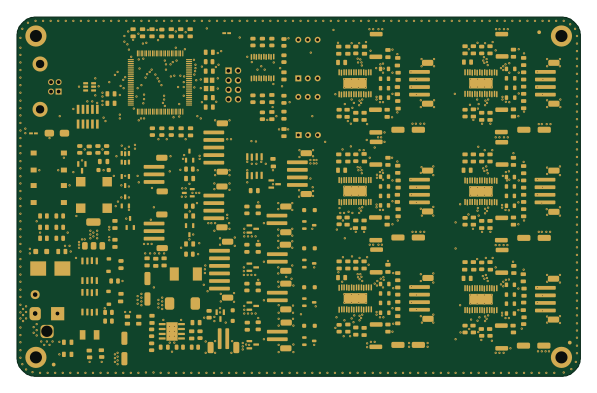 STM32
LumenPnP Motherboard
opulo-inc
149 × 95 mm296 parts4LCC-BY-SA-4.03.7k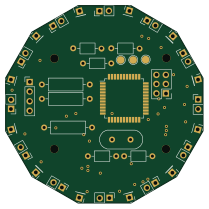 STM32
Base
google
52.3 × 52.3 mm36 parts2LApache-2.02.9k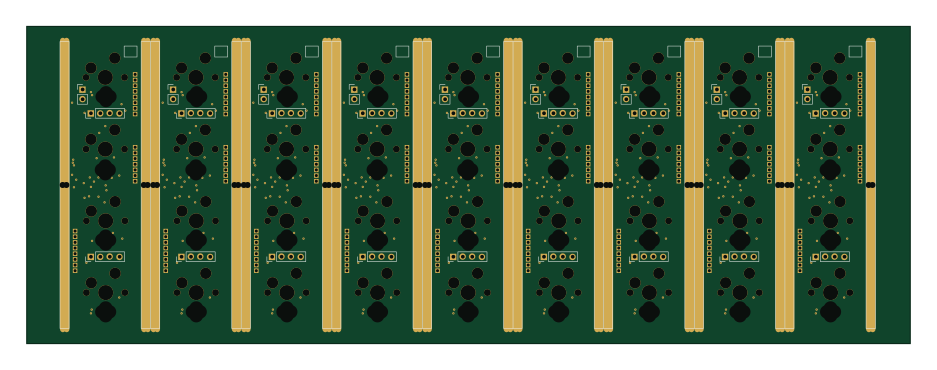 STM32
Main panel
234 × 84 mm26 parts4LApache-2.02.9k STM32
Type a
150 × 30 mm14 parts2LApache-2.02.9k STM32
Type g
169 × 30 mm24 parts2LApache-2.02.9k STM32
Type c
188 × 30 mm17 parts2LApache-2.02.9k