
SevenSegment

About the SevenSegment PCB
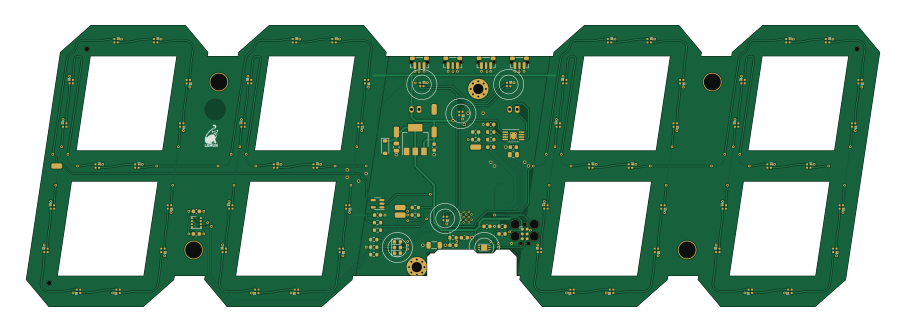
SevenSegment is an open source ESP32 PCB design by BerkeleyHCI, published on GitHub under the BSD-3-Clause license. It is a 2-layer board measuring 226 × 74.4 mm, with 114 components from 25 distinct parts.
Its main chip is the ESP32-S3-WROOM-1-N16R8 (Espressif Systems), from the ESP32 family.
It belongs with the keyboards and iot & wireless designs in this gallery.
From the project
A Python-based hardware description language for PCBs for higher-level (block-diagram / system-architecture level) PCB design through libraries of directly reusable subcircuit generators.
subcircuit generator library based hardware description language for circuit board design
Polymorphic Blocks is an open-source, Python-based hardware description language (HDL) for schematic-equivalent design of printed circuit boards (PCBs). Its library of components provide a high-level abstraction for circuit design while subcircuit generators automate the calculation of fine details. Abstract component interfaces enable these libraries to be general across applications and component vendors.
SevenSegment bill of materials (BOM)
114 components, 25 distinct parts.
| Qty | Part | Footprint | Refs |
|---|---|---|---|
| 12 | — | C_0603_1608Metric | CC1, CC4, CC5, CC6, CC7, CC8, CC9, CC10 +4 |
| 2 | — | C_0805_2012Metric | CC2, CC13 |
| 1 | — | C_1206_3216Metric | CC3 |
| 1 | BZT52C3V6 (SMC(Sangdest Microelectronicstronic (Nanjing))) - 5?A@1V 90? Single 3.6V~3.8V 350mW 3.4V SOD-123 Zener Diodes ROHS | D_SOD-123 | CD1 |
| 3 | — | JlcToolingHole_1.152mm | CH1, CH2, CH3 |
| 2 | B2B-PH-K (JST) | JST_PH_B2B-PH-K_1x02_P2.00mm_Vertical | CJ1, CJ3 |
| 1 | — | Tag-Connect_TC2030-IDC-FP_2x03_P1.27mm_Vertical | CJ2 |
| 12 | — | R_0603_1608Metric | CR1, CR2, CR3, CR4, CR5, CR6, CR7, CR8 +4 |
| 4 | SKRTLAE010 (Alps Alpine) | SW_Push_1P1T-MP_NO_Horizontal_Alps_SKRTLAE010 | CSW1, CSW2, CSW3, CSW4 |
| 1 | 5015 (Keystone) - pwr | TestPoint_TE_RCT_0805 | CTP1 |
| 1 | 5015 (Keystone) - gnd | TestPoint_TE_RCT_0805 | CTP2 |
| 1 | 5015 (Keystone) - v3v3 | TestPoint_TE_RCT_0805 | CTP3 |
| 1 | 5015 (Keystone) - i2c_chain_0.scl | TestPoint_TE_RCT_0805 | CTP4 |
| 1 | 5015 (Keystone) - i2c_tp._io_sda_link | TestPoint_TE_RCT_0805 | CTP5 |
| 1 | 5015 (Keystone) - _rgb_shift_output_link | TestPoint_TE_RCT_0805 | CTP6 |
| 1 | 5015 (Keystone) - spk_chain_1 | TestPoint_TE_RCT_0805 | CTP7 |
| 1 | LDL1117S33R (STMicroelectronics) | SOT-223-3_TabPin2 | CU1 |
| 1 | ESP32-S3-WROOM-1-N16R8 (Espressif Systems) | ESP32-S3-WROOM-1 | CU2 |
| 1 | BME680 (Bosch Sensortec) | Bosch_LGA-8_3x3mm_P0.8mm_ClockwisePinNumbering | CU3 |
| 1 | BH1750 (Rohm Semiconductor) | HVSOF6 | CU4 |
Show 5 more
| Qty | Part | Footprint | Refs |
|---|---|---|---|
| 1 | 74AHCT1G125W5-7 (Diodes Incorporated) | SOT-23-5 | CU5 |
| 1 | TPA2005D1 (Texas Instruments) | MSOP-8-1EP_3x3mm_P0.65mm_EP1.68x1.88mm_ThermalVias | CU6 |
| 1 | KT-0603R (Hubei KENTO Elec) - Red 615~630nm 1.9~2.2V 0603 Light Emitting Diodes (LED) RoHS | LED_0603_1608Metric | CD2 |
| 2 | — | LED_0603_1608Metric | CD3, CD4 |
| 60 | SK6805-EC15 (Opsco Optoelectronics) | LED_SK6812_EC15_1.5x1.5mm | CD5, CD6, CD7, CD8, CD9, CD10, CD11, CD12 +52 |
SevenSegment design files
The KiCad project lives in the BerkeleyHCI/PolymorphicBlocks repository on GitHub; these links point at the commit this page was built from.
SevenSegment: common questions
What microcontroller does the SevenSegment use?
The SevenSegment is built around the ESP32-S3-WROOM-1-N16R8 (Espressif Systems), from the ESP32 family.
How big is the SevenSegment PCB?
The SevenSegment measures 226 × 74.4 mm, has 2 copper layers and is 1.6 mm thick.
How many components are on the SevenSegment?
114 components, from 25 distinct parts. The full bill of materials is listed on this page.
Where can I download the SevenSegment design files?
From the BerkeleyHCI/PolymorphicBlocks repository on GitHub, which has the KiCad layout; the links under Design files point to each one.
Can I use the SevenSegment design in my own project?
Yes, under the terms of its BSD-3-Clause license, which BerkeleyHCI chose for the repository.
Can I test firmware for the SevenSegment without the hardware?
Yes. HardLabs builds a simulation of the board from its netlist and BOM, so you can run and debug ESP32 firmware against it before you order a PCB.
More boards in PolymorphicBlocks
 ESP32
ESP32UsbSourceMeasure
168 × 52 mm310 parts4LBSD-3-Clause91 RP2040/RP2350
FcmlPanel
115 × 72 mm240 parts2LBSD-3-Clause91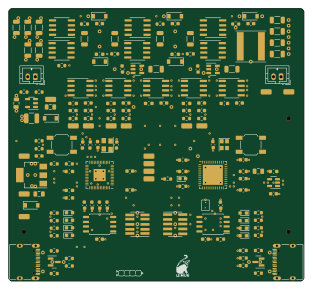 RP2040/RP2350
Fcml
78 × 72 mm179 parts2LBSD-3-Clause91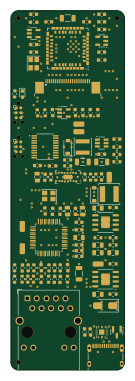 ESP32
ESP32IotThermalCamera
30 × 95 mm119 parts2LBSD-3-Clause91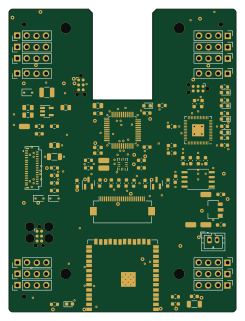 RP2040/RP2350
RobotCrawler
60 × 80 mm112 parts2LBSD-3-Clause91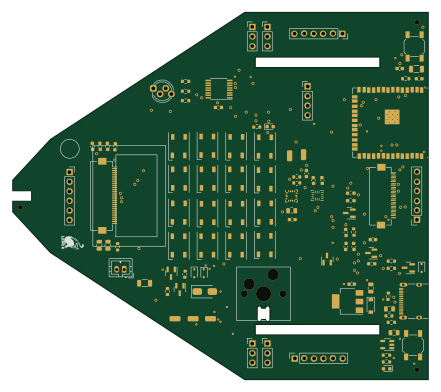 ESP32
ESP32PcbBot
110 × 97.2 mm107 parts2LBSD-3-Clause91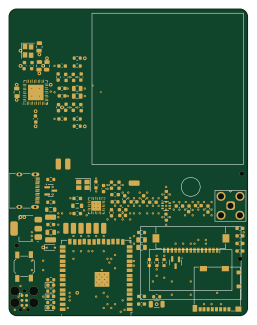 ESP32
ESP32EspLora
63 × 81 mm104 parts2LBSD-3-Clause91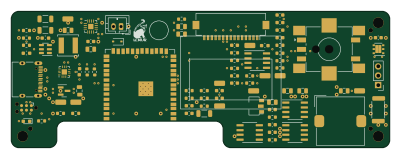 ESP32
ESP32IotIron
100 × 36 mm93 parts2LBSD-3-Clause91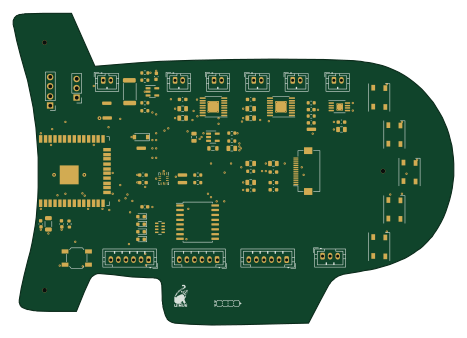 ESP32
ESP32RobotDriver
116.5 × 82.3 mm86 parts2LBSD-3-Clause91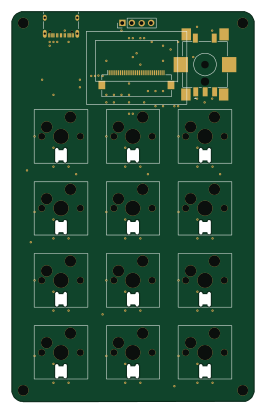
Keyboard
64.1 × 103.2 mm80 parts2LBSD-3-Clause91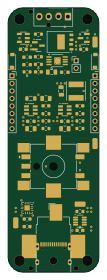
IotFan
24 × 70 mm56 parts2LBSD-3-Clause91
Similar boards
 ESP32
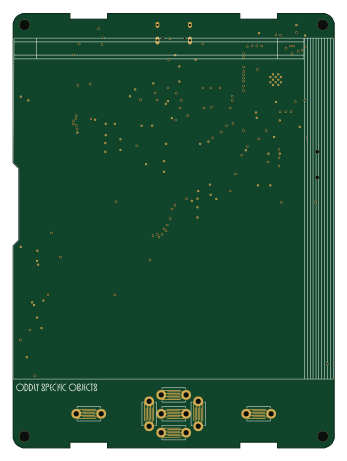
ESP32Open Book Abridged Edition
joeycastillo
85 × 115 mm65 parts2LCC-BY-SA-4.08.1k ESP32
ESP32Esp32 minimal
atopile
36.2 × 26.8 mm20 parts2LMIT4.0k ESP32
ESP32Badge
56.3 × 39 mm239 parts4LMIT4.0k ESP32
ESP32Controller
StuckAtPrototype
29 × 74 mm58 parts4LApache-2.03.8k ESP32
ESP32Racer
36 × 50.2 mm70 parts4LApache-2.03.8k ESP32
ESP32Bitaxe
skot
56.5 × 99.8 mm86 parts4LCERN-OHL-S-2.01.4k