
EinsteinCE

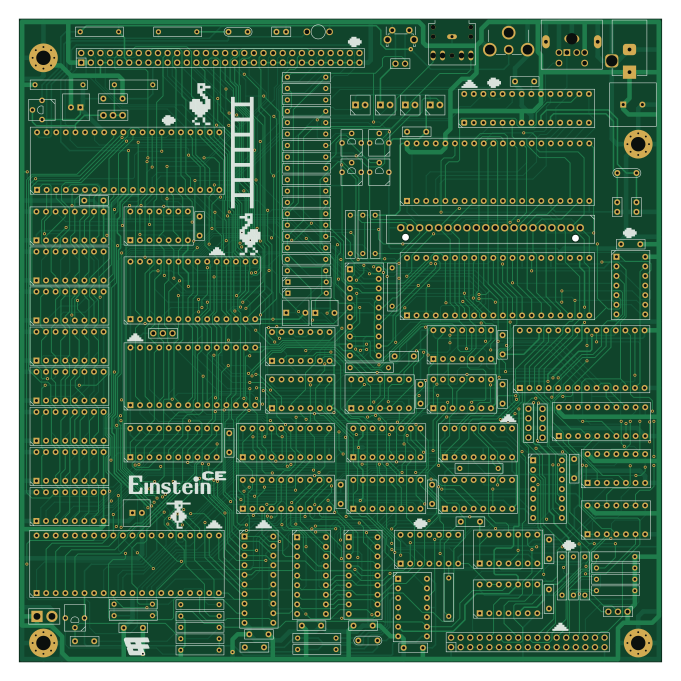
About the EinsteinCE PCB
EinsteinCE is an open source AVR/Arduino PCB design by Board-Folk, published on GitHub. It is a 2-layer board measuring 170 × 170.1 mm, with 153 components from 78 distinct parts.
Its main chip is the ATMEGA328, from the AVR/Arduino family. Other key parts include the MB8118. By type, the board carries 45 resistors, 32 capacitors, 12 modules, 8 ICs, 6 transistors and 6 diodes.
It belongs with the audio designs in this gallery.
From the project
Tatung Einstein TC-01
This isn't particularly serious and it's going to have some haters, so an explanation is needed first off. The idea was to do an as simple as possible Einstein - bits removed or substituted - to fit on a mini-ITX board (170x170mm) as 5V only to prove some schematics. It's cheap to make, being small and the VDP being substituted, the only particularly expensive chip being the WD1770.
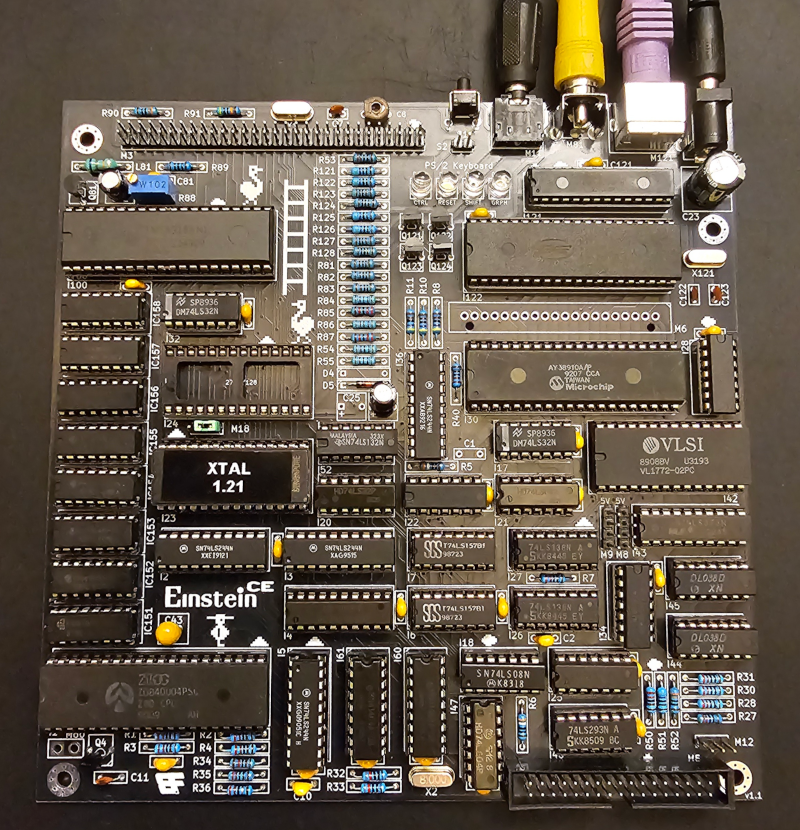
Main components on the EinsteinCE
EinsteinCE bill of materials (BOM)
153 components, 78 distinct parts.
| Qty | Part | Footprint | Refs |
|---|---|---|---|
| 8 | MB8118 | DIP-16_W7.62mm | IC151, IC152, IC153, IC154, IC155, IC156, IC157, IC158 |
| 1 | TATUNG PIPE | M3 PinHeader_2x30_P2.54mm | M3 |
| 1 | INTERNAL | PinHeader_2x17_P2.54mm | M5 |
| 1 | KEYBOARD | Keyboard | M6 |
| 1 | 5V DC IN | BarrelJack_Horizontal | M7 |
| 1 | DRIVE A POWER | M10 PinHeader_1x04_P2.54mm | M8 |
| 1 | DRIVE B POWER | M10 PinHeader_1x04_P2.54mm | M9 |
| 1 | STEREO | Stereo_Jack | M11 |
| 1 | LED ASSY | M12 PinHeader_1x03_P2.54mm | M12 |
| 1 | ROM | M18 PinHeader_1x03_P2.54mm | M18 |
| 1 | 5V | Power Header 3.96mm | M60 |
| 1 | COMPOSITE | RCA | M81 |
| 1 | PS/2 | Connector_Mini-DIN_Female_6Pin_2rows | M121 |
| 1 | 2N3906 | Transistor - Box 1 (Alt 1+3) No corner marking | Q4 |
| 1 | BC549 | Transistor - Box 1 (Leg Rear) | Q81 |
| 4 | BC517 | Transistor - Box 1 (Leg Rear) | Q121, Q122, Q123, Q124 |
| 1 | 10.7386MHz | Crystal | X1 |
| 1 | 8MHz | Crystal | X2 |
| 1 | 16MHz | Crystal | X121 |
| 4 | MountingHole | Hole3.81_Pad_Via | HA1, HA2, HA3, HA4 |
Show 58 more
| Qty | Part | Footprint | Refs |
|---|---|---|---|
| 1 | Z80CPU | DIP-40_W15.24mm | I1 |
| 4 | 74LS244 | DIP-20_W7.62mm | I2, I3, I5, I36 |
| 1 | 74LS245 | DIP-20_W7.62mm | I4 |
| 2 | 74LS157 | DIP-16_W7.62mm | I6, I7 |
| 3 | 74LS32 | DIP-14_W7.62mm | I17, I20, I32 |
| 1 | 74LS08 | DIP-14_W7.62mm | I18 |
| 2 | 74LS04 | DIP-14_W7.62mm | I21, I47 |
| 1 | 74LS00 | DIP-14_W7.62mm | I22 |
| 2 | 2764/128 | DIP-28_W15.24mm | I23, I24 |
| 1 | 74LS74 | DIP-14_W7.62mm | I25 |
| 2 | 74LS138 | DIP-16_W7.62mm | I26, I27 |
| 2 | 74LS02 | DIP-14_W7.62mm | I28, I34 |
| 1 | AY-3-8910 | DIP-40_W15.24mm | I30 |
| 1 | WD1770 | DIP-28_W15.24mm | I42 |
| 1 | 74LS373 | DIP-20_W7.62mm | I43 |
| 2 | 74LS38 | DIP-14_W7.62mm | I44, I45 |
| 1 | 74LS293 | DIP-14_W7.62mm | I48 |
| 1 | 74LS132 | DIP-14_W7.62mm | I52 |
| 2 | TMS4464 | DIP-18_W7.62mm | I60, I61 |
| 1 | TMS9918 | DIP-40_W15.24mm | I100 |
| 1 | ATMEGA328 | DIP-28_W7.62mm | I121 |
| 1 | MT8816 | DIP-40_W15.24mm | I122 |
| 1 | Reset | SW_Tactile_SPST_Angled_PTS645Vx58-2LFS_RESET | S1 |
| 1 | Reset | LK 2-pin 2.54mm - No Box | S2 |
| 2 | BAT85 | Diode 10.16mm | D4, D5 |
| 1 | CTRL | LED_D3.0mm | D121 |
| 1 | RESET | LED_D3.0mm | D122 |
| 1 | SHIFT | LED_D3.0mm | D123 |
| 1 | GRPH | LED_D3.0mm | D124 |
| 1 | 10uH | Resistor 12.70mm | L81 |
| 1 | 100pF | C_Disc_5.08mm | C2 |
| 1 | 33pF | C_Disc_2.54mm | C7 |
| 1 | 5-40pF | CVN6500 | C8 |
| 1 | 1nF | C_Disc_5.08mm | C10 |
| 1 | 33pF | C_Disc_5.08mm | C11 |
| 1 | 100uF 25V | Elec_5.08mm - Box | C20 |
| 1 | 470uF 16V | Elec_5.08mm - Big Box | C23 |
| 1 | 47uF 16V | Elec_5.08mm - Box | C25 |
| 19 | 100nF | C_Disc_5.08mm | C27, C28, C30, C31, C32, C33, C34, C35 +11 |
| 1 | 47uF TANT | Elec_2.5mm - Box | C43 |
| 1 | 47nF | C_Disc_5.08mm | C81 |
| 1 | 100uF | Elec_2.5mm - Box | C82 |
| 2 | 20pF | C_Disc_2.54mm | C122, C123 |
| 7 | 2K2 | Resistor 10.16mm | R1, R2, R3, R4, R7, R40, R50 |
| 2 | 390R | Resistor 10.16mm | R5, R6 |
| 3 | 4K7 | Resistor 10.16mm | R8, R10, R11 |
| 6 | 220R | Resistor 10.16mm | R27, R28, R30, R31, R35, R53 |
| 2 | 820R | Resistor 10.16mm | R32, R33 |
| 1 | 1K2 | Resistor 10.16mm | R34 |
| 1 | 22R | Resistor 10.16mm | R36 |
| 5 | 470R | Resistor 10.16mm | R51, R121, R122, R125, R126 |
| 2 | 330R | Resistor 10.16mm | R52, R90 |
| 4 | 10K | Resistor 10.16mm | R54, R55, R84, R87 |
| 7 | 1K | Resistor 10.16mm | R81, R82, R83, R123, R124, R127, R128 |
| 2 | 22K | Resistor 10.16mm | R85, R86 |
| 1 | 1K | Pot Straight | R88 |
| 1 | 100R | Resistor 10.16mm | R89 |
| 1 | 470K | Resistor 10.16mm | R91 |
EinsteinCE design files
The KiCad project lives in the Board-Folk/Einstein-TC-01 repository on GitHub; these links point at the commit this page was built from.
EinsteinCE: common questions
What microcontroller does the EinsteinCE use?
The EinsteinCE is built around the ATMEGA328, from the AVR/Arduino family.
How big is the EinsteinCE PCB?
The EinsteinCE measures 170 × 170.1 mm, has 2 copper layers and is 1.6 mm thick.
How many components are on the EinsteinCE?
153 components, from 78 distinct parts. The full bill of materials is listed on this page.
Where can I download the EinsteinCE design files?
From the Board-Folk/Einstein-TC-01 repository on GitHub, which has the KiCad layout and the schematic; the links under Design files point to each one.
Can I use the EinsteinCE design in my own project?
The repository has no license, so all rights stay with Board-Folk. Use it as a reference, and ask the author before reusing the design.
Can I test firmware for the EinsteinCE without the hardware?
Yes. HardLabs builds a simulation of the board from its netlist and BOM, so you can run and debug AVR/Arduino firmware against it before you order a PCB.
More boards in Einstein-TC-01
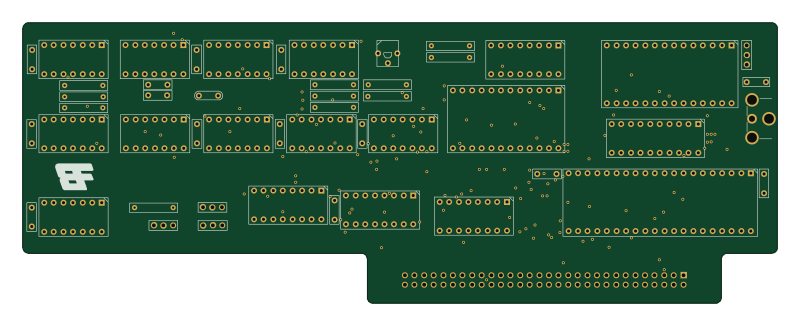
TC02Mini
199.6 × 74.2 mm51 parts2LNo license4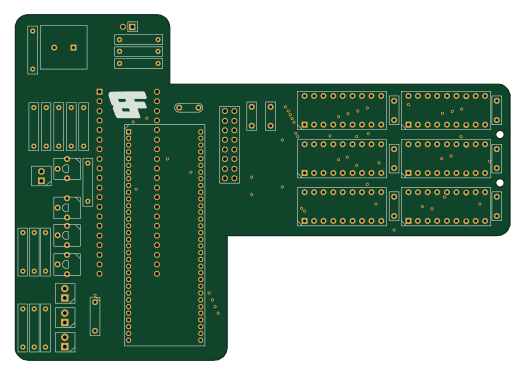
V9958AdapterTC01
131.1 × 91.4 mm44 parts2LNo license4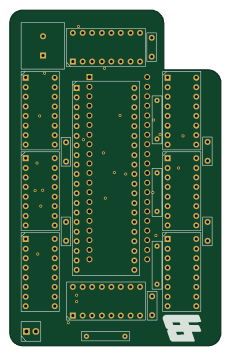
TMSAdapterTC01
55.9 × 88.9 mm22 parts2LNo license4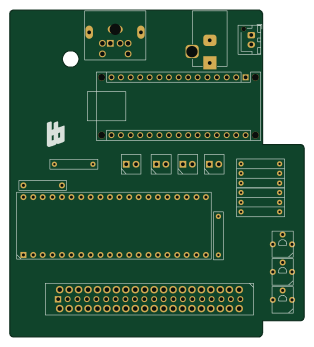
EinsteinTC01PS2
77.9 × 86.5 mm21 parts2LNo license4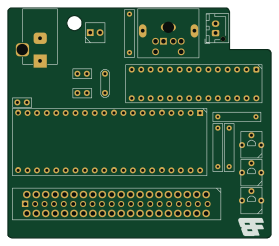 AVR/Arduino
EinsteinTC01PS2Mini
69.8 × 60.9 mm18 parts2LNo license4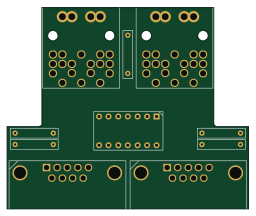
TC01AtariJoystick
63.8 × 53.3 mm10 parts2LNo license4
Similar boards
 AVR/Arduino
Redox keyboard
mattdibi
162.2 × 126.5 mm77 parts2LMIT2.0k AVR/Arduino
ModuleV450
stuartpittaway
30 × 61.4 mm39 parts2LCC-BY-NC-4.01.1k AVR/Arduino
V4
30 × 50 mm38 parts2LCC-BY-NC-4.01.1k AVR/Arduino
Discipline
coseyfannitutti
304.9 × 122.8 mm170 parts2LCC-BY-NC-4.01.0k AVR/Arduino
Megadesk
gcormier
41.7 × 32.2 mm23 parts2LGPL-3.0818 AVR/Arduino
Easyduino Atmega Nano
Hanqaqa
43.4 × 18 mm30 parts4LCERN-OHL-P-2.0746