
HapticCopiloting

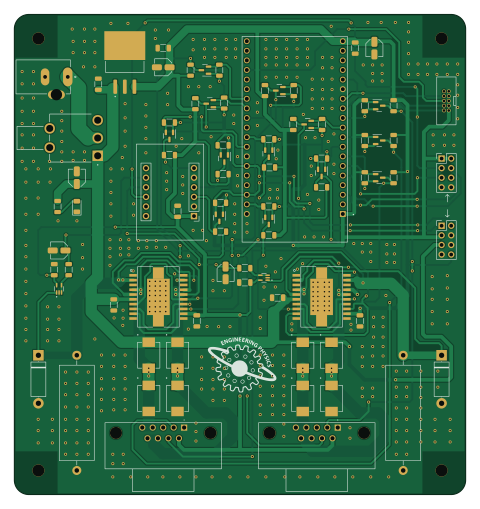
About the HapticCopiloting PCB
HapticCopiloting is an open source ESP32 PCB design by bri-yan, published on GitHub. It is a 2-layer board measuring 119.4 × 127 mm, with 84 components from 23 distinct parts.
Its main chip is the ESP32-DEVKITC-32UE, from the ESP32 family. Other key parts include the LM340S-5.0_NOPB, OPA347SA_3K, L298P, adafruit_ads1115 and 20021511-00010T4LF. By type, the board carries 31 resistors, 15 capacitors, 13 transistors, 11 diodes, 8 ICs and 5 connectors.
It belongs with the sensors designs in this gallery.
From the project
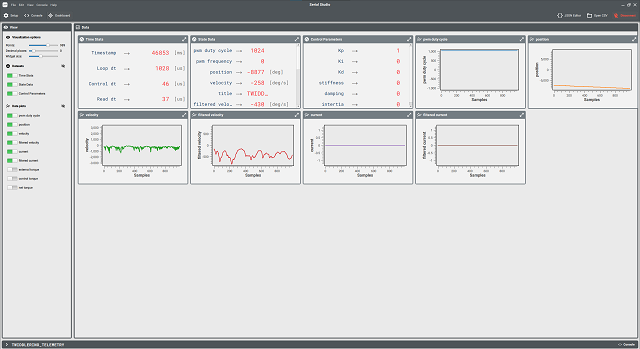
ENPH 459 Capstone Project
Demonstrating complex human-robot control through a 1 DOF haptic device featuring a BDC motor control system in live feedback with a virtual environment.
Authors: Gavin Pringle Yousif El-Wishahy Sayeh Oloumi Yazdi Brian Yan
When dancing with a partner, forces and torques from each person influence the motion of the other. Each person’s motion is therefore partially controlled by themselves and partially controlled by their partner.
Main components on the HapticCopiloting
HapticCopiloting bill of materials (BOM)
84 components, 23 distinct parts.
| Qty | Part | Footprint | Refs |
|---|---|---|---|
| 1 | ESP32-DEVKITC-32UE | ESPRESSIF_ESP32-DEVKITC-32UE | U1 |
| 1 | LM340S-5.0_NOPB | LM340S-5 | U2 |
| 2 | OPA347SA_3K | SOT65P210X110-5N | U3, U4 |
| 2 | L298P | L298P | U5, U6 |
| 1 | adafruit_ads1115 | adafruit_ads1115 | U7 |
| 1 | 20021511-00010T4LF | 20021511-00010T4LF | U8 |
| 13 | BSS138 | SOT-23 | Q1, Q2, Q3, Q4, Q5, Q6, Q7, Q8 +5 |
| 2 | 2311765-1 | TE_2311765-1 | J1, J3 |
| 1 | PJ-202AH | CUI_PJ-202AH | J2 |
| 1 | Extra_GPIO | PinHeader_2x04_P2.54mm_Vertical | J4 |
| 1 | Power_I2C | PinHeader_2x04_P2.54mm_Vertical | J6 |
| 1 | 100SP1T2B4M6QE | SW_100SP1T2B4M6QE | S1 |
| 8 | RS3A | RS3A-13-F | D1, D2, D3, D4, D5, D6, D7, D8 |
| 1 | LED | LED_1206_3216Metric | D9 |
| 2 | 1N5337B | D_5W_P12.70mm_Horizontal | D10, D11 |
| 2 | 3.3uF | C_Elec_4x5.4 | C1, C2 |
| 3 | 10uF | C_Elec_4x5.4 | C3, C8, C10 |
| 1 | 220nF | C_1206_3216Metric | C4 |
| 9 | 100nF | C_1206_3216Metric | C5, C6, C7, C9, C11, C12, C13, C14 +1 |
| 26 | 10k | R_1206_3216Metric | R1, R2, R3, R4, R5, R6, R7, R8 +18 |
Show 3 more
| Qty | Part | Footprint | Refs |
|---|---|---|---|
| 2 | 1R | R_Axial_Power_L25.0mm_W9.0mm_P30.48mm | R9, R10 |
| 2 | 1k | R_1206_3216Metric | R11, R12 |
| 1 | 470R | R_1206_3216Metric | R13 |
HapticCopiloting design files
The KiCad project lives in the bri-yan/HapticCopiloting repository on GitHub; these links point at the commit this page was built from.
HapticCopiloting: common questions
What microcontroller does the HapticCopiloting use?
The HapticCopiloting is built around the ESP32-DEVKITC-32UE, from the ESP32 family.
How big is the HapticCopiloting PCB?
The HapticCopiloting measures 119.4 × 127 mm, has 2 copper layers and is 1.6 mm thick.
How many components are on the HapticCopiloting?
84 components, from 23 distinct parts. The full bill of materials is listed on this page.
Where can I download the HapticCopiloting design files?
From the bri-yan/HapticCopiloting repository on GitHub, which has the KiCad layout and the schematic; the links under Design files point to each one.
Can I use the HapticCopiloting design in my own project?
The repository has no license, so all rights stay with bri-yan. Use it as a reference, and ask the author before reusing the design.
Can I test firmware for the HapticCopiloting without the hardware?
Yes. HardLabs builds a simulation of the board from its netlist and BOM, so you can run and debug ESP32 firmware against it before you order a PCB.
Similar boards
 ESP32
ESP32Open Book Abridged Edition
joeycastillo
85 × 115 mm65 parts2LCC-BY-SA-4.08.1k ESP32
ESP32Badge
atopile
56.3 × 39 mm239 parts4LMIT4.0k ESP32
ESP32Esp32 minimal
36.2 × 26.8 mm20 parts2LMIT4.0k ESP32
ESP32Racer
StuckAtPrototype
36 × 50.2 mm70 parts4LApache-2.03.8k ESP32
ESP32Controller
29 × 74 mm58 parts4LApache-2.03.8k ESP32
ESP32Bitaxe
skot
56.5 × 99.8 mm86 parts4LCERN-OHL-S-2.01.4k