
Keyboard

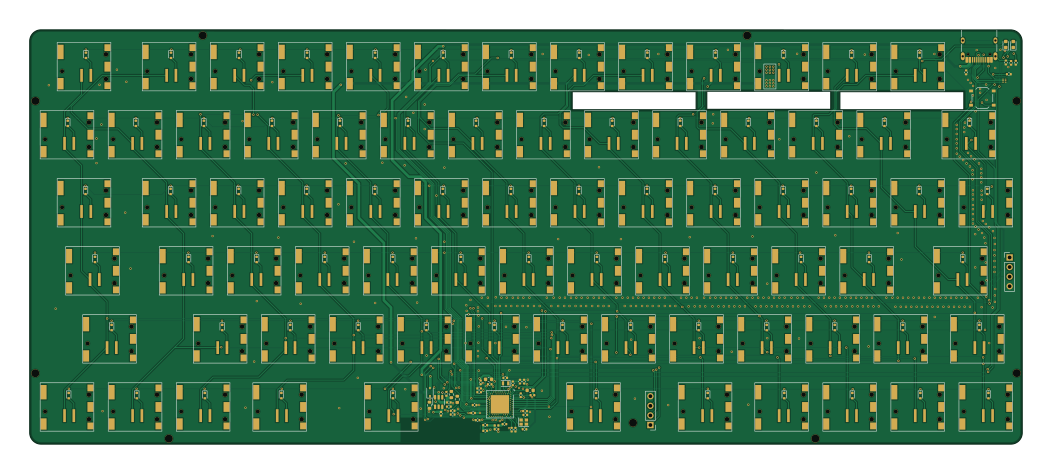
About the Keyboard PCB
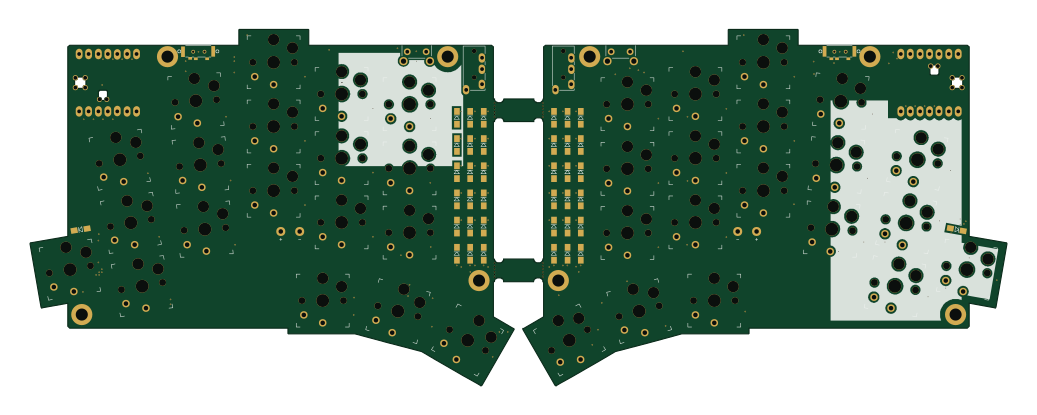
Keyboard is an open source Nordic nRF PCB design by byrantech, published on GitHub under the MIT license. It is a 2-layer board measuring 262.5 × 109.6 mm, with 206 components from 108 distinct parts.
Its main chip is the nRF52840, from the Nordic nRF family. Other key parts include the BQ21040DBVR and ESDR0502NMUTAG. By type, the board carries 81 diodes, 78 relays, 24 capacitors, 11 resistors, 4 inductors and 3 ICs.
It belongs with the keyboards and iot & wireless designs in this gallery.
From the project
anyon_e, a highly integrated, high end, open source laptop. Attempt the impossible.
nRF52840-based wireless mechanical keyboard with Cherry ULP switches.
Keycap model: https://cad.onshape.com/documents/84a4de0481dc58ca7a1fb22c/w/5ff1a0cc24fa744c0cb7a3a5/e/e79186c43fe11bbd17587153
The full keyboard CAD is in the main chassis OnShape link.
Other sized keycaps modified from Carin keyboard with Blender (very sketchy and not very reproducible, so I won't put it up)
Main components on the Keyboard
Keyboard bill of materials (BOM)
206 components, 108 distinct parts.
| Qty | Part | Footprint | Refs |
|---|---|---|---|
| 1 | BQ21040DBVR | SOT95P280X145-6N | U1 |
| 1 | nRF52840 | Nordic_AQFN-73-1EP_7x7mm_P0.5mm | U2 |
| 1 | ESDR0502NMUTAG | UDFN-6_1.2x1.0mm_P0.4mm | U3 |
| 1 | 32.768 kHz | Crystal_SMD_2012-2Pin_2.0x1.2mm | Y1 |
| 1 | 32MHz | Crystal_SMD_2016-4Pin_2.0x1.6mm | Y2 |
| 1 | USB-C | USB_C_Receptacle_HRO_TYPE-C-31-M-12 | P1 |
| 1 | Esc | Cherry_ULP_SMD | K1 |
| 1 | F1 | Cherry_ULP_SMD | K2 |
| 1 | F2 | Cherry_ULP_SMD | K3 |
| 1 | F3 | Cherry_ULP_SMD | K4 |
| 1 | F4 | Cherry_ULP_SMD | K5 |
| 1 | F5 | Cherry_ULP_SMD | K6 |
| 1 | F6 | Cherry_ULP_SMD | K7 |
| 1 | F7 | Cherry_ULP_SMD | K8 |
| 1 | F8 | Cherry_ULP_SMD | K9 |
| 1 | F9 | Cherry_ULP_SMD | K10 |
| 1 | F10 | Cherry_ULP_SMD | K11 |
| 1 | F11 | Cherry_ULP_SMD | K12 |
| 1 | F12 | Cherry_ULP_SMD | K13 |
| 1 | ~~,` | Cherry_ULP_SMD | K15 |
Show 88 more
| Qty | Part | Footprint | Refs |
|---|---|---|---|
| 1 | !,1 | Cherry_ULP_SMD | K16 |
| 1 | @,2 | Cherry_ULP_SMD | K17 |
| 1 | #,3 | Cherry_ULP_SMD | K18 |
| 1 | $,4 | Cherry_ULP_SMD | K19 |
| 1 | %,5 | Cherry_ULP_SMD | K20 |
| 1 | ^,6 | Cherry_ULP_SMD | K21 |
| 1 | &,7 | Cherry_ULP_SMD | K22 |
| 1 | *,8 | Cherry_ULP_SMD | K23 |
| 1 | (,9 | Cherry_ULP_SMD | K24 |
| 1 | ),0 | Cherry_ULP_SMD | K25 |
| 1 | _,- | Cherry_ULP_SMD | K26 |
| 1 | +,= | Cherry_ULP_SMD | K27 |
| 1 | Backspace | Cherry_ULP_SMD | K28 |
| 1 | Tab | Cherry_ULP_SMD | K29 |
| 1 | Q | Cherry_ULP_SMD | K30 |
| 1 | W | Cherry_ULP_SMD | K31 |
| 1 | E | Cherry_ULP_SMD | K32 |
| 1 | R | Cherry_ULP_SMD | K33 |
| 1 | T | Cherry_ULP_SMD | K34 |
| 1 | Y | Cherry_ULP_SMD | K35 |
| 1 | U | Cherry_ULP_SMD | K36 |
| 1 | I | Cherry_ULP_SMD | K37 |
| 1 | O | Cherry_ULP_SMD | K38 |
| 1 | P | Cherry_ULP_SMD | K39 |
| 1 | {,[ | Cherry_ULP_SMD | K40 |
| 1 | },] | Cherry_ULP_SMD | K41 |
| 1 | |,\ | Cherry_ULP_SMD | K42 |
| 1 | Caps Lock | Cherry_ULP_SMD | K43 |
| 1 | A | Cherry_ULP_SMD | K44 |
| 1 | S | Cherry_ULP_SMD | K45 |
| 1 | D | Cherry_ULP_SMD | K46 |
| 1 | F | Cherry_ULP_SMD | K47 |
| 1 | G | Cherry_ULP_SMD | K48 |
| 1 | H | Cherry_ULP_SMD | K49 |
| 1 | J | Cherry_ULP_SMD | K50 |
| 1 | K | Cherry_ULP_SMD | K51 |
| 1 | L | Cherry_ULP_SMD | K52 |
| 1 | :,; | Cherry_ULP_SMD | K53 |
| 1 | ",' | Cherry_ULP_SMD | K54 |
| 1 | Enter | Cherry_ULP_SMD | K55 |
| 2 | Shift | Cherry_ULP_SMD | K56, K68 |
| 1 | Z | Cherry_ULP_SMD | K57 |
| 1 | X | Cherry_ULP_SMD | K58 |
| 1 | C | Cherry_ULP_SMD | K59 |
| 1 | V | Cherry_ULP_SMD | K60 |
| 1 | B | Cherry_ULP_SMD | K61 |
| 1 | N | Cherry_ULP_SMD | K62 |
| 1 | M | Cherry_ULP_SMD | K63 |
| 1 | <,, | Cherry_ULP_SMD | K64 |
| 1 | >,. | Cherry_ULP_SMD | K65 |
| 1 | ?,/ | Cherry_ULP_SMD | K66 |
| 1 | ↑ | Cherry_ULP_SMD | K67 |
| 1 | Fn | Cherry_ULP_SMD | K69 |
| 1 | Ctrl | Cherry_ULP_SMD | K70 |
| 2 | Alt | Cherry_ULP_SMD | K71, K76 |
| 2 | Meta | Cherry_ULP_SMD | K72, K75 |
| 2 | Space | Cherry_ULP_SMD | K73, K74 |
| 1 | ← | Cherry_ULP_SMD | K77 |
| 1 | ↓ | Cherry_ULP_SMD | K78 |
| 1 | → | Cherry_ULP_SMD | K79 |
| 1 | NetTie_2 | net-tie-2-tiny | NT1 |
| 1 | Reset | SW_Push_1P1T_XKB_TS-1187A | SW1 |
| 1 | CHG | LED_0603_1608Metric | D1 |
| 1 | B5819W SL | D_SOD-323 | D2 |
| 1 | BLUE | LED_0603_1608Metric | D3 |
| 78 | D | D_SOD-523 | D4, D5, D6, D7, D8, D9, D10, D11 +70 |
| 1 | 15nH | L_0402_1005Metric | L1 |
| 2 | 10uH | L_0603_1608Metric | L2, L3 |
| 1 | 3.9nH | L_0402_1005Metric | L4 |
| 4 | 4.7uF | C_0402_1005Metric | C1, C4, C13, C19 |
| 4 | 1uF | C_0402_1005Metric | C2, C14, C15, C20 |
| 1 | 47nF | C_0402_1005Metric | C3 |
| 1 | 1nF | C_0402_1005Metric | C5 |
| 1 | 100pF | C_0402_1005Metric | C6 |
| 4 | 100nF | C_0402_1005Metric | C7, C16, C17, C18 |
| 4 | 15pF | C_0402_1005Metric | C8, C9, C21, C22 |
| 1 | 1.5pF | C_0402_1005Metric | C10 |
| 2 | 1pF | C_0402_1005Metric | C11, C12 |
| 1 | 10nF | C_0402_1005Metric | C23 |
| 1 | 1000pF/NC | C_0402_1005Metric | C24 |
| 1 | 0R | R_0402_1005Metric | R1 |
| 2 | 10k | R_0402_1005Metric | R2, R4 |
| 1 | 2.7k | R_0603_1608Metric | R3 |
| 1 | 1.5k | R_0402_1005Metric | R5 |
| 2 | 5.1k | R_0402_1005Metric | R6, R7 |
| 2 | 2M | R_0603_1608Metric | R8, R9 |
| 1 | 10M | R_0402_1005Metric | R10 |
| 1 | 1M | R_0402_1005Metric | R11 |
Keyboard design files
The KiCad project lives in the byrantech/laptop repository on GitHub; these links point at the commit this page was built from.
- Layoutkeyboard/keyboard.kicad_pcb
- Schematickeyboard/keyboard.kicad_sch
Keyboard: common questions
What microcontroller does the Keyboard use?
The Keyboard is built around the nRF52840, from the Nordic nRF family.
How big is the Keyboard PCB?
The Keyboard measures 262.5 × 109.6 mm, has 2 copper layers and is 1.6 mm thick.
How many components are on the Keyboard?
206 components, from 108 distinct parts. The full bill of materials is listed on this page.
Where can I download the Keyboard design files?
From the byrantech/laptop repository on GitHub, which has the KiCad layout and the schematic; the links under Design files point to each one.
Can I use the Keyboard design in my own project?
Yes, under the terms of its MIT license, which byrantech chose for the repository.
Can I test firmware for the Keyboard without the hardware?
Yes. HardLabs builds a simulation of the board from its netlist and BOM, so you can run and debug Nordic nRF firmware against it before you order a PCB.
More boards in laptop
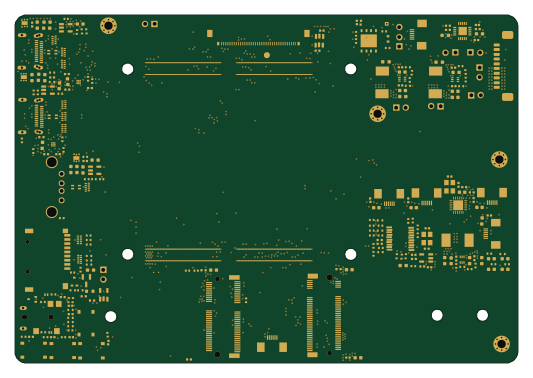
Anyon e motherboard
133 × 92 mm258 parts6LMIT4.3k ESP32
ESP32Powertrain
64 × 45.4 mm171 parts4LMIT4.3k RISC-V
Audio
27.8 × 22.3 mm38 parts2LMIT4.3k
Display eval
52.1 × 22.6 mm12 parts4LMIT4.3k
Encoder
12 × 12 mm7 parts2LMIT4.3k
Protector
32.2 × 15.4 mm6 parts2LMIT4.3k
Switch
18.5 × 11.1 mm5 parts2LMIT4.3k
Similar boards
 Nordic nRF
TOTEM
GEIGEIGEIST
258.8 × 94.4 mm85 parts2LCERN-OHL-P-2.02.0k Nordic nRF
Pixl.js
solosky
40 × 23 mm45 parts4LGPL-2.01.4k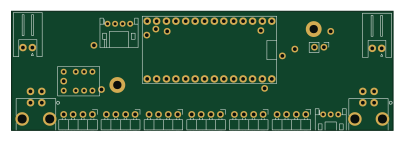 Nordic nRF
Management
dennisss
101 × 31.5 mm50 parts2LApache-2.0381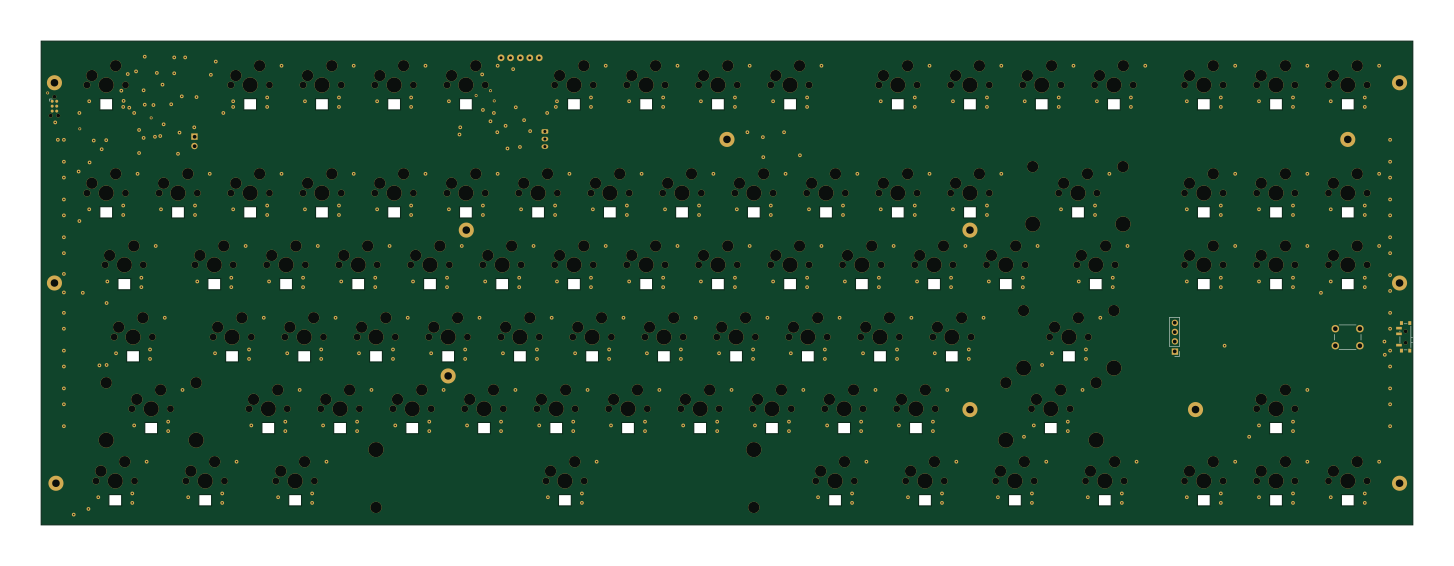 Nordic nRF
Board
363 × 128 mm420 parts4LApache-2.0381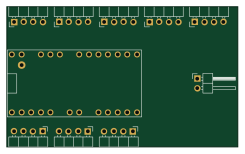 Nordic nRF
Board hl15-latest
61 × 37 mm14 parts2LApache-2.0381 Nordic nRF
Mikoto
zhiayang
18 × 33.3 mm53 parts4LApache-2.0355