
Ion connector bottom

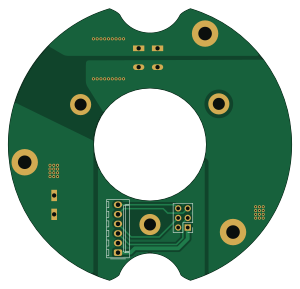
About the Ion connector bottom PCB
Ion connector bottom is an open source PCB design by consp, published on GitHub. It is a 2-layer board measuring 75 × 71.9 mm, with 4 components from 4 distinct parts.
It belongs with the sensors designs in this gallery.
From the project
PCB's I've designed which can be shared
The motor is a 20 magnet, 24 slot PMSM. It should be able to function with hall sensors but due to how it's configured you need to make sure the hall sensors are very precicely aligned.
You need some form of magic (logic or analogue) to offset the magnet difference. This can be done with interpretation but I chose the old fashioned digital logic aproach: Add another sensor per signal, offset by 90 degrees and XOR them to get a normal expected sample. There are more options logically but this is what I went with.
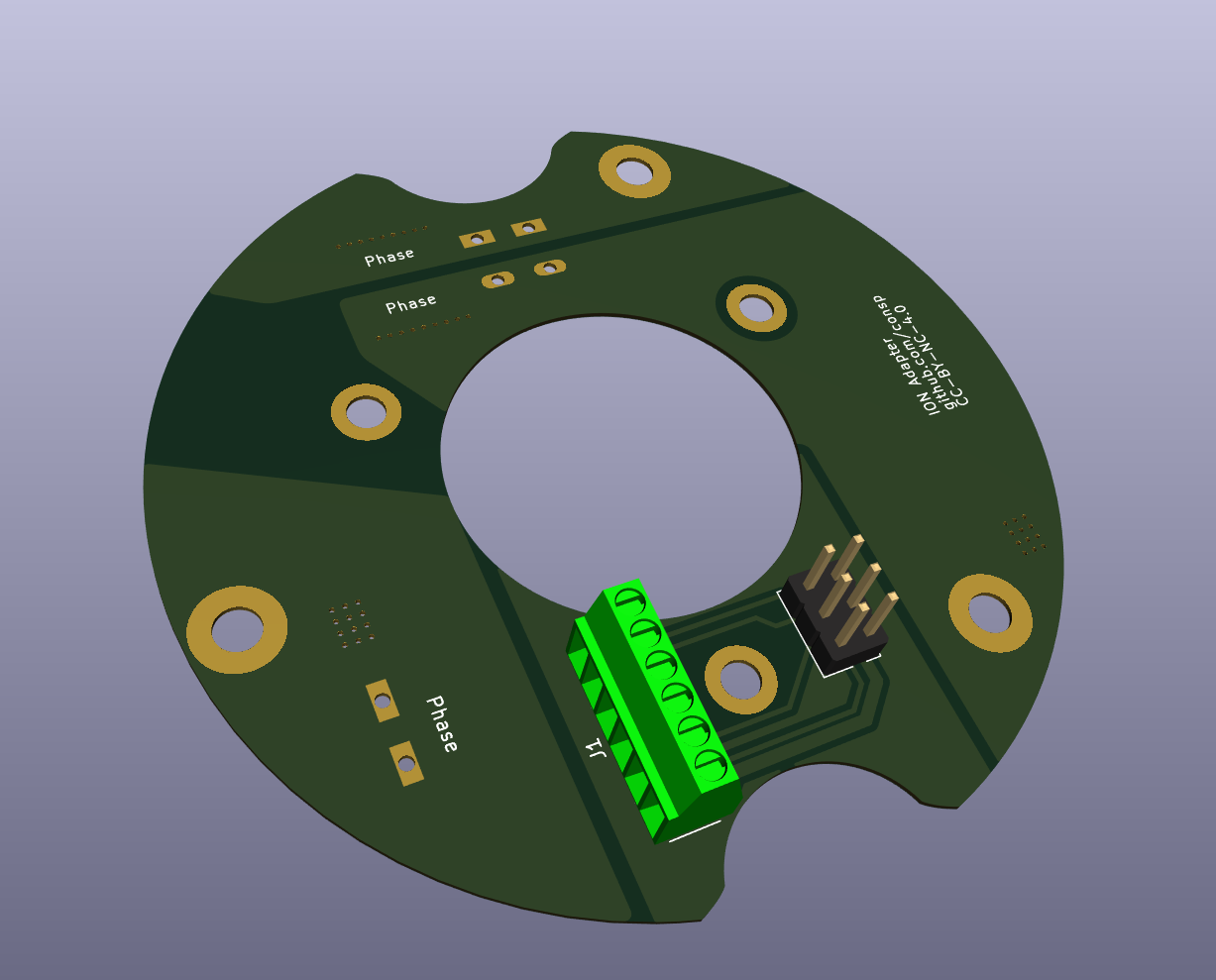
Ion connector bottom bill of materials (BOM)
4 components, 4 distinct parts.
| Qty | Part | Footprint | Refs |
|---|---|---|---|
| 1 | Conn_01x06 | Molex_KK-254_AE-6410-06A_1x06_P2.54mm_Vertical | J1 |
| 1 | Conn_01x01 | TerminalBlock_WAGO_236-401_1x01_P5.00mm_45Degree | J2 |
| 1 | Conn_02x03_Odd_Even | PinHeader_2x03_P2.54mm_Vertical | B2B1 |
| 1 | Conn_01x02 | TerminalBlock_WAGO_236-402_1x02_P5.00mm_45Degree | Ph1 |
Ion connector bottom design files
The KiCad project lives in the consp/pcbs repository on GitHub; these links point at the commit this page was built from.
Ion connector bottom: common questions
How big is the Ion connector bottom PCB?
The Ion connector bottom measures 75 × 71.9 mm, has 2 copper layers and is 0.49 mm thick.
How many components are on the Ion connector bottom?
4 components, from 4 distinct parts. The full bill of materials is listed on this page.
Where can I download the Ion connector bottom design files?
From the consp/pcbs repository on GitHub, which has the KiCad layout and the schematic; the links under Design files point to each one.
Can I use the Ion connector bottom design in my own project?
The repository has no license, so all rights stay with consp. Use it as a reference, and ask the author before reusing the design.
More boards in pcbs
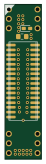
Similar boards
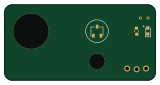
Sensor smd
scottbez1
40 × 20 mm5 parts2LApache-2.04.2k
Sensors
StuckAtPrototype
15.2 × 9 mm14 parts4LApache-2.03.8k
Microphone
Mentra-Community
5.5 × 6.1 mm6 parts2LMIT1.2k
TemperaturePCB PANEL
stuartpittaway
116 × 75.5 mm178 parts2LCC-BY-NC-4.01.1k
Pots
shanteacontrols
390 × 93 mm75 parts2LApache-2.0956
ButtonsLEDs
390 × 37 mm82 parts2LApache-2.0956