
Flight computer

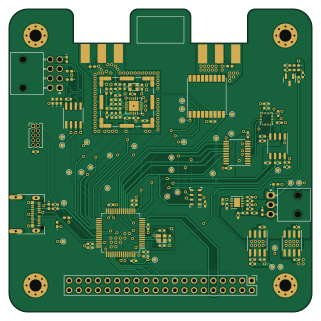
About the Flight computer PCB
Flight computer is an open source STM32 PCB design by cuspaceflight, published on GitHub. It is a 4-layer board measuring 80 × 80 mm, with 114 components from 57 distinct parts.
Its main chip is the STM32F405RGT6, from the STM32 family. Other key parts include the MAX14787E, NXB0108PW-Q100J, ICM-20789, MS5611-01BA and PCA9306. By type, the board carries 42 capacitors, 20 resistors, 15 diodes, 11 ICs, 8 connectors and 7 inductors.
It belongs with the rf & radio designs in this gallery.
From the project
PCBs for the 'Lychee' Jan 2022 HAB Launch
Lychee is a HAB (high-altitude balloon) which serves two main purposes: - An induction project for new members looking to get hands-on building and launching a HAB. - A test bed for prototype Martlet IV electronics.
With rough designs already complete for Martlet IV's eventual launch, we decided to port the flight computer into a less modular form factor and consolidate modules, to create an extensible dual-board architecture that allows us to test both fundamental system hardware and prototype future modules through an expansion slot.
Main components on the Flight computer
Flight computer bill of materials (BOM)
114 components, 57 distinct parts.
| Qty | Part | Footprint | Refs |
|---|---|---|---|
| 1 | STM32F405RGT6 | STM32F405RGT6 | U101 |
| 1 | MAX14787E | MAX14787E | U102 |
| 1 | NXB0108PW-Q100J | NXB0108PW-Q100J | U201 |
| 1 | ICM-20789 | ICM-20789 | U202 |
| 1 | MS5611-01BA | MS5611-01BA | U203 |
| 1 | PCA9306 | PCA9306 | U204 |
| 1 | Si4463 | Si4463 | U301 |
| 1 | MAX-M8 | MAX-M8 | U302 |
| 2 | MAX604 | MAX604 | U401, U403 |
| 1 | BQ29200 | BQ29200 | U402 |
| 1 | BSS138 | BSS138 | Q101 |
| 1 | 26M | Xtal_SMD_2016 | Y101 |
| 1 | LFTCXO068373 | LFTCXO068373 | Y301 |
| 1 | BATT | Molex_Nano-Fit_105313-1103 | J101 |
| 1 | GPS | SMA-Edge | J102 |
| 1 | TELEM | SMA-Edge | J103 |
| 1 | Expansion Slot | Header_RaspberryPi | J104 |
| 1 | USB C | USB_C | J105 |
| 1 | SWD | Header_SWD | J106 |
| 1 | BLACKBOX | Molex_Nano-Fit_105314-1108 | J107 |
Show 37 more
| Qty | Part | Footprint | Refs |
|---|---|---|---|
| 1 | BMI-S-201 | BMI-S-201 | J301 |
| 8 | TestPoint | TestPoint | 1.8V, 3.3V, MISO 1, MISO 2, MOSI 1, MOSI 2, SCLK 1, SCLK 2 |
| 13 | D_ESD | D_0402 | D101, D102, D103, D104, D107, D108, D109, D110 +5 |
| 1 | RED | LED_0402 | D105 |
| 1 | YLW | LED_0402 | D106 |
| 1 | 120n | L_0402 | L301 |
| 1 | 3n3 | L_0402 | L302 |
| 2 | 12n | L_0402 | L303, L305 |
| 2 | 24n | L_0402 | L304, L307 |
| 1 | 18n | L_0402 | L306 |
| 1 | 1µ | C_0402 | C101 |
| 18 | 100n | C_0402 | C102, C103, C105, C106, C107, C110, C201, C202 +10 |
| 1 | 4µ7 | C_0402 | C104 |
| 2 | 2µ2 | C_0402 | C108, C109 |
| 2 | 10p | C_0402 | C111, C112 |
| 2 | 2u2 | C_0402 | C204, C310 |
| 1 | 10n | C_0402 | C206 |
| 1 | 2n | C_0402 | C302 |
| 1 | 5p1 | C_0402 | C303 |
| 1 | 6n8 | C_0402 | C304 |
| 2 | 3p3 | C_0402 | C305, C306 |
| 1 | 1p2 | C_0402 | C307 |
| 1 | 3p | C_0402 | C308 |
| 1 | 1u | C_0402 | C309 |
| 1 | 220p | C_0402 | C312 |
| 1 | 100p | C_0402 | C313 |
| 4 | 10u | C_0402 | C401, C402, C407, C408 |
| 1 | 330n | C_0402 | C406 |
| 5 | 100 | R_0402 | R101, R105, R401, R403, R405 |
| 2 | 50 | R_0402 | R102, R103 |
| 1 | 110k | R_0402 | R104 |
| 2 | 10k | R_0402 | R106, R107 |
| 1 | 120 | R_0402 | R108 |
| 2 | 200k | R_0402 | R201, R407 |
| 4 | 4k7 | R_0402 | R202, R203, R204, R205 |
| 2 | 160 | R_0402 | R402, R404 |
| 1 | 100k | R_0402 | R406 |
Flight computer design files
The KiCad project lives in the cuspaceflight/lychee repository on GitHub; these links point at the commit this page was built from.
Flight computer: common questions
What microcontroller does the Flight computer use?
The Flight computer is built around the STM32F405RGT6, from the STM32 family.
How big is the Flight computer PCB?
The Flight computer measures 80 × 80 mm, has 4 copper layers and is 1.6062 mm thick.
How many components are on the Flight computer?
114 components, from 57 distinct parts. The full bill of materials is listed on this page.
Where can I download the Flight computer design files?
From the cuspaceflight/lychee repository on GitHub, which has the KiCad layout and the schematic; the links under Design files point to each one.
Can I use the Flight computer design in my own project?
The repository has no license, so all rights stay with cuspaceflight. Use it as a reference, and ask the author before reusing the design.
Can I test firmware for the Flight computer without the hardware?
Yes. HardLabs builds a simulation of the board from its netlist and BOM, so you can run and debug STM32 firmware against it before you order a PCB.
More boards in lychee
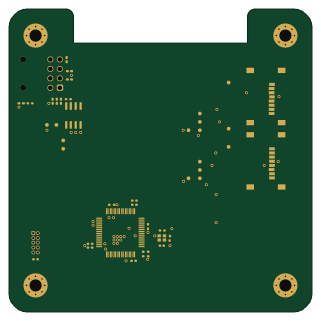
Similar boards
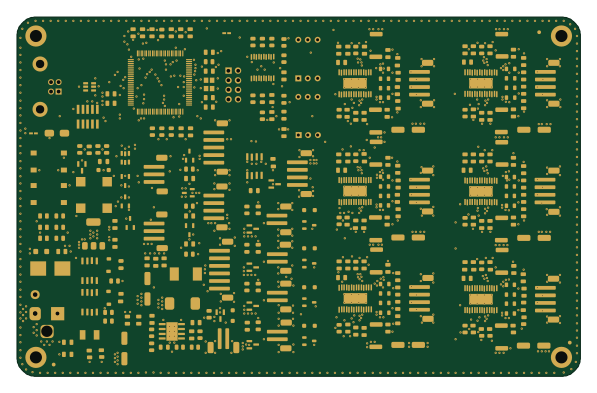 STM32
STM32LumenPnP Motherboard
opulo-inc
149 × 95 mm296 parts4LCC-BY-SA-4.03.7k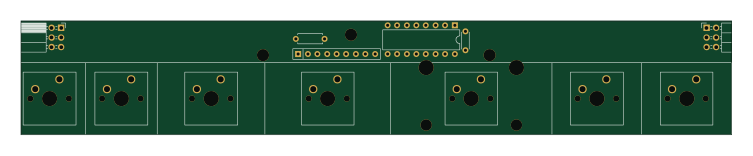 STM32
STM32Type c
google
188 × 30 mm17 parts2LApache-2.02.9k STM32
STM32Main panel
234 × 84 mm26 parts4LApache-2.02.9k STM32
STM32Base
52.3 × 52.3 mm36 parts2LApache-2.02.9k STM32
STM32Type a
150 × 30 mm14 parts2LApache-2.02.9k STM32
STM32Type e
140.5 × 30 mm13 parts2LApache-2.02.9k