
Asynchronous-SPDIF-Mixer

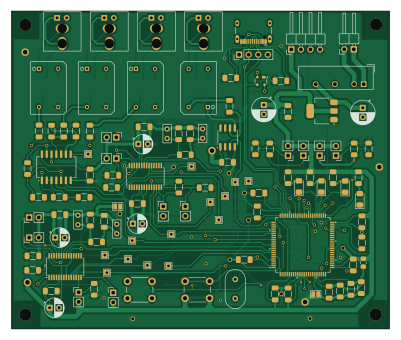
About the Asynchronous-SPDIF-Mixer PCB
Asynchronous-SPDIF-Mixer is an open source STM32 PCB design by DADDesign-Projects, published on GitHub under the MIT license. It is a 2-layer board measuring 100 × 84 mm, with 136 components from 68 distinct parts.
Its main chip is the STM32H743VIT6, from the STM32 family. Other key parts include the 74HC04, MAX3490, W25Q64, DIR9001 and AMS1117-3.3. By type, the board carries 44 capacitors, 38 resistors, 14 test points, 12 jumpers, 7 ICs and 7 connectors.
It belongs with the audio designs in this gallery.
From the project
"Asynchronous SPDIF Mixer" synchronizes and mixes up to three asynchronous S/PDIF streams into a 48 kHz output. Running on an STM32H743 and developed in C++ with CubeIDE, it compensates for drift with interpolation. A custom KiCad-designed PCB hosts this real-time audio processing solution.
"Asynchronous SPDIF Mixer" is a hardware and software project designed to synchronize and mix up to three asynchronous S/PDIF streams into a single 48 kHz output stream. The system compensates for drift between sources and uses interpolation to ensure smooth and artifact-free audio transitions. The project includes USB-MIDI control, allowing real-time mixing of the three audio channels via an external MIDI controller or any MIDI-compatible software.
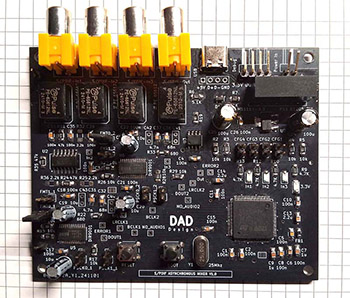
Main components on the Asynchronous-SPDIF-Mixer
Asynchronous-SPDIF-Mixer bill of materials (BOM)
136 components, 68 distinct parts.
| Qty | Part | Footprint | Refs |
|---|---|---|---|
| 1 | STM32H743VIT6 | LQFP100-14x14mm | U1 |
| 1 | 74HC04 | SO-14_5.3x10.2mm_P1.27mm | U2 |
| 1 | MAX3490 | SOIC-8_3.9x4.9mm_P1.27mm | U3 |
| 1 | W25Q64 | SOIC-8_5.23x5.23mm_P1.27mm | U4 |
| 2 | DIR9001 | TSSOP-28-1EP_4.4x9.7mm_P0.65mm_EP2.85x6.7mm | U5, U6 |
| 1 | AMS1117-3.3 | SOT-223-3_TabPin2 | U7 |
| 1 | 25Mhz | Quartz | Y1 |
| 1 | Power In | PinHeader_1x02_P2.54mm_Horizontal | J1 |
| 1 | Debug | PinHeader_1x04_P2.54mm_Horizontal | J2 |
| 1 | USB_C_Receptacle_USB2.0_16P | USB_C_Receptacle_HCTL_HC-TYPE-C-16P-01A | J3 |
| 1 | S/PDIF-Out | CINCH_RCA | J4 |
| 1 | S/PDIF-In1 | CINCH_RCA | J5 |
| 1 | S/PDIF-In2 | CINCH_RCA | J6 |
| 1 | S/PDIF-In3 | CINCH_RCA | J7 |
| 1 | CFG1 | PinHeader_1x02_P2.54mm_Vertical | JP1 |
| 1 | CFG2 | PinHeader_1x02_P2.54mm_Vertical | JP2 |
| 1 | CFG3 | PinHeader_1x02_P2.54mm_Vertical | JP3 |
| 1 | CFG4 | PinHeader_1x02_P2.54mm_Vertical | JP4 |
| 1 | PSCK1_1 | PinHeader_1x02_P2.54mm_Vertical | JP5 |
| 1 | PSCK0_1 | PinHeader_1x02_P2.54mm_Vertical | JP6 |
Show 48 more
| Qty | Part | Footprint | Refs |
|---|---|---|---|
| 1 | FMT1_1 | PinHeader_1x02_P2.54mm_Vertical | JP7 |
| 1 | FMT0_1 | PinHeader_1x02_P2.54mm_Vertical | JP8 |
| 1 | PSCK1_2 | PinHeader_1x02_P2.54mm_Vertical | JP9 |
| 1 | PSCK0_2 | PinHeader_1x02_P2.54mm_Vertical | JP10 |
| 1 | FMT1_2 | PinHeader_1x02_P2.54mm_Vertical | JP11 |
| 1 | FMT0_2 | PinHeader_1x02_P2.54mm_Vertical | JP12 |
| 1 | B1205_2W | Converter_DCDC_TRACO_TBA1-xxxxE_Single_THT | PS1 |
| 1 | BOOT | SW_PUSH_6mm_H5mm | SW1 |
| 1 | RESET | SW_PUSH_6mm_H5mm | SW2 |
| 4 | PE 65612 | PE-65612 | T1, T2, T3, T4 |
| 1 | BCLK1 | TestPoint_THTPad_1.5x1.5mm_Drill0.7mm | TP1 |
| 1 | LRCLK1 | TestPoint_THTPad_1.5x1.5mm_Drill0.7mm | TP2 |
| 1 | DOUT1 | TestPoint_THTPad_1.5x1.5mm_Drill0.7mm | TP3 |
| 1 | ERROR1 | TestPoint_THTPad_1.5x1.5mm_Drill0.7mm | TP4 |
| 1 | NO_AUDIO1 | TestPoint_THTPad_1.5x1.5mm_Drill0.7mm | TP5 |
| 1 | Out | TestPoint_THTPad_1.5x1.5mm_Drill0.7mm | TP6 |
| 1 | In1 | TestPoint_THTPad_1.5x1.5mm_Drill0.7mm | TP7 |
| 1 | BCLK2 | TestPoint_THTPad_1.5x1.5mm_Drill0.7mm | TP8 |
| 1 | LRCLK2 | TestPoint_THTPad_1.5x1.5mm_Drill0.7mm | TP9 |
| 1 | DOUT2 | TestPoint_THTPad_1.5x1.5mm_Drill0.7mm | TP10 |
| 1 | ERROR2 | TestPoint_THTPad_1.5x1.5mm_Drill0.7mm | TP11 |
| 1 | NO_AUDIO2 | TestPoint_THTPad_1.5x1.5mm_Drill0.7mm | TP12 |
| 1 | In2 | TestPoint_THTPad_1.5x1.5mm_Drill0.7mm | TP13 |
| 1 | In3 | TestPoint_THTPad_1.5x1.5mm_Drill0.7mm | TP14 |
| 1 | PRTR5V0U2X | SOT-143 | D1 |
| 1 | 3.3V | LED_1206_3216Metric_Pad1.42x1.75mm_HandSolder | D2 |
| 1 | In3 | LED_1206_3216Metric_Pad1.42x1.75mm_HandSolder | D3 |
| 1 | In2 | LED_1206_3216Metric_Pad1.42x1.75mm_HandSolder | D4 |
| 1 | In1 | LED_1206_3216Metric_Pad1.42x1.75mm_HandSolder | D5 |
| 1 | 1K 100MHz | C_0805_2012Metric_Pad1.18x1.45mm_HandSolder | FB1 |
| 24 | 100n | C_1206_3216Metric_Pad1.33x1.80mm_HandSolder | C1, C2, C3, C4, C5, C6, C8, C10 +16 |
| 2 | 1u | C_1206_3216Metric_Pad1.33x1.80mm_HandSolder | C7, C9 |
| 2 | 2.2u | C_1206_3216Metric_Pad1.33x1.80mm_HandSolder | C13, C14 |
| 4 | 10u | CP_Radial_D5.0mm_P2.50mm | C16, C19, C20, C23 |
| 2 | 100u | CP_Radial_D6.3mm_P2.50mm | C24, C25 |
| 2 | 15p | C_1206_3216Metric_Pad1.33x1.80mm_HandSolder | C29, C30 |
| 2 | 4.7n | C_1206_3216Metric_Pad1.33x1.80mm_HandSolder | C31, C37 |
| 2 | 68n | C_1206_3216Metric_Pad1.33x1.80mm_HandSolder | C32, C38 |
| 2 | 68n | C_Rect_L4.6mm_W2.0mm_P2.50mm_MKS02_FKP02 | C41, C44 |
| 2 | 4.7n | C_Rect_L4.6mm_W2.0mm_P2.50mm_MKS02_FKP02 | C42, C43 |
| 3 | 0 | SolderJumper-2_P1.3mm_Bridged2Bar_Pad1.0x1.5mm | R1, R37, R38 |
| 12 | 10k | R_1206_3216Metric_Pad1.30x1.75mm_HandSolder | R2, R3, R4, R5, R15, R16, R17, R18 +4 |
| 2 | 5.1K | R_1206_3216Metric_Pad1.30x1.75mm_HandSolder | R6, R7 |
| 4 | 47k | R_1206_3216Metric_Pad1.30x1.75mm_HandSolder | R8, R24, R31, R35 |
| 6 | 4.7K | R_1206_3216Metric_Pad1.30x1.75mm_HandSolder | R9, R10, R11, R12, R13, R14 |
| 6 | 75 | R_1206_3216Metric_Pad1.30x1.75mm_HandSolder | R19, R20, R21, R23, R30, R34 |
| 2 | 680 | R_1206_3216Metric_Pad1.30x1.75mm_HandSolder | R22, R33 |
| 3 | 2.2k | R_1206_3216Metric_Pad1.30x1.75mm_HandSolder | R25, R32, R36 |
Asynchronous-SPDIF-Mixer design files
The KiCad project lives in the DADDesign-Projects/Asynchronous-SPDIF-Mixer repository on GitHub; these links point at the commit this page was built from.
Asynchronous-SPDIF-Mixer: common questions
What microcontroller does the Asynchronous-SPDIF-Mixer use?
The Asynchronous-SPDIF-Mixer is built around the STM32H743VIT6, from the STM32 family.
How big is the Asynchronous-SPDIF-Mixer PCB?
The Asynchronous-SPDIF-Mixer measures 100 × 84 mm, has 2 copper layers and is 1.6 mm thick.
How many components are on the Asynchronous-SPDIF-Mixer?
136 components, from 68 distinct parts. The full bill of materials is listed on this page.
Where can I download the Asynchronous-SPDIF-Mixer design files?
From the DADDesign-Projects/Asynchronous-SPDIF-Mixer repository on GitHub, which has the KiCad layout and the schematic; the links under Design files point to each one.
Can I use the Asynchronous-SPDIF-Mixer design in my own project?
Yes, under the terms of its MIT license, which DADDesign-Projects chose for the repository.
Can I test firmware for the Asynchronous-SPDIF-Mixer without the hardware?
Yes. HardLabs builds a simulation of the board from its netlist and BOM, so you can run and debug STM32 firmware against it before you order a PCB.
Similar boards
 STM32
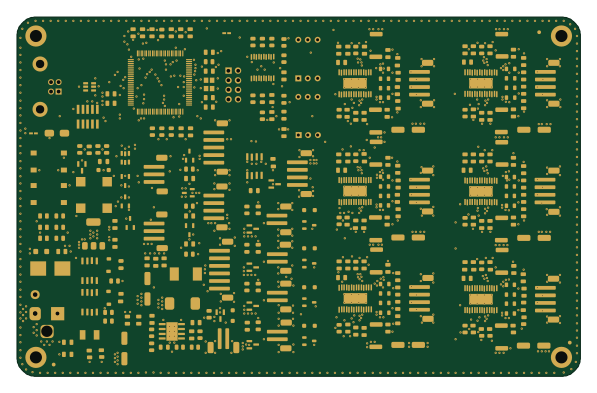
STM32LumenPnP Motherboard
opulo-inc
149 × 95 mm296 parts4LCC-BY-SA-4.03.7k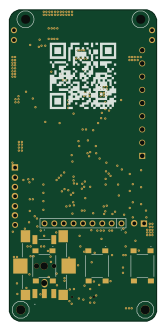 STM32
STM32AxxSolder
AxxAxx
39 × 82.5 mm122 parts2LGPL-3.01.7k STM32
STM32AIOC
skuep
21 × 31.5 mm47 parts2LMIT1.4k STM32
STM32Ferris
pierrechevalier83
208.8 × 86.8 mm102 parts2LSHL-2.11.3k STM32
STM32176 pin board
rusefi
61.8 × 73.2 mm76 parts2LGPL-3.01.2k STM32
STM32Brain board STM32F407
61.8 × 73.2 mm69 parts2LGPL-3.01.2k