
Mini one

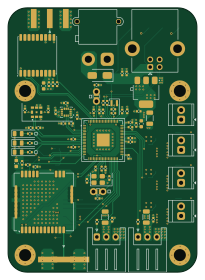
About the Mini one PCB
Mini one is an open source Raspberry Pi PCB design by esicoe, published on GitHub. It is a 4-layer board measuring 50 × 70 mm, with 112 components from 40 distinct parts.
Its main chip is the RP2354B, from the Raspberry Pi family. Other key parts include the AMS1117-3.3, BMP585, W25Q128JVSIQ, LSM6DSV32XTR and MAX-M10S. By type, the board carries 46 capacitors, 33 resistors, 13 connectors, 7 ICs, 7 diodes and 3 transistors.
It belongs with the rf & radio, sensors and robotics & motion designs in this gallery.
From the project
mini-one is a 50 x 70 mm flight computer for high-power rocketry airframes of 54 mm and up. It carries the sensors, storage, GPS, LoRa telemetry, pyro channels and servo outputs for a flight steered by thrust vector control (TVC), and it's the second generation of my avionics pla
mini-one is a 50 x 70 mm flight computer for high-power rocketry airframes of 54 mm and up. It carries the sensors, storage, GPS, LoRa telemetry, pyro channels and servo outputs for a flight steered by thrust vector control (TVC), and it's the second generation of my avionics platform.
The schematic is split into five hierarchical sheets: processor, power and interface, sensors and memory, RF, and outputs. Everything is in pcb/, and the Gerbers, BOM and pick-and-place files are in manufacturing/.
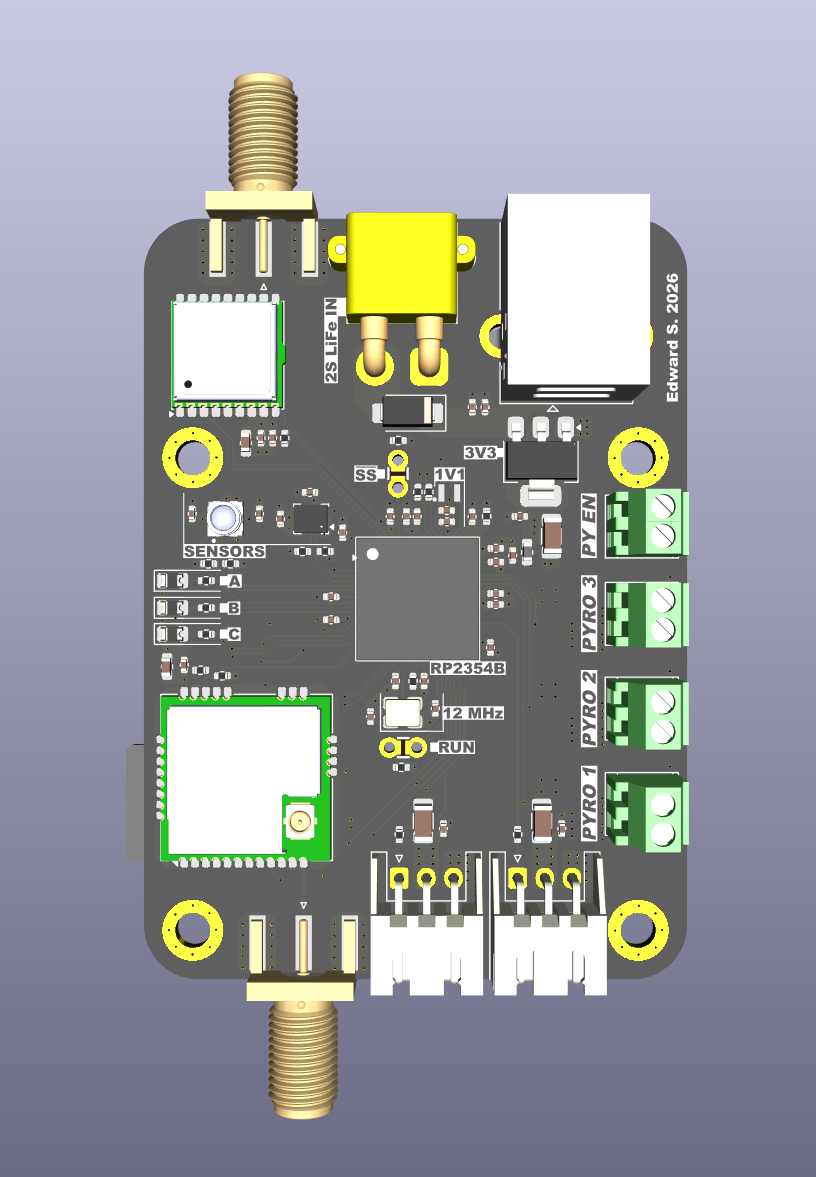
Main components on the Mini one
Mini one bill of materials (BOM)
112 components, 40 distinct parts — part numbers from the project's BOM.
| Qty | Part | Footprint | Refs |
|---|---|---|---|
| 1 | RP2354B | QFN-80-1EP_10x10mm_P0.4mm_EP3.4x3.4mm | U1 |
| 1 | AMS1117-3.3 | SOT-223-3_TabPin2 | U2 |
| 1 | BMP585 | BMP585 | U3 |
| 1 | W25Q128JVSIQ | SOIC-8_5.3x5.3mm_P1.27mm | U4 |
| 1 | LSM6DSV32XTR LSM6DSV320XTR | LGA-14_3x2.5mm_P0.5mm_LayoutBorder3x4y | U5 |
| 1 | MAX-M10S | ublox_MAX | U6 |
| 1 | RAK3172-8-SM-NI | RAK3172 | U7 |
| 3 | AO3400A | SOT-23 | Q1, Q2, Q3 |
| 1 | ABM8-272-T3 | Crystal_SMD_3225-4Pin_3.2x2.5mm | Y1 |
| 1 | 1-0201FBV0T ~{RUN} | Jumper_2_PTH_SMD_Combo-NO | J1 |
| 1 | 1-0201FBV0T ~{SS} | Jumper_2_PTH_SMD_Combo-NO | J2 |
| 1 | XT30-V-M | AMASS_XT30PW-M_1x02_P2.50mm_Horizontal | J3 |
| 1 | USB1030 | USB_B_Lumberg_2411_02_Horizontal | J4 |
| 1 | PYRO1 | TerminalBlock_TE_282834-2_1x02_P2.54mm_Horizontal | J5 |
| 1 | SERVO1 | JST_XH_S3B-XH-A_1x03_P2.50mm_Horizontal | J6 |
| 1 | SERVO2 | JST_XH_S3B-XH-A_1x03_P2.50mm_Horizontal | J7 |
| 1 | PYRO2 | TerminalBlock_TE_282834-2_1x02_P2.54mm_Horizontal | J8 |
| 1 | PYRO ARM | TerminalBlock_TE_282834-2_1x02_P2.54mm_Horizontal | J9 |
| 1 | PYRO3 | TerminalBlock_TE_282834-2_1x02_P2.54mm_Horizontal | J10 |
| 1 | MSD-1-A | microSD_External_Pin | J11 |
Show 20 more
| Qty | Part | Footprint | Refs |
|---|---|---|---|
| 2 | SMA_Edge | SMA_Amphenol_132289_EdgeMount | J12, J13 |
| 3 | KT-0805Y | D_0805_2012Metric | D1, D2, D3 |
| 1 | SS54 | D_SMA | D4 |
| 3 | KT-0603R | D_0603_1608Metric | D5, D6, D7 |
| 1 | GZ1608D601TF | L_0603_1608Metric | FB1 |
| 1 | 3U3 3u3 | 0806_Polarized | L1 |
| 25 | 100N 100n | C_0402_1005Metric | C1, C2, C4, C7, C8, C10, C12, C13 +17 |
| 6 | 4U7 4u7 | C_0402_1005Metric | C3, C5, C6, C15, C16, C20 |
| 2 | 15P 15p | C_0402_1005Metric | C9, C11 |
| 9 | 22U 22u | C_1206_3216Metric | C23, C24, C25, C26, C28, C30, C31, C32 +1 |
| 1 | 1u | C_0402_1005Metric | C37 |
| 3 | 10U 10u | C_0603_1608Metric | C39, C45, C46 |
| 3 | 1k | R_0402_1005Metric | R1, R2, R9 |
| 2 | 27R | R_0402_1005Metric | R3, R4 |
| 3 | 220R | R_0402_1005Metric | R5, R6, R7 |
| 1 | 33R | R_0402_1005Metric | R8 |
| 7 | 4K7 4k7 | R_0402_1005Metric | R10, R14, R18, R21, R22, R29, R30 |
| 5 | 330R | R_0402_1005Metric | R11, R13, R15, R16, R19 |
| 3 | 2K7 2k7 | R_0603_1608Metric | R12, R17, R20 |
| 9 | 10K 10k | R_0402_1005Metric | R23, R24, R25, R26, R27, R28, R31, R32 +1 |
Mini one design files
The KiCad project lives in the esicoe/mini-one repository on GitHub; these links point at the commit this page was built from.
Mini one: common questions
What microcontroller does the Mini one use?
The Mini one is built around the RP2354B, from the Raspberry Pi family.
How big is the Mini one PCB?
The Mini one measures 50 × 70 mm, has 4 copper layers and is 1.6 mm thick.
How many components are on the Mini one?
112 components, from 40 distinct parts, with part numbers taken from the project's own BOM. The full bill of materials is listed on this page.
Where can I download the Mini one design files?
From the esicoe/mini-one repository on GitHub, which has the KiCad layout, the schematic and the BOM; the links under Design files point to each one.
Can I use the Mini one design in my own project?
The repository has no license, so all rights stay with esicoe. Use it as a reference, and ask the author before reusing the design.
Can I test firmware for the Mini one without the hardware?
Yes. HardLabs builds a simulation of the board from its netlist and BOM, so you can run and debug Raspberry Pi firmware against it before you order a PCB.
Similar boards
 Raspberry Pi
Haxo hw
cardonabits
102.4 × 211.3 mm38 parts2LCustom license672 Raspberry Pi
Desktop 50 Pin TopConn
BlueSCSI
89.2 × 82.6 mm103 parts2LGPL-3.0449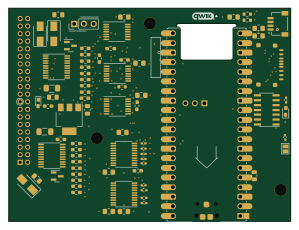 Raspberry Pi
PowerBook
74.5 × 56.3 mm78 parts2LGPL-3.0449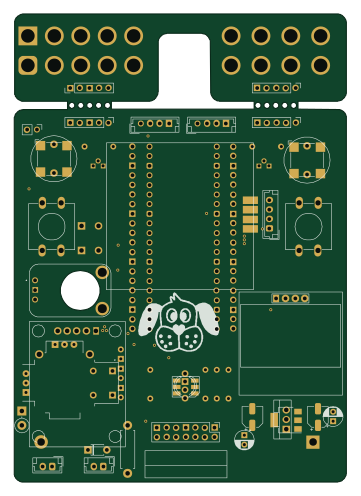 Raspberry Pi
BitDogLab 5.4
BitDogLab
87.9 × 123.9 mm56 parts2LCERN-OHL-S-2.0201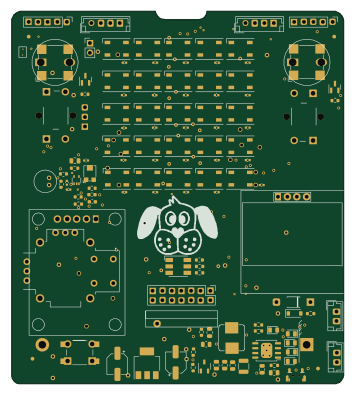 Raspberry Pi
BitDogLab Main SMD version
87.9 × 98.7 mm124 parts2LCERN-OHL-S-2.0201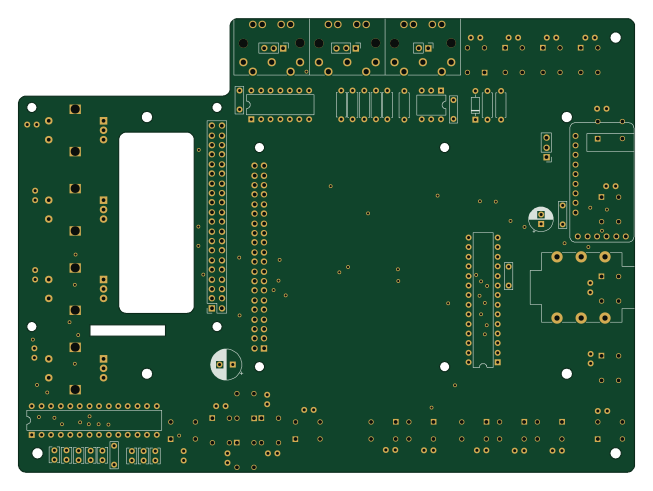 Raspberry Pi
Zynthian mini v2 20 buttons short
zynthian
163 × 120 mm87 parts2LNo license154