
Orca one

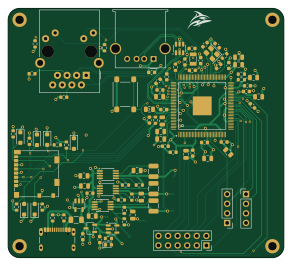
About the Orca one PCB
Orca one is an open source PCB design by Finn254254, published on GitHub under the CERN-OHL-S-2.0 license. It is a 4-layer board measuring 73 × 66 mm, with 96 components from 37 distinct parts.
Other key parts include the V3S, XC6206PXXXMR, TPS62160DGK, AP2127K-3.0 and TPS2041B. By type, the board carries 45 capacitors, 22 resistors, 8 ICs, 7 connectors, 7 diodes and 3 inductors.
From the project
Proprietary hardware files, schematics, PCB design, documentation and bring-up work for the Orca One V1.0 SBC.
Hardware design · PCB layout · ORCA OS testing · Bring-up documentation
Orca One is the first test board for Orca servers. The main purpose of the board is to give us our own hardware to start testing ORCA OS on.
The first goal is simple: get our lightweight Linux-based ORCA OS to successfully boot on hardware we designed ourselves. This board is not meant to be a powerful Orca server yet. It is a starting point for testing the hardware and software before moving onto more complicated boards.
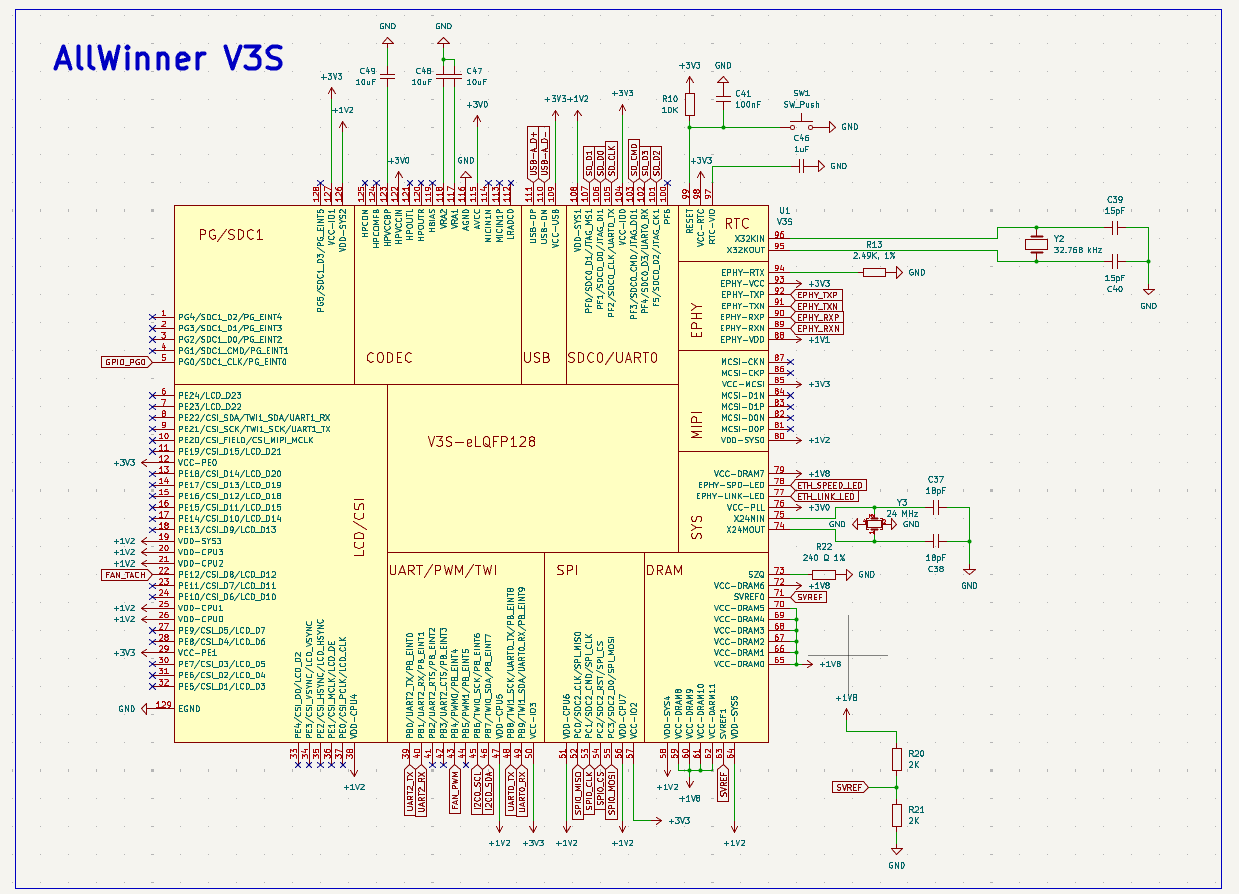
Main components on the Orca one
Orca one bill of materials (BOM)
96 components, 37 distinct parts — part numbers from the project's BOM.
| Qty | Part | Footprint | Refs |
|---|---|---|---|
| 1 | V3S Allwinner(全志) | LQFP-128_L14.0-W14.0-P0.40-LS16.0-BL-EP5.0 | U1 |
| 1 | XC6206PXXXMR XC6206PxxxMR | SOT-23-3 | U2 |
| 3 | TPS62160DGK | MSOP-8_3x3mm_P0.65mm | U3, U4, U6 |
| 1 | AP2127K-3.0 | SOT-23-5 | U5 |
| 1 | TPS2041B | SOT-23-5 | U7 |
| 1 | SRV05-4 | SOT-23-6 | U8 |
| 1 | 32.768 kHz | Crystal_SMD_3215-2Pin_3.2x1.5mm | Y2 |
| 1 | 24 MHz | Crystal_SMD_3225-4Pin_3.2x2.5mm | Y3 |
| 1 | USB_C_RECEPTACLE_USB2.0_16P USB_C_Receptacle_USB2.0_16P | USB_C_Receptacle_GCT_USB4105-xx-A_16P_TopMnt_Horizontal | J1 |
| 1 | Micro_SD_Card | microSD_HC_Molex_104031-0811 | J2 |
| 2 | CONN_01X04 Conn_01x04 | PinHeader_1x04_P2.54mm_Vertical | J3, J7 |
| 1 | USB_A | USB_A_Molex_67643_Horizontal | J4 |
| 1 | RJ45_AMPHENOL_RJMG1BD3B8K1ANR RJ45_Amphenol_RJMG1BD3B8K1ANR | RJ45_Amphenol_RJMG1BD3B8K1ANR | J5 |
| 1 | CONN_02X06_ODD_EVEN Conn_02x06_Odd_Even | PinSocket_2x06_P2.54mm_Vertical | J6 |
| 1 | 2A | Fuse_1206_3216Metric | F1 |
| 1 | SW_Push | SW_SPST_PTS645Sx43SMTR92 | SW1 |
| 1 | GREEN | LED_0603_1608Metric | D1 |
| 6 | D_TVS_Filled | D_SOD-123F | D2, D3, D4, D5, D6, D7 |
| 3 | 2.2 µH | L_1210_3225Metric | L1, L2, L3 |
| 2 | 1u | C_0603_1608Metric | C1, C2 |
Show 17 more
| Qty | Part | Footprint | Refs |
|---|---|---|---|
| 12 | 10UF 10uF | C_0805_2012Metric | C3, C8, C9, C17, C33, C34, C35, C47 +4 |
| 19 | 100NF 100nF | C_0603_1608Metric | C4, C5, C6, C7, C11, C12, C13, C15 +11 |
| 3 | 22UF 22uF | C_0805_2012Metric | C10, C14, C36 |
| 3 | 1UF 1uF | C_0805_2012Metric | C16, C50, C51 |
| 2 | 18PF 18pF | C_0603_1608Metric | C37, C38 |
| 2 | 15PF 15pF | C_0603_1608Metric | C39, C40 |
| 2 | 1UF 1uF | C_0603_1608Metric | C42, C46 |
| 2 | 5.1K | R_0603_1608Metric | R1, R2 |
| 3 | 1K | R_0603_1608Metric | R3, R11, R12 |
| 2 | 100K | R_0603_1608Metric | R4, R6 |
| 1 | 80.6K | R_0603_1608Metric | R5 |
| 2 | 200K | R_0603_1608Metric | R7, R9 |
| 1 | 75K | R_0603_1608Metric | R8 |
| 7 | 10K | R_0603_1608Metric | R10, R14, R15, R16, R17, R18, R19 |
| 1 | 2.49K, 1% | R_0603_1608Metric | R13 |
| 2 | 2K | R_0603_1608Metric | R20, R21 |
| 1 | 240 Ω 1% | R_0603_1608Metric | R22 |
Orca one design files
The KiCad project lives in the Finn254254/orca-one repository on GitHub; these links point at the commit this page was built from.
Orca one: common questions
How big is the Orca one PCB?
The Orca one measures 73 × 66 mm, has 4 copper layers and is 1.6 mm thick.
How many components are on the Orca one?
96 components, from 37 distinct parts, with part numbers taken from the project's own BOM. The full bill of materials is listed on this page.
Where can I download the Orca one design files?
From the Finn254254/orca-one repository on GitHub, which has the KiCad layout, the schematic and the BOM; the links under Design files point to each one.
Can I use the Orca one design in my own project?
Yes, under the terms of its CERN-OHL-S-2.0 license, which Finn254254 chose for the repository.