
DIY-Yoto

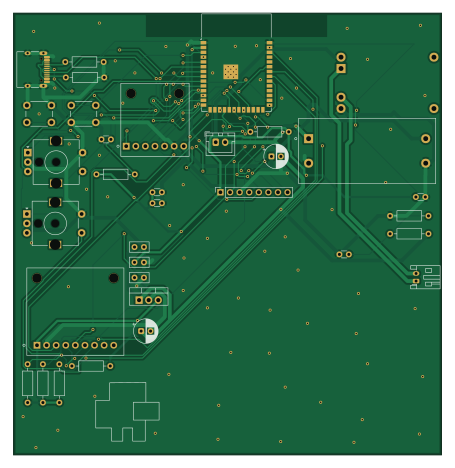
About the DIY-Yoto PCB
DIY-Yoto is an open source ESP32 PCB design by FTC27076, published on GitHub. It is a 2-layer board measuring 113.3 × 116.9 mm, with 32 components from 24 distinct parts.
Its main chip is the ESP32-S3-WROOM-1, from the ESP32 family. Other key parts include the MAX98357A. By type, the board carries 10 capacitors, 10 resistors, 7 connectors, 2 ICs, 2 switches and 1 module.
It belongs with the audio, power & battery and iot & wireless designs in this gallery.
From the project
Its a diy yoto
A screen-free, kid-friendly audio player in the style of a Yoto. Put a card on top and it plays that card's stories or songs. It runs fully offline: no Wi-Fi, no app, no account. All audio lives on a micro SD card, and any 13.56 MHz RFID card or NFC sticker can become a card.
- Tap a card to play, lift it to pause, put it back to resume where it stopped - Each card remembers which track it was on - Two knobs: volume (press to pause) and track skip (press to restart the track) - Volume cap for small ears - Rechargeable LiPo with USB-C charging; play while charging - Deep sleep after 5 minutes…
Main components on the DIY-Yoto
DIY-Yoto bill of materials (BOM)
32 components, 24 distinct parts — part numbers from the project's BOM.
| Qty | Part | Footprint | Refs |
|---|---|---|---|
| 1 | MAX98357A L7805 | TO-220-3_Vertical | U1 |
| 1 | ESP32-S3-WROOM-1 | ESP32-S3-WROOM-1ThermalVia0.3 | U2 |
| 1 | ~ | PinSocket_1x08_P2.54mm_Vertical | MOD1 |
| 1 | LiPo 1S | JST_PH_S2B-PH-K_1x02_P2.00mm_Horizontal | J3 |
| 1 | Power switch 2A+ | JST_XH_B2B-XH-A_1x02_P2.50mm_Vertical | J7 |
| 1 | TP4056-42-ESOP8 | TP4056_USBC_Protected_Module | J12 |
| 1 | MT3608 | MT3608_Boost_Module | J13 |
| 1 | MAX98357A | Adafruit_MAX98357A_3006 | J14 |
| 1 | Micro_SD_Card | Adafruit_MicroSD_SDIO_4682 | J15 |
| 1 | USB_C_Receptacle_USB2.0_16P | USB_C_Receptacle_HRO_TYPE-C-31-M-12 | J16 |
| 2 | SW_Push | SW_PUSH_6mm | SW2, SW3 |
| 1 | 10UF 100µF 16V electrolytic | CP_Radial_D6.3mm_P2.50mm | C1 |
| 3 | 10UF 10µF X5R radial ceramic | C_Disc_D5.0mm_W2.5mm_P2.50mm | C2, C3, C9 |
| 1 | 1UF 100nF ceramic disc | C_Disc_D3.0mm_W1.6mm_P2.50mm | C4 |
| 1 | 22UF 100µF 16V electrolytic | CP_Radial_D6.3mm_P2.50mm | C5 |
| 2 | 100NF 100nF ceramic disc | C_Disc_D3.0mm_W1.6mm_P2.50mm | C6, C10 |
| 1 | 22UF 100nF ceramic disc | C_Disc_D3.0mm_W1.6mm_P2.50mm | C7 |
| 1 | 22UF 1µF radial ceramic | C_Disc_D3.0mm_W1.6mm_P2.50mm | C8 |
| 2 | 5.1K 100k 1/4W | R_Axial_DIN0207_L6.3mm_D2.5mm_P10.16mm_Horizontal | R1, R2 |
| 3 | 10k 1/4W | R_Axial_DIN0207_L6.3mm_D2.5mm_P10.16mm_Horizontal | R3, R4, R5 |
Show 4 more
| Qty | Part | Footprint | Refs |
|---|---|---|---|
| 2 | 100K 10k 1/4W | R_Axial_DIN0207_L6.3mm_D2.5mm_P10.16mm_Horizontal | R6, R7 |
| 1 | 22K 10k 1/4W | R_Axial_DIN0207_L6.3mm_D2.5mm_P10.16mm_Horizontal | R8 |
| 1 | 5.1k | R_Axial_DIN0207_L6.3mm_D2.5mm_P10.16mm_Horizontal | R9 |
| 1 | 10K 5.1k | R_Axial_DIN0207_L6.3mm_D2.5mm_P10.16mm_Horizontal | R10 |
DIY-Yoto design files
The KiCad project lives in the FTC27076/DIY-Yoto repository on GitHub; these links point at the commit this page was built from.
- LayoutUntitled.kicad_pcb
- SchematicUntitled.kicad_sch
- BOMUntitled.csv
DIY-Yoto: common questions
What microcontroller does the DIY-Yoto use?
The DIY-Yoto is built around the ESP32-S3-WROOM-1, from the ESP32 family.
How big is the DIY-Yoto PCB?
The DIY-Yoto measures 113.3 × 116.9 mm, has 2 copper layers and is 1.6 mm thick.
How many components are on the DIY-Yoto?
32 components, from 24 distinct parts, with part numbers taken from the project's own BOM. The full bill of materials is listed on this page.
Where can I download the DIY-Yoto design files?
From the FTC27076/DIY-Yoto repository on GitHub, which has the KiCad layout, the schematic and the BOM; the links under Design files point to each one.
Can I use the DIY-Yoto design in my own project?
The repository has no license, so all rights stay with FTC27076. Use it as a reference, and ask the author before reusing the design.
Can I test firmware for the DIY-Yoto without the hardware?
Yes. HardLabs builds a simulation of the board from its netlist and BOM, so you can run and debug ESP32 firmware against it before you order a PCB.
Similar boards
 ESP32
OSO-BOOK-B1
joeycastillo
85 × 115 mm65 parts2LCC-BY-SA-4.08.1k ESP32
Powertrain
byrantech
64 × 45.4 mm171 parts4LMIT4.3k ESP32
Badge
atopile
56.3 × 39 mm239 parts4LMIT4.0k ESP32
Esp32 minimal
36.2 × 26.8 mm20 parts2LMIT4.0k ESP32
Controller
StuckAtPrototype
29 × 74 mm58 parts4LApache-2.03.8k ESP32
Racer
36 × 50.2 mm70 parts4LApache-2.03.8k