
Universal connector board

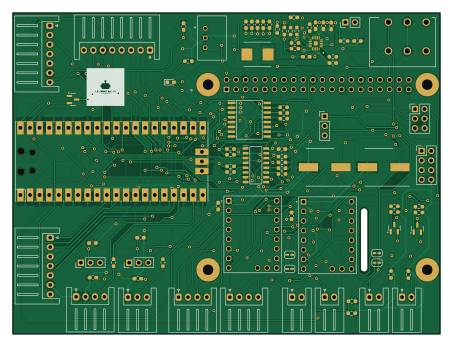
About the Universal connector board
Universal connector board is an open source Raspberry Pi PCB design by HCL-Hbot, published on GitHub. It is a 2-layer board measuring 113.1 × 85 mm, with 88 components from 53 distinct parts.
Its main chip is the RASPBERRY_PI_4B_4GB, from the Raspberry Pi family. Other key parts include the RPI_Pico_EvaluationBoard, SN74LV4052ADR, TPS51397ARJER, TCA9534DWR and TMC2209_MotorDriver. By type, the board carries 31 resistors, 22 capacitors, 14 connectors, 7 ICs, 7 jumpers and 3 transistors.
It belongs with the robotics & motion and displays & leds designs in this gallery.
From the project
1) Add explicit header pins next to the PICO. This can be useful to easily attach external equipment like a Logic Analyzer or TTL-module, or simply wires to a breadboard if needed. (You can see in the picture of the PCB that we soldered them on for now). 2) Flip the display pin o
1) Add explicit header pins next to the PICO. This can be useful to easily attach external equipment like a Logic Analyzer or TTL-module, or simply wires to a breadboard if needed. (You can see in the picture of the PCB that we soldered them on for now). 2) Flip the display pin order. This is convenient for testing and prototyping, because the displays can than just be connected (temporarily) to headers on the PCB without the need for several cables. 3) Add more silk layer documenation. Some of this was already actually done in the design, but some of these labels were skipped during…
Main components on the Universal connector board
Universal connector board bill of materials (BOM)
88 components, 53 distinct parts — part numbers from the project's BOM.
| Qty | Part | Footprint | Refs |
|---|---|---|---|
| 1 | RPI_Pico_EvaluationBoard | RPi_Pico_SMD_TH | IC1 |
| 1 | SN74LV4052ADR | SOIC127P600X175-16N | IC2 |
| 1 | TPS51397ARJER | QFN45P300X300X100-21N-D | IC3 |
| 1 | TCA9534DWR | SOIC127P1030X265-16N | IC4 |
| 2 | TMC2209_MotorDriver | MODULE_TMC2209_SILENTSTEPSTICK | U1, U2 |
| 1 | RASPBERRY_PI_4B_4GB | MODULE_RASPBERRY_PI_4B_4GB | U3 |
| 2 | 2N7002 | SOT-23 | Q1, Q2 |
| 1 | BSS84 | SOT-23 | Q3 |
| 1 | 691401700003B | 691401700003B | J1 |
| 1 | Display1 | JST_XH_S7B-XH-A_1x07_P2.50mm_Horizontal | J2 |
| 1 | Display2 | JST_XH_S7B-XH-A_1x07_P2.50mm_Horizontal | J3 |
| 1 | Ledstrip2 | JST_XH_S3B-XH-A_1x03_P2.50mm_Horizontal | J5 |
| 1 | Extra MUX_UART | PinHeader_2x04_P2.54mm_Vertical | J6 |
| 1 | Radar | JST_XH_S8B-XH-A_1x08_P2.50mm_Horizontal | J7 |
| 1 | Ledstrip1 | JST_XH_S4B-XH-A_1x04_P2.50mm_Horizontal | J8 |
| 1 | Mouth | JST_XH_S2B-XH-A_1x02_P2.50mm_Horizontal | J9 |
| 1 | Cheeks | JST_XH_S2B-XH-A_1x02_P2.50mm_Horizontal | J10 |
| 1 | MD_SW1 | JST_XH_S2B-XH-A_1x02_P2.50mm_Horizontal | J11 |
| 1 | MD_SW2 | JST_XH_S2B-XH-A_1x02_P2.50mm_Horizontal | J12 |
| 1 | Motor1 | JST_XH_S4B-XH-A_1x04_P2.50mm_Horizontal | J13 |
Show 33 more
| Qty | Part | Footprint | Refs |
|---|---|---|---|
| 1 | Motor2 | JST_XH_S4B-XH-A_1x04_P2.50mm_Horizontal | J14 |
| 1 | Extra VCC/GND | PinHeader_2x03_P2.54mm_Vertical | J15 |
| 1 | Mux_Vcc | PinHeader_1x03_P2.54mm_Vertical | JP1 |
| 4 | Jumper_2_Open | SolderJumper-2_P1.3mm_Open_RoundedPad1.0x1.5mm | JP2, JP3, JP4, JP5 |
| 1 | Ledstrip1_VCC | PinHeader_1x03_P2.54mm_Vertical | JP6 |
| 1 | Ledstrip2_VCC | PinHeader_1x03_P2.54mm_Vertical | JP7 |
| 1 | TSR 1-2433 TSR_1-2433 | TSR-1-2433 | PS1 |
| 1 | SW_Push | PinHeader_1x02_P2.54mm_Vertical | SW1 |
| 1 | LED | LED_0603_1608Metric_Pad1.05x0.95mm_HandSolder | D1 |
| 1 | SRP6540-1R0M | INDPM7265X400N | L1 |
| 4 | 0.10μF | C_0603_1608Metric_Pad1.08x0.95mm_HandSolder | C1, C19, C20, C21 |
| 2 | 1000μF | C_0603_1608Metric_Pad1.08x0.95mm_HandSolder | C2, C3 |
| 1 | 1uF | C_0603_1608Metric_Pad1.08x0.95mm_HandSolder | C4 |
| 2 | 22uF | C_0603_1608Metric_Pad1.08x0.95mm_HandSolder | C5, C6 |
| 3 | 0.1uF | C_0603_1608Metric_Pad1.08x0.95mm_HandSolder | C7, C8, C10 |
| 1 | 100pF | C_0603_1608Metric_Pad1.08x0.95mm_HandSolder | C9 |
| 4 | 47µF | C_0603_1608Metric_Pad1.08x0.95mm_HandSolder | C11, C12, C13, C14 |
| 2 | MAL214699103E3 Elec_Capacitor | CAPAE1000X1050N | C15, C17 |
| 2 | 100nF 50V | C_0603_1608Metric_Pad1.08x0.95mm_HandSolder | C16, C18 |
| 1 | 100nF | C_0603_1608Metric_Pad1.08x0.95mm_HandSolder | C22 |
| 9 | 100k | R_0603_1608Metric_Pad0.98x0.95mm_HandSolder | R1, R2, R3, R4, R5, R6, R7, R8 +1 |
| 2 | 470 | R_0603_1608Metric_Pad0.98x0.95mm_HandSolder | R9, R10 |
| 2 | 0 | R_0603_1608Metric_Pad0.98x0.95mm_HandSolder | R11, R18 |
| 1 | 330k | R_0603_1608Metric_Pad0.98x0.95mm_HandSolder | R13 |
| 2 | 15k | R_0603_1608Metric_Pad0.98x0.95mm_HandSolder | R14, R17 |
| 1 | 51.1 | R_0603_1608Metric_Pad0.98x0.95mm_HandSolder | R15 |
| 1 | 110k | R_0603_1608Metric_Pad0.98x0.95mm_HandSolder | R16 |
| 3 | 10k | R_0603_1608Metric_Pad0.98x0.95mm_HandSolder | R19, R20, R21 |
| 2 | 47 | R_0603_1608Metric_Pad0.98x0.95mm_HandSolder | R22, R29 |
| 4 | 50k | R_0603_1608Metric_Pad0.98x0.95mm_HandSolder | R23, R25, R26, R28 |
| 1 | 75 | R_0603_1608Metric_Pad0.98x0.95mm_HandSolder | R24 |
| 2 | 100 | R_0603_1608Metric_Pad0.98x0.95mm_HandSolder | R27, R30 |
| 1 | 4.7k | R_0603_1608Metric_Pad0.98x0.95mm_HandSolder | R31 |
Universal connector board design files
The KiCad project lives in the HCL-Hbot/universal_connector_board repository on GitHub; these links point at the commit this page was built from.
Universal connector board: common questions
What microcontroller does the Universal connector board use?
The Universal connector board is built around the RASPBERRY_PI_4B_4GB, from the Raspberry Pi family.
How big is the Universal connector board?
The Universal connector board measures 113.1 × 85 mm, has 2 copper layers and is 1.6 mm thick.
How many components are on the Universal connector board?
88 components, from 53 distinct parts, with part numbers taken from the project's own BOM. The full bill of materials is listed on this page.
Where can I download the Universal connector board design files?
From the HCL-Hbot/universal_connector_board repository on GitHub, which has the KiCad layout, the schematic and the BOM; the links under Design files point to each one.
Can I use the Universal connector board design in my own project?
The repository has no license, so all rights stay with HCL-Hbot. Use it as a reference, and ask the author before reusing the design.
Can I test firmware for the Universal connector board without the hardware?
Yes. HardLabs builds a simulation of the board from its netlist and BOM, so you can run and debug Raspberry Pi firmware against it before you order a PCB.
Similar boards
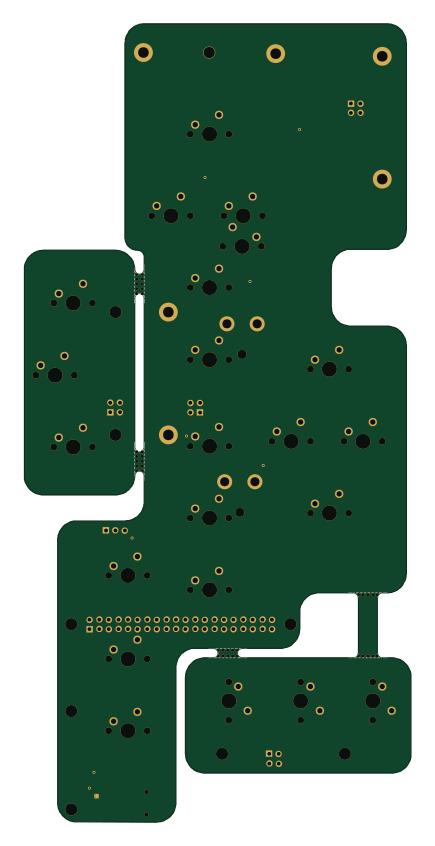 Raspberry Pi
Haxo hw
cardonabits
102.4 × 211.3 mm38 parts2LCustom license672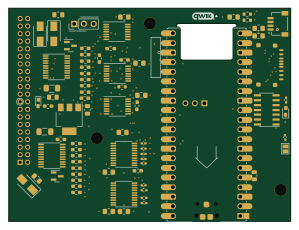 Raspberry Pi
PowerBook
BlueSCSI
74.5 × 56.3 mm78 parts2LGPL-3.0449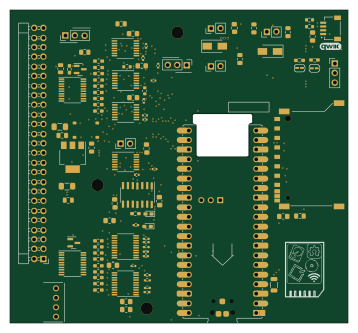 Raspberry Pi
Desktop 50 Pin TopConn
89.2 × 82.6 mm103 parts2LGPL-3.0449 Raspberry Pi
BitDogLab 5.4
BitDogLab
87.9 × 123.9 mm56 parts2LCERN-OHL-S-2.0201 Raspberry Pi
BitDogLab Main SMD version
87.9 × 98.7 mm124 parts2LCERN-OHL-S-2.0201 Raspberry Pi
Zynthian mini v2 20 buttons short
zynthian
163 × 120 mm87 parts2LNo license154