
PDA

About the PDA PCB
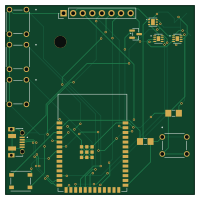
PDA is an open source ESP32 PCB design by jacobjuneau6, published on GitHub under the MIT license. It is a 2-layer board measuring 50 × 50 mm, with 15 components from 11 distinct parts.
Its main chip is the 5407-ESP32-S3-WROOM-1-N16R8, from the ESP32 family. Other key parts include the MCP73831T-2DCI/MC, TPS74533PCQWDRVRQ1, MAX17048G+T10 and 785-1000-1. By type, the board carries 5 ICs, 4 switches, 2 connectors, 2 resistors, 1 LED and 1 inductor.
It belongs with the displays & leds and power & battery designs in this gallery.
From the project
A simple ESP32-S3 based phone companion and pocket computer. This open-source hardware project includes a custom PCB, 3D-printable case, and Arduino firmware — everything you need to build a portable device with a color TFT display, LiPo battery management, and physical navigatio
A simple ESP32-S3 based phone companion and pocket computer. This open-source hardware project includes a custom PCB, 3D-printable case, and Arduino firmware — everything you need to build a portable device with a color TFT display, LiPo battery management, and physical navigation buttons.
- ESP32-S3-WROOM-1-N16R8 module (16 MB flash, 8 MB PSRAM) - ST7789 240×320 TFT color display with PWM backlight control - MAX17048 LiPo fuel gauge for accurate battery state-of-charge - MCP73831 Li-Ion/Li-Po battery charger (charges via USB) - WS2812/NeoPixel RGB status LED - 3 navigation buttons (UP…
Main components on the PDA
PDA bill of materials (BOM)
15 components, 11 distinct parts — part numbers from the project's BOM.
| Qty | Part | Footprint | Refs |
|---|---|---|---|
| 1 | 5407-ESP32-S3-WROOM-1-N16R8 ESP32-S3-WROOM-1-N16R8 | ESP32-S3-WROOM-1_EXP | U1 |
| 1 | MCP73831T-2DCI/MC MCP73831T-2DCI_MC | SON50P200X200X80-9N | U2 |
| 1 | TPS74533PCQWDRVRQ1 TI(德州仪器) | WSON-6_L2.0-W2.0-P0.65-TL-EP | U3 |
| 1 | MAX17048G+T10 MAX17048G_T10 | SON50P200X200X80-9N | U4 |
| 1 | 785-1000-1 AO3400A | SOT-23 | U5 |
| 1 | 137-RAHMB20AUETR RAHMB20AUETR | SWITCHCRAFT_RAHMB20AUETR | J1 |
| 1 | PINHD_1x2_Male | PinHeader_1x02_P2.54mm_Vertical_SMD_Pin1Left | J2 |
| 4 | SW401 B3F-1002 | SW_B3F-1000_OMR | SW1, SW2, SW3, SW4 |
| 1 | 568-16347 COM-16347 | COM-16347_SPK | LED1 |
| 1 | ~ | PinHeader_1x08_P2.54mm_Vertical | L1 |
| 2 | 13-RC1206FR-132KL RC1206FR-132KL | RESC3216X65 | R1, R2 |
PDA design files
The KiCad project lives in the jacobjuneau6/PDA repository on GitHub; these links point at the commit this page was built from.
- Layoutboard/board.kicad_pcb
- Schematicboard/board.kicad_sch
- BOMBOM.csv
PDA: common questions
What microcontroller does the PDA use?
The PDA is built around the 5407-ESP32-S3-WROOM-1-N16R8, from the ESP32 family.
How big is the PDA PCB?
The PDA measures 50 × 50 mm, has 2 copper layers and is 1.6 mm thick.
How many components are on the PDA?
15 components, from 11 distinct parts, with part numbers taken from the project's own BOM. The full bill of materials is listed on this page.
Where can I download the PDA design files?
From the jacobjuneau6/PDA repository on GitHub, which has the KiCad layout, the schematic and the BOM; the links under Design files point to each one.
Can I use the PDA design in my own project?
Yes, under the terms of its MIT license, which jacobjuneau6 chose for the repository.
Can I test firmware for the PDA without the hardware?
Yes. HardLabs builds a simulation of the board from its netlist and BOM, so you can run and debug ESP32 firmware against it before you order a PCB.
Similar boards
 ESP32
ESP32Open Book Abridged Edition
joeycastillo
85 × 115 mm65 parts2LCC-BY-SA-4.08.1k ESP32
ESP32Esp32 minimal
atopile
36.2 × 26.8 mm20 parts2LMIT4.0k ESP32
ESP32Badge
56.3 × 39 mm239 parts4LMIT4.0k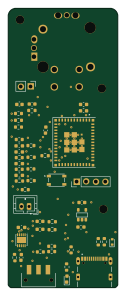 ESP32
ESP32Controller
StuckAtPrototype
29 × 74 mm58 parts4LApache-2.03.8k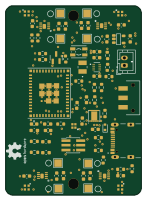 ESP32
ESP32Racer
36 × 50.2 mm70 parts4LApache-2.03.8k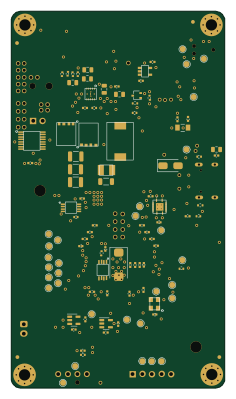 ESP32
ESP32Bitaxe
skot
56.5 × 99.8 mm86 parts4LCERN-OHL-S-2.01.4k