
Tedium X8

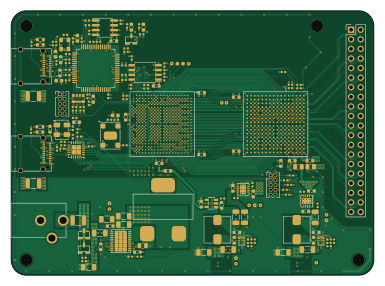
About the Tedium X8 PCB
Tedium X8 is an open source FPGA PCB design by jboone, published on GitHub under the BSD-3-Clause license. It is a 4-layer board measuring 96 × 70 mm, with 279 components from 74 distinct parts.
Its main chip is the LFE5U-85F-8BG381, from the FPGA family. Other key parts include the TPS53318, TPS62823, XRT86VX38, ADM7171ACPZ-3.3-R7 and ADP150AUJZ-2.5-R7. By type, the board carries 138 capacitors, 78 resistors, 18 ICs, 16 test points, 11 inductors and 6 connectors.
It belongs with the usb & debug tools designs in this gallery.
From the project
TDM telephony experimentation
oss-cad-suite: open-source digital design and verification tools, with nightly binary builds. poetry: Python dependencies and packaging management tool. g++-riscv64-linux-gnu rustup toolchain install stable -t riscv32i-unknown-none-elf
Clone this repository, and generally follow these steps:
NOTE: My Tedium .venv got weird when I had the "OSS CAD Suite" environment already enabled. Poetry would download dependencies on poetry install or poetry update, but would then delete them when running poetry run or poetry shell.
Main components on the Tedium X8
Tedium X8 bill of materials (BOM)
279 components, 74 distinct parts.
| Qty | Part | Footprint | Refs |
|---|---|---|---|
| 1 | LFE5U-85F-8BG381 | LATTICE_BGA_CABGA381 | U1 |
| 1 | TPS53318 | IPC_SON23P50_600X500X150L50X27T547X324N | U2 |
| 2 | TPS62823 | IPC_SON8P50_200X150X100L35X25N | U3, U4 |
| 1 | XRT86VX38 | IPC_BGA256CP100_16X16_1700X1700X178B55N | U5 |
| 1 | ADM7171ACPZ-3.3-R7 | IPC_SON9P50_300X300X80L40X25T244X160N | U6 |
| 1 | ADP150AUJZ-2.5-R7 | IPC_SOT23-5P95_280X100L45X40N | U7 |
| 1 | ADM7171ACPZ-1.8-R7 | IPC_SON9P50_300X300X80L40X25T244X160N | U8 |
| 1 | 93LC46C | IPC_SOIC8P127_490X600X175L83X41N | U9 |
| 1 | FT2232H | IPC_QFP64P50_1200X1200X160L60X22N | U10 |
| 1 | USB3317C-CP | IPC_QFN25P50_400X400X100L40X24T250N | U11 |
| 2 | INA180B3 | TI_DBV_SOT-23-5 | U12, U17 |
| 4 | INA180B2 | TI_DBV_SOT-23-5 | U13, U15, U16, U18 |
| 1 | QSPI8 | IPC_SOIC8P127_528X790X216L65X41N | U14 |
| 1 | BC817 | IPC_SOT23-3P95_237X112L50X42N | Q1 |
| 2 | Q_PMOS_GSD | IPC_SOT23-3P95_237X112L50X42N | Q2, Q3 |
| 1 | 16M384 | ASVMB | X1 |
| 1 | 12M | IPC_OSCCC320X250X120L75X100N | X2 |
| 1 | 26M | IPC_OSCSC4P254_500X320X140L100X120N | X3 |
| 1 | BARREL_JACK | PJ-102AH | CON1 |
| 1 | Conn_02x20_Odd_Even | PinHeader_2x20_P2.54mm_Vertical | J1 |
Show 54 more
| Qty | Part | Footprint | Refs |
|---|---|---|---|
| 1 | DNP | PinHeader_2x05_P1.27mm_Vertical | J3 |
| 1 | Conn_ARM_JTAG_SWD_10 | PinHeader_2x05_P1.27mm_Vertical | J5 |
| 2 | USB_C | 12401610E4#2A | P1, P2 |
| 3 | Polyfuse_Small | IPC_FUSSC257X321X120L50N | F1, F2, F3 |
| 1 | V1P1_I | TP_1MM | TP1 |
| 1 | V3P8_I | TP_1MM | TP2 |
| 1 | V2P3_I | TP_1MM | TP3 |
| 1 | V3P3_I | TP_1MM | TP4 |
| 1 | V2P5_I | TP_1MM | TP5 |
| 1 | V1P8_I | TP_1MM | TP6 |
| 4 | TestPoint | TP_1MM | TP7, TP8, TP9, TP10 |
| 6 | GND | TP_1MM | TP11, TP12, TP13, TP14, TP15, TP16 |
| 3 | LED | IPC_LEDC1608X90L40N | D1, D2, D3 |
| 6 | L_Small | IPC_BEADC160X80X95L40N | L1, L7, L8, L9, L10, L11 |
| 2 | 470N | WE-HCI_7050 | L2, L3 |
| 1 | 1U | SER1590 | L4 |
| 2 | L_Small | IPC_BEADC200X125X105L50N | L5, L6 |
| 17 | 10U | IPC_CAPC160X80X90L35N | C1, C2, C28, C29, C31, C32, C33, C34 +9 |
| 67 | 100N | IPC_CAPC60X30X33L15N | C3, C4, C5, C6, C7, C8, C9, C10 +59 |
| 4 | 1U | IPC_CAPC160X80X90L35N | C12, C20, C129, C137 |
| 1 | 47U | IPC_CAPC320X160X180L55N | C16 |
| 10 | 4U7 | IPC_CAPC160X80X90L35N | C17, C18, C19, C81, C82, C83, C86, C87 +2 |
| 2 | 100N | IPC_CAPC200X125X135L45N | C21, C25 |
| 1 | 1N2 | IPC_CAPC160X80X90L35N | C22 |
| 2 | 120P | IPC_CAPC100X50X55L25N | C23, C24 |
| 2 | 100U | IPC_CAPC320X160X180L55N | C26, C80 |
| 2 | 22U | IPC_CAPC160X80X90L35N | C27, C38 |
| 20 | 100N | IPC_CAPC100X50X55L25N | C30, C35, C36, C89, C94, C95, C99, C100 +12 |
| 2 | ? | IPC_CAPC100X50X55L25N | C84, C85 |
| 3 | 10N | IPC_CAPC100X50X55L25N | C90, C119, C127 |
| 2 | 100N | IPC_CAPC160X80X90L35N | C126, C128 |
| 3 | 22U | IPC_CAPC320X160X180L55N | C133, C134, C135 |
| 15 | 10K | IPC_RESC100X50X40L25N | R1, R29, R31, R37, R41, R42, R43, R44 +7 |
| 1 | 0R01 | IPC_RESC320X160X89L51N | R2 |
| 10 | 100K | IPC_RESC100X50X40L25N | R3, R6, R7, R9, R23, R25, R28, R56 +2 |
| 5 | 0R1 | IPC_RESC320X160X89L51N | R4, R5, R49, R51, R55 |
| 2 | 30K | IPC_RESC100X50X40L25N | R8, R10 |
| 1 | 68K1 | IPC_RESC100X50X40L25N | R11 |
| 1 | 432R | IPC_RESC100X50X40L25N | R12 |
| 3 | 1K | IPC_RESC100X50X40L25N | R13, R19, R30 |
| 5 | DNP | IPC_RESC100X50X40L25N | R14, R15, R18, R20, R22 |
| 5 | 10R | IPC_RESC100X50X40L25N | R16, R17, R54, R63, R64 |
| 11 | 4K7 | IPC_RESC100X50X40L25N | R21, R32, R34, R38, R40, R46, R47, R48 +3 |
| 1 | 536K | IPC_RESC100X50X40L25N | R24 |
| 1 | 50R | IPC_RESC100X50X40L25N | R26 |
| 1 | 280K | IPC_RESC100X50X40L25N | R27 |
| 5 | 2K2 | IPC_RESC100X50X40L25N | R33, R35, R36, R61, R67 |
| 2 | 330R | IPC_RESC160X80X55L25N | R39, R70 |
| 1 | 7K68 | IPC_RESC100X50X40L25N | R45 |
| 1 | 12K | IPC_RESC100X50X40L25N | R66 |
| 1 | 8K06 | IPC_RESC100X50X40L25N | R71 |
| 4 | 5K1 | IPC_RESC100X50X40L25N | R73, R74, R75, R76 |
| 1 | 100R | IPC_RESC100X50X40L25N | R77 |
| 1 | 100R | IPC_RESCAXS8P80_320X160X60L30X45N | RN1 |
Tedium X8 design files
The KiCad project lives in the jboone/tedium repository on GitHub; these links point at the commit this page was built from.
Tedium X8: common questions
What microcontroller does the Tedium X8 use?
The Tedium X8 is built around the LFE5U-85F-8BG381, from the FPGA family.
How big is the Tedium X8 PCB?
The Tedium X8 measures 96 × 70 mm, has 4 copper layers and is 1.6 mm thick.
How many components are on the Tedium X8?
279 components, from 74 distinct parts. The full bill of materials is listed on this page.
Where can I download the Tedium X8 design files?
From the jboone/tedium repository on GitHub, which has the KiCad layout and the schematic; the links under Design files point to each one.
Can I use the Tedium X8 design in my own project?
Yes, under the terms of its BSD-3-Clause license, which jboone chose for the repository.
Can I test firmware for the Tedium X8 without the hardware?
Yes. HardLabs builds a simulation of the board from its netlist and BOM, so you can run and debug FPGA firmware against it before you order a PCB.
More boards in tedium
Similar boards
 FPGA
FPGABase board
GlasgowEmbedded
80 × 49 mm222 parts4L0BSD2.2k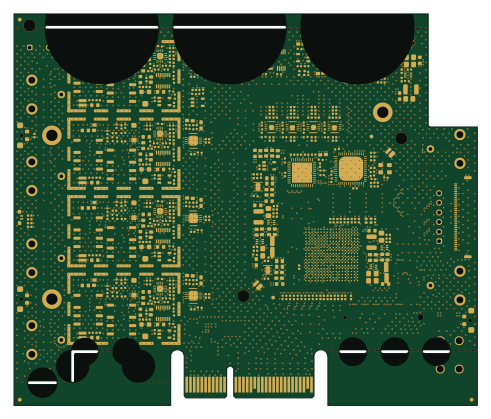 FPGA
FPGAThunderscope Rev5.3
EEVengers
122.5 × 103.5 mm817 parts6LMIT1.3k FPGA
FPGAUsb sniffer
ataradov
58.2 × 38.1 mm86 parts2LBSD-3-Clause1.3k FPGA
FPGATomu, I'm
theacodes
13 × 9.4 mm40 parts4LMIT1.1k FPGA
FPGAIcepi zero
cheyao
65 × 30 mm143 parts4LSHL-2.1828 FPGA
FPGAGcvideo
ikorb
49 × 30 mm44 parts4LNo license765