
Slow clock

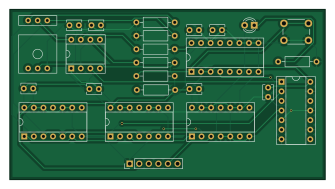
About the Slow clock PCB
Slow clock is an open source PCB design by lafehubert, published on GitHub. It is a 2-layer board measuring 83.6 × 45.1 mm, with 26 components from 18 distinct parts.
Other key parts include the LM555, 74LS14, 74LS08, 74LS123 and 74HCT00. By type, the board carries 8 capacitors, 7 resistors, 6 ICs, 2 switches, 1 connector and 1 diode.
From the project
A place for info and code relating to my electronics projects
This slow clock was initially inspired by Ben Eater's design (https://eater.net/8bit/clock) but I found the 555 to be too fiddly for the monostable stage, and overkill for the bistable stage, so I used a 74LS123 for the former and an R-S latch made from a couple of NANDs on a 74LS00 for the latter. I also replaced the 74LS04 with a 74LS14 which seemed to clean up the waveform a good bit.
Main components on the Slow clock
Slow clock bill of materials (BOM)
26 components, 18 distinct parts.
| Qty | Part | Footprint | Refs |
|---|---|---|---|
| 1 | LM555 | DIP-8_W7.62mm_Socket | U1 |
| 1 | 74LS14 | DIP-14_W7.62mm_Socket | U2 |
| 1 | 74LS08 | DIP-14_W7.62mm_Socket | U3 |
| 1 | 74LS123 | DIP-16_W7.62mm_Socket | U4 |
| 1 | 74HCT00 | DIP-14_W7.62mm_Socket | U5 |
| 1 | 74LS32 | DIP-14_W7.62mm_Socket | U6 |
| 1 | Conn_01x06_Male | PinHeader_1x06_P2.54mm_Vertical | J1 |
| 1 | 1 MΩ | GM_Small_Square_9mm_Pot | RV1 |
| 1 | SW_Push | SW_PUSH_6mm | SW1 |
| 1 | SW_SPDT | GM_SPDT_Slide_Switch | SW2 |
| 1 | Blue 3mm LED | LED_D3.0mm | D1 |
| 1 | 0.01 µF | C_Disc_D3.8mm_W2.6mm_P2.50mm | C1 |
| 2 | 1 µF | C_Disc_D3.8mm_W2.6mm_P2.50mm | C2, C3 |
| 5 | 0.1 µF | C_Disc_D3.8mm_W2.6mm_P2.50mm | C4, C5, C6, C7, C8 |
| 2 | 1 kΩ | R_Axial_DIN0207_L6.3mm_D2.5mm_P10.16mm_Horizontal | R1, R2 |
| 1 | 820 kΩ | R_Axial_DIN0207_L6.3mm_D2.5mm_P10.16mm_Horizontal | R3 |
| 3 | 10 kΩ | R_Axial_DIN0207_L6.3mm_D2.5mm_P10.16mm_Horizontal | R4, R6, R7 |
| 1 | 330 Ω | R_Axial_DIN0207_L6.3mm_D2.5mm_P10.16mm_Horizontal | R5 |
Slow clock design files
The KiCad project lives in the lafehubert/electronics repository on GitHub; these links point at the commit this page was built from.
Slow clock: common questions
How big is the Slow clock PCB?
The Slow clock measures 83.6 × 45.1 mm, has 2 copper layers and is 1.6 mm thick.
How many components are on the Slow clock?
26 components, from 18 distinct parts. The full bill of materials is listed on this page.
Where can I download the Slow clock design files?
From the lafehubert/electronics repository on GitHub, which has the KiCad layout; the links under Design files point to each one.
Can I use the Slow clock design in my own project?
The repository has no license, so all rights stay with lafehubert. Use it as a reference, and ask the author before reusing the design.
More boards in electronics
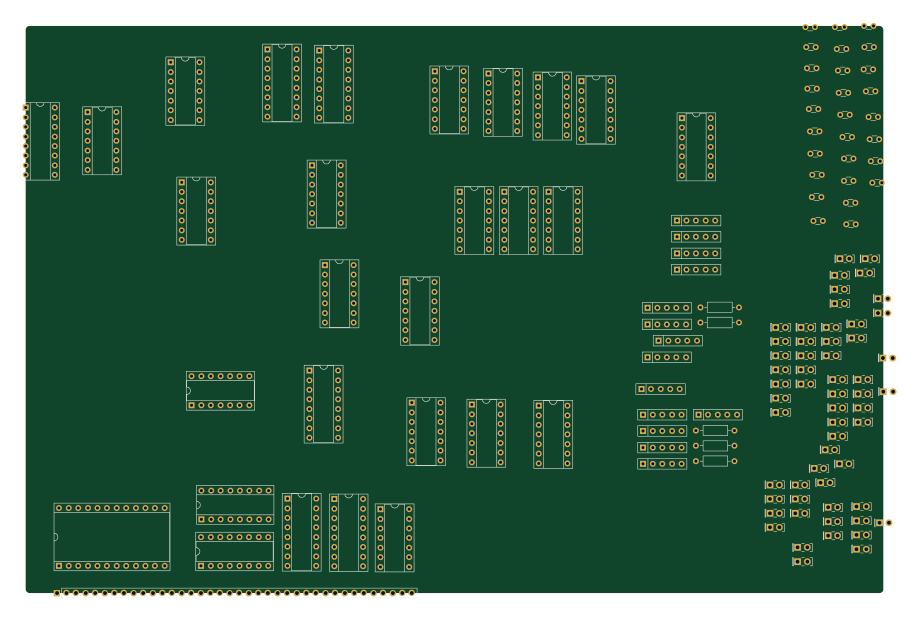
Ya4b alu
227 × 150.1 mm133 parts2LNo license0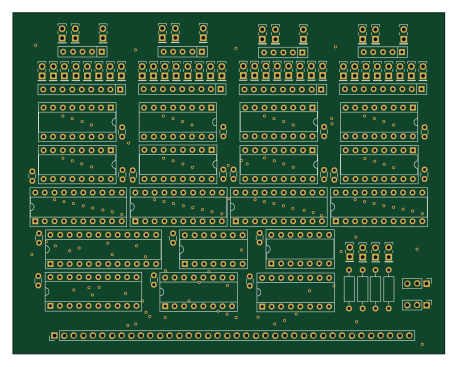
Address register bank
114.3 × 90.3 mm99 parts4LNo license0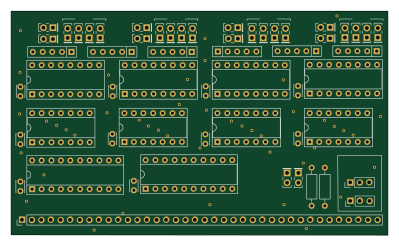
Data register bank
99.6 × 59.1 mm57 parts4LNo license0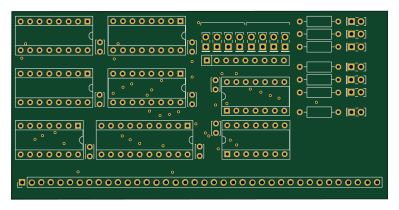
Transfer register board
99.5 × 49.7 mm40 parts2LNo license0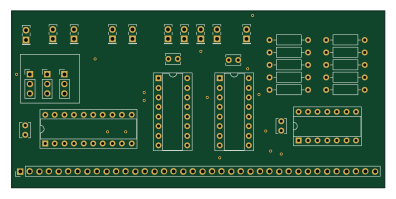
Ram-32-word
98.8 × 46.7 mm32 parts2LNo license0