
Slaveboard

About the Slaveboard PCB
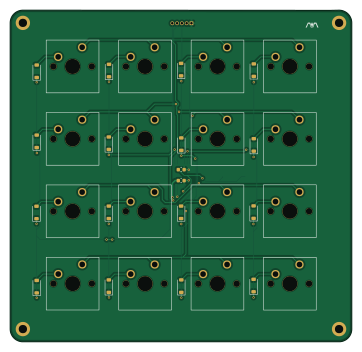
Slaveboard is an open source RISC-V PCB design by Magnetile, published on GitHub under the MIT license. It is a 4-layer board measuring 90.5 × 87.8 mm, with 19 components from 3 distinct parts.
Its main chip is the CH32V003FXPX, from the RISC-V family. By type, the board carries 16 diodes, 2 capacitors and 1 IC.
It belongs with the iot & wireless and power & battery designs in this gallery.
From the project
A open source modular wireless input device. Based on nRF52840
Open source modular wireless macropad system
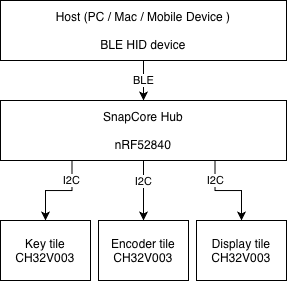
Magnetile is a modular wireless input device. A central hub connects to interchangeable input tiles - mechanical keys, rotary encoders, sliders, display keys - via magnetic pogo pin connectors. The hub presents as a single BLE HID device to the host. Everything is open source.
Tiles are hot-swappable modules. Each tile has its own small MCU communicating over I²C. The hub aggregates all input and handles the BLE stack. A single LiPo cell in the hub powers the entire system through the pogo pins.
Main components on the Slaveboard
Slaveboard bill of materials (BOM)
19 components, 3 distinct parts — part numbers from the project's BOM.
| Qty | Part | Footprint | Refs |
|---|---|---|---|
| 1 | CH32V003FXPX CH32V003FxPx | TSSOP-20_4.4x6.5mm_P0.65mm | U1 |
| 16 | 1N4148W | D_SOD-123 | D1, D2, D3, D4, D5, D6, D7, D8 +8 |
| 2 | 100NF 100nF | C_0603_1608Metric | C1, C2 |
Slaveboard design files
The KiCad project lives in the Magnetile/magnetile-hardware repository on GitHub; these links point at the commit this page was built from.
Slaveboard: common questions
What microcontroller does the Slaveboard use?
The Slaveboard is built around the CH32V003FXPX, from the RISC-V family.
How big is the Slaveboard PCB?
The Slaveboard measures 90.5 × 87.8 mm, has 4 copper layers and is 1.6 mm thick.
How many components are on the Slaveboard?
19 components, from 3 distinct parts, with part numbers taken from the project's own BOM. The full bill of materials is listed on this page.
Where can I download the Slaveboard design files?
From the Magnetile/magnetile-hardware repository on GitHub, which has the KiCad layout, the schematic and the BOM; the links under Design files point to each one.
Can I use the Slaveboard design in my own project?
Yes, under the terms of its MIT license, which Magnetile chose for the repository.
Can I test firmware for the Slaveboard without the hardware?
Yes. HardLabs builds a simulation of the board from its netlist and BOM, so you can run and debug RISC-V firmware against it before you order a PCB.
More boards in magnetile-hardware
Similar boards
 RISC-V
Audio
byrantech
27.8 × 22.3 mm38 parts2LMIT4.3k RISC-V
Workbench-1 Controller
Quchaosheng
160 × 130 mm106 parts8LApache-2.0129 RISC-V
Froggyswadge
cnlohr
81.5 × 72.2 mm92 parts2LMIT105 RISC-V
Keytartouch
152.5 × 117.5 mm69 parts2LMIT105 RISC-V
Ch32v003f4u6 with wsled
40.6 × 44.5 mm26 parts2LMIT105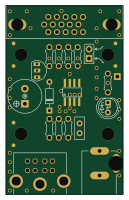 RISC-V
RVPC Rev B
OLIMEX
31 × 50 mm26 parts2LGPL-3.098