
Froggyswadge

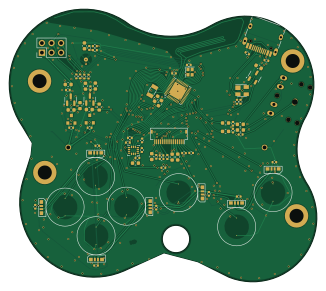
About the Froggyswadge PCB
Froggyswadge is an open source RISC-V PCB design by cnlohr, published on GitHub under the MIT license. It is a 2-layer board measuring 81.5 × 72.2 mm, with 92 components from 28 distinct parts.
Its main chip is the QFN-48-WCH-VARIANT-CH584-CH585-1EP_5x5mm_P0.35mm_EP3.7x3.7mm, from the RISC-V family. Other key parts include the SM5701_2.2V, XC6206PxxxMR, XT1861B332MR-G and LSM6DSL. By type, the board carries 35 capacitors, 18 resistors, 8 connectors, 8 diodes, 7 switches and 5 ICs.
It belongs with the audio, iot & wireless and displays & leds designs in this gallery.
From the project
My dumping grounds for all my kicad projects and random hardware bringup.
Single AA Battery, BH-AA-A1AJ020 -or- Rechargeable CR123 CPU: CH584M (C42381470) (54¢) 78MHz, RISC-V, IMBC 504kB Flash (Optional +512kB in CH584X) 96kB RAM 2.4GHz (BLE-only, no wifi) support NFC (13.56 MHz RFID) USBFS (Could be USBHS if 585M) 40 GPIOs Processor current is: 5uA Standby (with RTC) 2mA Operating, no radio 7mA (RX) 12mA (Peak TX) Boost supply C5345596, 2.2V VDD, CH584 can run at low voltage. LDO for USB operation to 3.3VDD. If rechargeable, need buck. OLED or LCD Consider OLED because lower power Consider monochrome OLED for cost. Many support greyscale. Consider LCD but higher…
Main components on the Froggyswadge
Froggyswadge bill of materials (BOM)
92 components, 28 distinct parts.
| Qty | Part | Footprint | Refs |
|---|---|---|---|
| 1 | ~ | QFN-48-WCH-VARIANT-CH584-CH585-1EP_5x5mm_P0.35mm_EP3.7x3.7mm | U1 |
| 1 | SM5701_2.2V | SOT-23 | U2 |
| 1 | XC6206PxxxMR | SOT-23-3 | U3 |
| 1 | XT1861B332MR-G | SOT-23 | U4 |
| 1 | LSM6DSL | LGA-14_3x2.5mm_P0.5mm_LayoutBorder3x4y | U6 |
| 2 | PMOS | SOT-23 | Q1, Q2 |
| 1 | 32MHz | Crystal_SMD_2016-4Pin_2.0x1.6mm | Y1 |
| 1 | 32.768kHz | Crystal_SMD_3215-2Pin_3.2x1.5mm | Y2 |
| 1 | SAO | PinHeader_2x03_P2.54mm_Vertical | J1 |
| 1 | PJ-307C | PJ-307C | J2 |
| 1 | RB130-2864KSWXG22 | FPC-16-P0.50mm-HC-FPC-05-09-16RLTAG-TOP-AND-BOTTOM | J3 |
| 4 | MOUNT | SMTSO20xx | J4, J5, J6, J7 |
| 1 | USB_C_Plug_USB2.0 | USB_C_Receptacle_HRO_TYPE-C-31-M-12 | P1 |
| 1 | Battery | 2460 | BT1 |
| 1 | 56db | INGHAi_MIC_GMI4013S-2C58DB | MK1 |
| 7 | SILICONE | BTC007_Button_Silicone | SW1, SW2, SW3, SW4, SW5, SW6, SW7 |
| 7 | SK6812-SIDE-A | LC8812-3210_XL-3210RGBC | D1, D2, D3, D4, D5, D6, D7 |
| 1 | SP0503BAHT | SOT-143 | D11 |
| 5 | 10uH | L_0603_1608Metric | L1, L2, L3, L4, L5 |
| 17 | 1μF | C_0402_1005Metric | C1, C4, C5, C12, C15, C16, C23, C24 +9 |
Show 8 more
| Qty | Part | Footprint | Refs |
|---|---|---|---|
| 2 | 100nF | C_0402_1005Metric | C2, C7 |
| 14 | 10μF | C_0603_1608Metric | C3, C6, C8, C10, C11, C13, C14, C17 +6 |
| 2 | 4.7nF | R_0402_1005Metric_COMPACT | C9, C22 |
| 9 | 5.1kΩ | R_0402_1005Metric_COMPACT | R1, R7, R8, R9, R10, R11, R12, R27 +1 |
| 5 | 33Ω | R_0402_1005Metric_COMPACT | R2, R3, R6, R13, R14 |
| 2 | 1MΩ | R_0402_1005Metric_COMPACT | R4, R5 |
| 1 | OLEDSHUNT | R_0402_1005Metric_COMPACT | R15 |
| 1 | 560kΩ | R_0402_1005Metric_COMPACT | R16 |
Froggyswadge design files
The KiCad project lives in the cnlohr/cnhardware repository on GitHub; these links point at the commit this page was built from.
Froggyswadge: common questions
What microcontroller does the Froggyswadge use?
The Froggyswadge is built around the QFN-48-WCH-VARIANT-CH584-CH585-1EP_5x5mm_P0.35mm_EP3.7x3.7mm, from the RISC-V family.
How big is the Froggyswadge PCB?
The Froggyswadge measures 81.5 × 72.2 mm, has 2 copper layers and is 1.6 mm thick.
How many components are on the Froggyswadge?
92 components, from 28 distinct parts. The full bill of materials is listed on this page.
Where can I download the Froggyswadge design files?
From the cnlohr/cnhardware repository on GitHub, which has the KiCad layout and the schematic; the links under Design files point to each one.
Can I use the Froggyswadge design in my own project?
Yes, under the terms of its MIT license, which cnlohr chose for the repository.
Can I test firmware for the Froggyswadge without the hardware?
Yes. HardLabs builds a simulation of the board from its netlist and BOM, so you can run and debug RISC-V firmware against it before you order a PCB.
More boards in cnhardware

Rgbwstrip120 250
250 × 10 mm90 parts2LMIT105
Ch32v307gigabit
90 × 60 mm83 parts2LMIT105 ESP32
ESP32Esp32s2-funprog
22 × 56 mm71 parts2LMIT105 RISC-V
Keytartouch
152.5 × 117.5 mm69 parts2LMIT105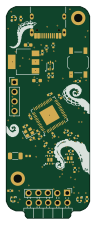 ESP32
ESP32Esp32s2-funprog2
22 × 56 mm41 parts2LMIT105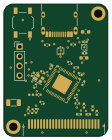 ESP32
ESP32RBO128128G-610-LCD
27.5 × 35 mm36 parts2LMIT105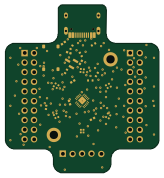 RISC-V
Ch32v003f4u6 with wsled
40.6 × 44.5 mm26 parts2LMIT105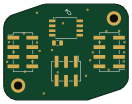 AVR/Arduino
Attiny85-testboard
33 × 25.4 mm5 parts2LMIT105
Similar boards
 RISC-V
Workbench-1 Controller
Quchaosheng
160 × 130 mm106 parts8LApache-2.0129 RISC-V
NorthPoleCircuit
Janky-Jingle-Crew
150 × 110 mm46 parts4LNo license62 RISC-V
Osc sg90-v006
OpenServoCore
20.6 × 9.6 mm26 parts4LApache-2.034 RISC-V
Panel
cheyao
99.2 × 100 mm9 parts2LSHL-2.132 RISC-V
Comu
9.4 × 13 mm9 parts2LSHL-2.132 RISC-V
Back
johanwheeler
82 × 82 mm145 parts2LMIT32