
OptoTACH

About the OptoTACH PCB
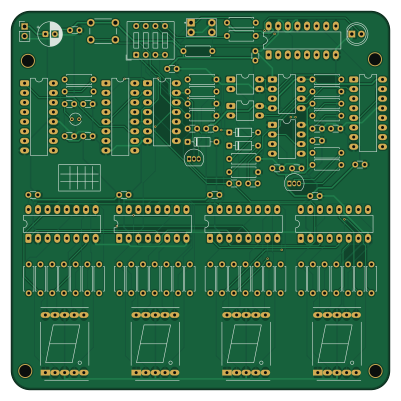
OptoTACH is an open source PCB design by maheen-ahmed1, published on GitHub under the MIT license. It is a 2-layer board measuring 100 × 100 mm, with 95 components from 31 distinct parts.
Other key parts include the TCRT5000, CD4093, PC817, NE555P and CD4017. By type, the board carries 45 resistors, 22 capacitors, 14 ICs, 4 LEDs, 4 diodes and 2 transistors.
From the project
Precision non-contact optical tachometer (0–9999 RPM/RPS) built entirely with discrete CMOS logic & 555 timers; no microcontroller, no firmware. Includes KiCad EDA, 3D model, Python simulation, and bench validation.
OptoTACH is a discrete hardware engineering project that implements a full-featured, 4-digit optical tachometer (0–9999 RPM / RPS / Event Counter) using pure CMOS logic and analog timing circuits—completely free of microcontrollers, firmware, and software dependencies.
This project was inspired by the original design published by Mousa Simple Projects (August 2020). However, the schematic in OptoTACH is fundamentally redesigned due to component obsolescence and supply-chain constraints.
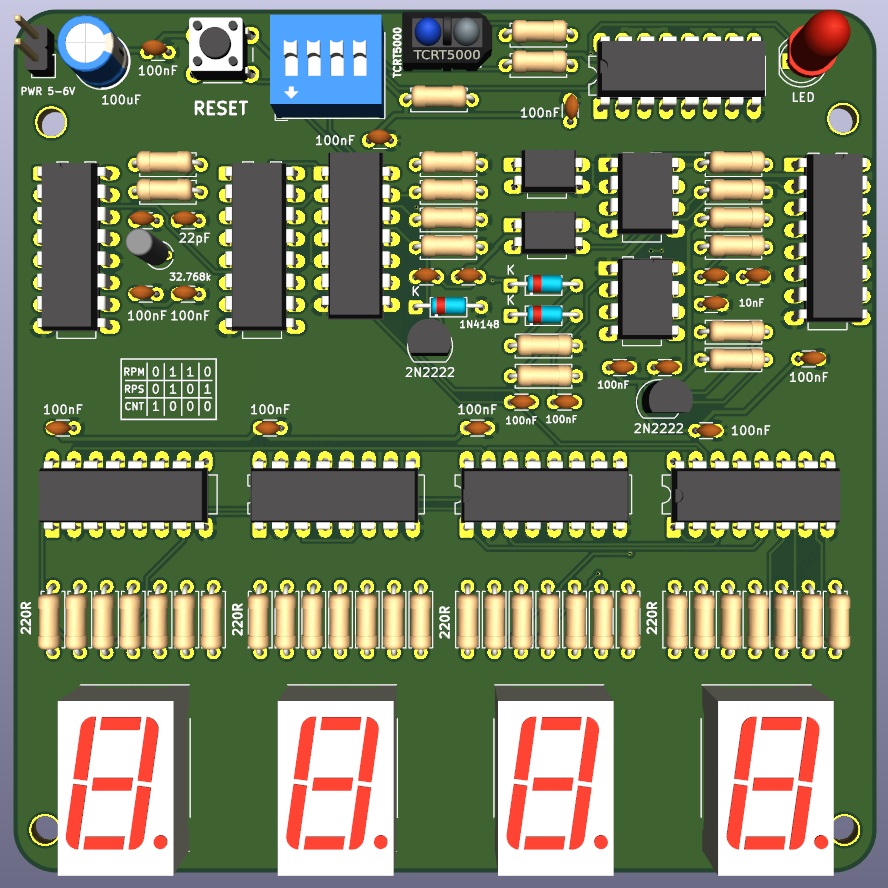
Main components on the OptoTACH
OptoTACH bill of materials (BOM)
95 components, 31 distinct parts.
| Qty | Part | Footprint | Refs |
|---|---|---|---|
| 1 | TCRT5000 | TCRT5000_NoClip | U1 |
| 1 | CD4093 | DIP-14_W7.62mm_LongPads | U2 |
| 2 | PC817 | DIP-4_W7.62mm_LongPads | U3, U5 |
| 2 | NE555P | DIP-8_W7.62mm_LongPads | U4, U6 |
| 2 | CD4017 | DIP-16_W7.62mm_LongPads | U7, U8 |
| 2 | CD4060 | DIP-16_W7.62mm_LongPads | U9, U10 |
| 4 | CD4026 | DIP-16_W7.62mm_LongPads | U11, U12, U13, U14 |
| 2 | 2N2222 | TO-92_Inline | Q1, Q2 |
| 1 | 32.768kHz | Crystal_C38-LF_D3.0mm_L8.0mm_Vertical | Y1 |
| 1 | PWR 5-6V | PinHeader_1x02_P2.54mm_Vertical | J1 |
| 1 | MODE | SW_DIP_SPSTx04_Slide_9.78x12.34mm_W7.62mm_P2.54mm | SW1 |
| 1 | RESET | SW_PUSH_6mm | SW2 |
| 4 | 7SEG_CC_0.56in | 7SegmentLED_LTS6760_LTS6780 | DS1, DS2, DS3, DS4 |
| 3 | 1N4148 | D_DO-35_SOD27_P7.62mm_Horizontal | D1, D2, D3 |
| 1 | LED | LED_D5.0mm | D4 |
| 16 | 100nF | C_Disc_D3.0mm_W1.6mm_P2.50mm | C1, C2, C3, C7, C9, C12, C13, C14 +8 |
| 2 | 22pF | C_Disc_D3.0mm_W1.6mm_P2.50mm | C4, C5 |
| 1 | 1uF | C_Disc_D3.0mm_W1.6mm_P2.50mm | C6 |
| 1 | 100uF | CP_Radial_D6.3mm_P2.50mm | C8 |
| 2 | 10nF | C_Disc_D3.0mm_W1.6mm_P2.50mm | C10, C11 |
Show 11 more
| Qty | Part | Footprint | Refs |
|---|---|---|---|
| 1 | 200 | R_Axial_DIN0207_L6.3mm_D2.5mm_P7.62mm_Horizontal | R1 |
| 2 | 10K | R_Axial_DIN0207_L6.3mm_D2.5mm_P7.62mm_Horizontal | R2, R17 |
| 6 | 1K | R_Axial_DIN0207_L6.3mm_D2.5mm_P7.62mm_Horizontal | R3, R4, R7, R8, R9, R14 |
| 2 | 2.2M | R_Axial_DIN0207_L6.3mm_D2.5mm_P7.62mm_Horizontal | R5, R6 |
| 1 | 6.8K | R_Axial_DIN0207_L6.3mm_D2.5mm_P7.62mm_Horizontal | R10 |
| 1 | 10M | R_Axial_DIN0207_L6.3mm_D2.5mm_P7.62mm_Horizontal | R11 |
| 1 | 220K | R_Axial_DIN0207_L6.3mm_D2.5mm_P7.62mm_Horizontal | R12 |
| 1 | 100K | R_Axial_DIN0207_L6.3mm_D2.5mm_P7.62mm_Horizontal | R13 |
| 1 | 2K | R_Axial_DIN0207_L6.3mm_D2.5mm_P7.62mm_Horizontal | R15 |
| 1 | 20K | R_Axial_DIN0207_L6.3mm_D2.5mm_P7.62mm_Horizontal | R16 |
| 28 | 220 | R_Axial_DIN0207_L6.3mm_D2.5mm_P7.62mm_Horizontal | R20, R21, R22, R23, R24, R25, R26, R30 +20 |
OptoTACH design files
The KiCad project lives in the maheen-ahmed1/OptoTACH repository on GitHub; these links point at the commit this page was built from.
- Layouthardware/tach_v1.0.kicad_pcb
- Schematichardware/tach_v1.0.kicad_sch
OptoTACH: common questions
How big is the OptoTACH PCB?
The OptoTACH measures 100 × 100 mm, has 2 copper layers and is 1.6 mm thick.
How many components are on the OptoTACH?
95 components, from 31 distinct parts. The full bill of materials is listed on this page.
Where can I download the OptoTACH design files?
From the maheen-ahmed1/OptoTACH repository on GitHub, which has the KiCad layout and the schematic; the links under Design files point to each one.
Can I use the OptoTACH design in my own project?
Yes, under the terms of its MIT license, which maheen-ahmed1 chose for the repository.